



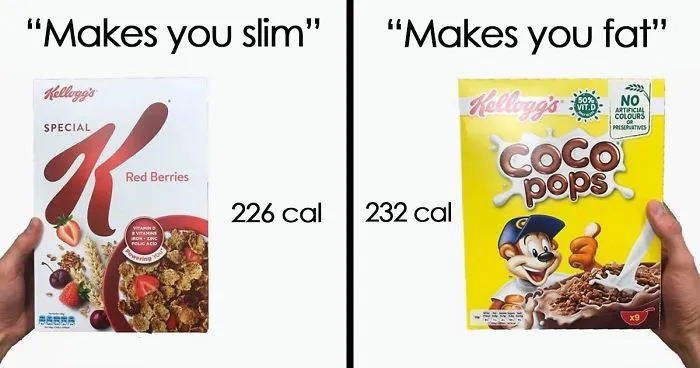

According to personal trainer & nutrition coach Graeme Tomlinson, people can lose fat or build muscle by eating foods they enjoy, as opposed to following a restrictive diet. Nutrition, however, is a complicated and tricky topic, and anyone can get confused in the abundance of the information surrounding it. To clear things up, Tomlinson is educating his followers one Instagram post at a time, debunking a lot of popular myths along the way.
"I've been interested in fitness and nutrition since I was young - I used to play semi-professional cricket," The Fitness Chef told Bored Panda. Now, it has already been 5 years since Tomlinson became a professional personal trainer & nutrition coach. The man also creates recipes for Men’s Health.
"The biggest problems that people who are trying to get in shape face are a lack of education and a mirage of false misinformation," he added. Tomlinson thinks that the best way to tackle them is surrounding yourself with evidence-based information. Thus, the motto of his nutrition beliefs, "Evidence-based. Simple. No B.S." Continue scrolling to check out his visual arguments, and you will definitely understand calories a little better.
#21 Coffee

Buckling myself in for a rough ride on the ‘pro keto’ forums this evening.By definition, the ketogenic diet is a diet whereby consumption of carbohydrate is low. This causes blood sugar levels to drop and the body breaks down fat for energy as no carbs are present. Keto dieters would claim that drinking keto/bullet proof ‘coffee’ puts you into an efficient ‘fat burning state’ superior to any normal state. See keto forums aplenty for ‘proof’. The above sounds great. I’m just getting my butter and coconut oil ready... oh hello (Mr Evidence-Based Science and Ms Common Sense have just turned up at my door... They say that a calorie deficit, eating less, moving more, being educated and drinking actual coffee is most efficient for sustained fat loss.
Report
12points
#22 Nights Out Are There To Be Enjoyed. Chances Are That They Aren’t Going To Be Enjoyed Fully

Nights out are there to be enjoyed. Chances are that they aren’t going to be enjoyed fully if you track every calorie you consume. But there is room for some sort of awareness of the energy you are consuming. This same awareness can be the difference between a great night out where you consume a huge access and an equally great night out where you limit the damage. For example; on the left there is multiple consumption of double vodka coke.. on the right - single vodka diet cokes. A significant calorie saving here. In addition, on the left there is copious amounts of drinks, some may say ridiculous. On the right, a reasonable amount, but not stupid. More calorie savings.Finally, on the left, we have the ‘consequential of being plastered’ decision to eat a pizza. On the right there is no pizza. 2000 calories saved.
Report
11points
#23 True/False?

True/false? Many of you will have heard this phrase before. But unsurprisingly, I doubt you read it in the journal of nutrition, or any journal for that matter.For years this ‘no carbs after dark’ metabolic artifice has plagued the fitness industry for those trying to stay/get lean. It was born out of the correct fact that our metabolism slows down as we sleep, which isn’t surprising as we aren’t moving much during this time. But this bears no correlation to this claim. According to a study published by obesity journal, a test group that ate most daily carbohydrates at dinner, compared to those who spread them out during the day actually showed greater losses in total body weight, body fat and waist circumference. This study is a small sample, but interesting nonetheless. To summarize another study published in the Nutrition, Metabolism and Cardiovascular Disease Journal, it found that eating carbs at night “may prevent midday hunger, better support weight loss and improve metabolic outcomes over conventional weight loss diets”. The study looked at macronutrient distribution throughout the day and its impact on hunger controlling hormones such as ghrelin, leptin and adiponectin. Subjects who consumed more carbs at night reported greater satiety. (Both studies referenced in comments). These are just two studies of course. But slightly more reliable than the ban carbs at nightfall brigade.
Report
11points
#24 Pasta

Nuts are often regarded as a credible source of protein. After all, they do contain protein so this statement holds some credence. The things is though: most people concerned about their protein consumption are either; trying to lose fat, gain muscle or maintain body composition. If 612 calories from a handful of nuts (a snack), fits your plan and you’re succeeding at it, that’s cool.If fat loss is the goal, my guess is that you’re striving for adequate protein consumption whilst avoiding calorie extortion. If you want to achieve that via consumption of nuts (in this case almonds), you’ll have to consume 612 calories to achieve a protein intake of 21g. Therefore, nuts (whilst including a host of vitamins and minerals such as B6, iron, magnesium & also mono/polyunsaturated fats) are probably not a credible source of protein - if the aim is to consume a meaningful protein portion. It all comes down to awareness. You possibly heard somewhere that nuts contain protein, but awareness of the total calorie amount of any food is also more important. As you can see here, you can literally eat a whole, balanced meal which has less calories, double the protein, plenty of nutrients and a strong likelihood that it will satiate you for longer than a handful of nuts.
Report
11points
#25 Juice Diet Or Food

I was recently slated for 13 minutes in a YouTube video made by a well known ‘master of juicing’, criticising my views on his (and all) juice diets and what I believe to be an unnecessary step in losing weight. Whilst I am no doctor, my views are replicated by several qualified medical practitioners who practice evidence based science. His main criticism of me was that I hadn’t read his book - I don’t need to. The master of juicing’s rationale for advocating sole consumption of juice for days and weeks at a time was “to give the body a chance to do what it naturally wants to do”. Despite not being a doctor, I recognize this statement as pseudosciencey bullsh*t. Juicing is completely unnecessary as a means for sustainable weight loss and scientifically unproven to benefit health in any way. In fact, it could develop/ingrain an unhealthy relationship with food and the weight loss process. No doubt many people have had success on a juicing diet - though their interpretation of success may be warped. The master of juicing rebuffed by questioning of the necessity and sustainability of his methods, ensuring me in his video that sustainability is something ‘he covers’ in his book. This was apparently exemplified by some case studies of people who had lost weight over a few months (after the initial juice only phase). He said that the sole consumption of juice for days/weeks was the kickstart needed to go on and lose weight for good. Okay..
Report
10points
#26 Nhs. It’s An Institution That Saves Lives, Prevents Disease And Improves The Health Of Millions Of People

I like the NHS. It’s an institution that saves lives, prevents disease and improves the health of millions of people. But sadly, when it comes to nutrition, the 30% overweight/obese rate suggests that their message is both dated and mixed up. Mixed up in the sense that whilst they advocate consumption of nutrients via fruit & veg as a way to optimise function (which it is), they fatefully intertwine this concept with that of weight control. This is exemplified by the fact that ‘10 a day’ is the only statement which we all universally recall as an NHS nutritional directive. Nutrients and calories are two separate entities which, if nurtured properly, should amalgamate to form a healthy individual rich in energy, function, immunity and ideal body composition. However, whilst nutrients help us function and fight disease, calories control weight. Whilst swapping calorie dense, processed food may accidentally control the weight of an individual, one has to realise WHY that happened. Rather than inflicting instantaneous demands regarding our consumption of some foods over others, it’s time we were educated better.
Report
9points
#27 Which One Would You Pick?

Which one would you pick? (Neither is also an option. The point here is not to promote the Big Mac over the pasta due to its lower calorie value, but to highlight the extortionate calorie value of a supposed ‘salad’. Salad = healthy in most minds. But what does ‘healthy’ even mean? A lot of people trying to lose weight or moderate calorie intake would assume that the pasta salad is going to be more beneficial their goals than a Big Mac. Who would blame them - I don’t. “The word salad is on the box, chicken is lean... pasta? Well it’s better than a friggin Big Mac, right?” But this example once again shows that education, understanding of food labelling and informed judgements are key to making the best choice for your goal. In isolation, this comparison shows the Big Mac as a better option for fat loss in pure terms of calorie intake supporting a calorie deficit (which you require for fat loss).There are of course several different variables which could mean that either of these choices will still support your goals. Total daily calorie intake outwith each for example. But nearly 1000 calories on a ‘routine’ Chicken & bacon pasta tub (which is unlikely to be seen as a treat or recognised for its calorie density), may not be the best idea for most. Neither is a Big Mac in all probability, but this comparison is interesting nonetheless.
Report
9points
#28 Which One Looks Better

Which one looks better? When someone decides they want to lose weight, their perception is often negative from the get go. Sometimes it’s viewed as a form of punishment being letting yourself become overweight. “That’s it, no more foods I like.” “Extremely small portions.” “I’m going to be hungry.” “Time to grit my teeth and force down the rabbit food.” “No more chocolate”. “No more carbs” etc etc... The clock is already ticking with this mindset and perception. It’s simply not going to last. If weight loss is the goal, the reality is that if doesn’t matter what you eat, as long as you’re in a calorie deficit. However, if you took this literally and decided to chew down junk food 24/7 you’d find it very hard to eat any volume of food as those foods are often calorie dense. And you’d also feel like shit. It’s a better idea to address how many calories you currently consume and reduce this total daily amount by 10-15%. No need to cut out food groups or ban any foods. That’s literally ridiculous and does not address the real issues which got you into this situation. In addition, start moving more, understand a little more about nutritional contents of food and track it. Soon enough you’ll realise that you get bang for your buck with whole foods in terms of calories consumed and your level of satiety (feeling full). But you’ll also realise that you can absolutely include all of your favourite foods - in moderation. It’s all about awareness, facts, logic and applying them rationally - this is objective. It’s not about perceptions, extremities or punishment. They are subjective. Extremities never last. Moderation is much more likely to. Choose moderation to get the best form of diet, body composition and happiness. It may sound boring, it may take a little while, but instead of intermittently eating rabbit food, it’ll probably stick forever.
Report
9points
#29 In Life, There Are Many Things That Lead Us To Feelings Of Guilt

In life, there are many things that lead us to feelings of guilt. That time you took your road rage out on an innocent pedestrian. The time you forgot a birthday or anniversary. That regretful one night stand whereby the other party fell in love with you after 7 hours... to name a few. But eating food has no place on this list. It has no place because it doesn’t make sense. We require calories to stay alive, which means feeling guilty about consuming calories means you feel guilty about being alive - which you don’t. The main problem arises when an individual labels food as an entity that it is not. For example; instead of a bowl of life diminishing evil, this sticky toffee pudding is a calorie source which happens to be calorie dense and proportionately higher in carbs and fat than it is protein. But that’s it. It is nonetheless still a calorie source. If consumed in moderation it forms a very small part of your overall diet and therefore it’s influence on your overall diet will also be very small. Believing that this one dessert has the power to alter body composition, ruin your health and put you in a spiralling emotional nightmare is completely irrational. And no matter how strongly you feel these things, the simple ability to mentally consult in a rational, scientific riposte to this fictional guilt is always possible. You just have to choose to do it. In simple terms of energy balance, the immediate consequences of consuming 400 calories of sticky toffee pudding (or your favourite calorie dense food), equate to consuming 400 calories of any food on earth.
Report
8points
#30 Sheila Is Overweight. She Knows She’s Overweight. She Decides To Do Something About Being Overweight

It goes a little something like this. Sheila is overweight. She knows she’s overweight. She decides to do something about being overweight. She googles ‘how to lose weight’ and she finds an array of ads on page one of the google search results. ‘Lose 7lbs in 7 days’ grabs her attention. Sheila takes note of the speed at which she could lose weight. After all, if she could do it quicker, why wouldn’t she? She’s in. She opts for the 7lbs in 7 days juicing plan. £375 poorer for purchasing illustrious juicing ingredients and a new juicer, Sheila is ready for action. Days 1-2: Success - she takes note of the nice taste of the juices and adheres to the plan. -
Day 3-5: Sheila is beginning to feel hungry. She’s also lacking energy, noticing digestive abnormalities and is growing weary of the same pomegranate, beetroot and ginger juice for dinner. Days 6-7: She now detests all aspects of the plan. Her social life doesn’t exist. She has no energy and she is now drinking a concoction of ‘f*ck knows what’ juices because she can’t be hooped cleaning the juicer for the 28th time in a week. That’s said, Sheila steps on the scales and has indeed lost 7lbs in 7 days. In the subsequent 7 days Sheila returns to consuming solid food, thus her old eating habits which created the problem also return. She remains uneducated about the basic principles of fat loss. Therefore, 2 months later, when she becomes even more overweight, she panics and juices for 7 days. And so it goes on and on and on. In her mind, this is what you must do to lose fat. In reality, she just gets fatter over time. If she surrounded herself with reason, she’d understand fairly quickly that in order to lose fat, she simply has to: 1. Realise she must be in a calorie deficit. 2. Adhere to said calorie deficit for a period of time. 3. Be educated and aware. An 8 year old child could literally learn this information and teach her it with ease
Day 3-5: Sheila is beginning to feel hungry. She’s also lacking energy, noticing digestive abnormalities and is growing weary of the same pomegranate, beetroot and ginger juice for dinner. Days 6-7: She now detests all aspects of the plan. Her social life doesn’t exist. She has no energy and she is now drinking a concoction of ‘f*ck knows what’ juices because she can’t be hooped cleaning the juicer for the 28th time in a week. That’s said, Sheila steps on the scales and has indeed lost 7lbs in 7 days. In the subsequent 7 days Sheila returns to consuming solid food, thus her old eating habits which created the problem also return. She remains uneducated about the basic principles of fat loss. Therefore, 2 months later, when she becomes even more overweight, she panics and juices for 7 days. And so it goes on and on and on. In her mind, this is what you must do to lose fat. In reality, she just gets fatter over time. If she surrounded herself with reason, she’d understand fairly quickly that in order to lose fat, she simply has to: 1. Realise she must be in a calorie deficit. 2. Adhere to said calorie deficit for a period of time. 3. Be educated and aware. An 8 year old child could literally learn this information and teach her it with ease
Report
6points
