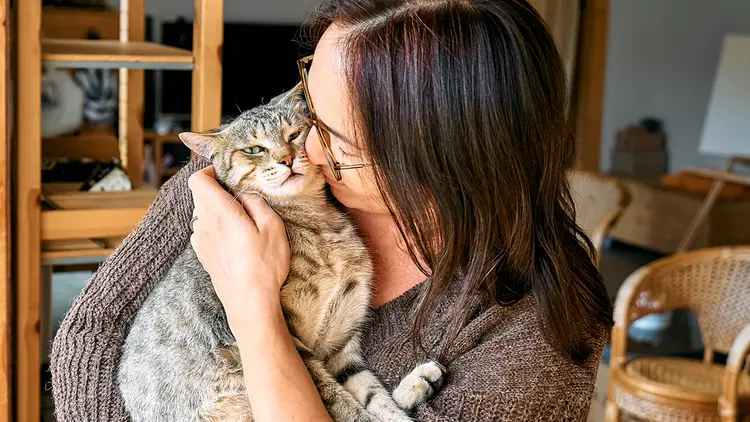
Back in my day, when we walked uphill to school both ways, pets had one choice. Kibble. Brown, chunky, dusty pellets that came in a bag the size of a large child and lasted forever. There is a home video of me crawling around the backyard, shoveling a fistful of the stuff into my mouth, which is probably what I can thank for my ox-like immune system. I had two pugs, famously sickly dogs by today's standards, who lived to a very healthy old age and went to the vet exactly once. They were never fat, food was always available, and they were cute as hell. I once bathed them in Kool-Aid to make them pink and they survived that too, unbothered and vaguely magenta. Years later, I am a city dweller whose dreams of dog ownership have been temporarily foiled by a rental clause. In my spare time, I pet sit, because I simply need some animal company now and then. Someone who doesn't talk back. But things have changed dramatically since I was a full-time pet owner. Owners have briefed me at length about the particular direction in which a dog's sausages must be cut. Raw meat I need to weigh to the gram. A cat whose specific ratty string must be twirled in front of its nose in a particular fashion, or apparently nobody sleeps. I have been told where to position the bowl relative to the wall. I have been given instructions I did not understand and nodded through anyway. Poppycock, all of it. Nothing quite broke this humble pet sitter's brain as much as the video influencer Tara Lynn posted for her bridesmaid, Mike, a fifteen-minute instructional guide on how to care for her seven cats and one dog while she goes on honeymoon. The video features observations about how her cats are aware of syringe sizes, another cat named Marvin must be locked in a cabinet to prevent mealtime anarchy, and a feeding sequence that must be followed to the T. "I'm sorry, that was really intense. Don't hate me." Don't worry, Mike. We hate her on your behalf. What the video actually represents, beneath the chaos, the pill organizer, and the fish tank whose dietary requirements have been outsourced to a separate text message, is a question the pet industry has been building toward for decades. How did we get from kibble and a water bowl to a fifteen-minute instructional video, a $50,000 lifetime commitment per animal, and human-grade food that can be called it underseasoned soup? It might be that none of it actually making the animals happier, or maybe we have simply found an extraordinarily expensive way to manage our own anxiety about loving something that cannot tell us what it needs. Bored Panda spoke to some experts to see if pet care has truly gone too far. vadymvdrobot/Envato (not the actual photo) The broad strokes: seven cats, one dog, two fish tanks, a pill organizer whose contents must be divided and distributed across multiple bowls with pharmaceutical precision, two syringes of different sizes for different medications, and a feeding sequence that must be followed in strict order or the whole operation descends into chaos. The dog eats outside on a stand and cannot come in until the cats are done. Both bedroom doors stay closed at all times or Sweetie and Marvin will pee on the beds. The floors get vacuumed multiple times a day. One cat gets locked in a cupboard. The fish tank in the guest room needs sinking wafers with the lid kept shut because the loaches are escape artists. The giant fish tank in the living room is a separate matter. Colin will text about that one. Tara genuinely does not know what they eat. Nearly 800,000 people tuned in to watch Mike attempt the impossible. It gave more of a mom-doing-a “get ready with me as I pack lunch for my 14 kids” energy. “I’m a cat sitter, and this is a $40+ visit,” one commenter wrote. “Wait, you did all of this BEFORE coffee,” another wrote, astounded. Laura Kalantaridis, owner of Delco Cat Sitting, spoke to Bored Panda about receiving such instructions professionally and regularly. "When clients leave me huge, detailed instructions, I might smile at how detailed they are, but I'm totally here for it. I get instructions about which dish their cat likes to eat from, or how they'll only eat if you sit there with them. If a client asked me to hold their cat like a baby and sing to them while walking around the house, I wouldn't roll my eyes. I would ask, 'What song do they like?'" Her framework for evaluating any request is consistent: does it make the pet's life better? As long as the answer is yes and the request is safe and reasonable, she accommodates it without judgment. She also gets paid for singing the lullabies, which presumably makes the job much easier. "In my experience, [cats] have too often been the afterthought in pet sitting, or in general: they're independent, they'll be fine. I built my business around giving them individual attention, and I love seeing people take their care seriously." The fifteen-minute video is, from this perspective, not a symptom of excess. It is the natural output of someone who knows exactly what her animals need and is determined to communicate it clearly. Marvin's GI medicine and Sweetie's capsules are prescribed. The specific feeding order exists because without it, the cats fight. These are the accumulated reality of living with seven cats, a dog, and two fish tanks, one of whose dietary needs has been outsourced to a separate text thread because it is even more extensive. trimarchi_photo/Envato (not the actual photo) The average American household now spends $4,272 per year on a single cat or dog. That covers the basics: food, routine vet visits, grooming, supplies. Spread it over a 12-year lifespan, and the baseline cost of owning one pet exceeds $50,000. Thomas Dock, director of communications at Noah's Animal Hospitals, says that "as pet parents increasingly desire a longer life for their pet and as technology and new products help them achieve that goal, we have seen average costs for a lifetime of veterinary care increase by 12 to 20% over just the last four years." That $50k figure is the peacetime number. It assumes nothing goes wrong. No swallowed sock, no oncology referral, no emergency surgery on Christmas Eve. Veterinary costs have risen 43% since 2021, according to the Bureau of Labor Statistics, outpacing general inflation by a margin that has pushed 37% of American pet owners into carrying debt specifically for their animals. The average insurance claim reached $392 in 2025, up 32% in five years. Emergency surgery for foreign body ingestion has climbed 45%, and cancer treatments are up 49%. Dr. Zac Pilossoph, an emergency and integrative medicine veterinarian who consults for Healthy Paws, describes working in conditions where basic care estimates rarely fall below $500 and most initial workups range from $1,200 to $2,500. For surgery or a critically ill patient, he almost never sees an estimate under $4,000. "These numbers are considerably higher, 33 to 50%, than what I remember them being prior to 2020," he told the New York Post. The medicine improved, but the cost increased. The gap between what people are willing to do for their animals and what they can actually afford has become one of the defining financial anxieties of modern pet ownership. A 2024 LendingTree report found that nearly a quarter of Gen Z pet owners have already surrendered a pet because of cost, and 46% are considering skipping pet ownership entirely to protect their finances. These are not people who love their animals less; they are just doing the basic maths. yavdat/Envato (not the actual photo) Somewhere between the vet-prescribed medications that Marvin and Sweetie actually need and the freeze-dried chicken Elmer gets on top of his wholehearted wet food, there is a large and growing category of pet products sitting in murkier territory. The calming powders, the dental chews, the probiotic supplements, the specialty broths. Leena Chitnis, founder of Timberdog, spoke to Bored Panda and says it is very smart marketing. "Some of these items do work, but often marginally and over a great period of time. Plaque powders and dental chews do not clean teeth, and if they do, it's in a random, haphazard way. The only thing that cleans teeth is a once-daily brushing for just a couple of minutes using an enzymatic toothpaste." The modern pet pantry, she suggests, is full of products that feel like good parenting and function primarily as good marketing. The Atlantic made the same point with considerably more appetite for research. Writer Ellen Cushing sampled The Farmer's Dog, a human-grade fresh pet food brand whose sales increased 60% from 2022 to 2023, generating over $800 million in revenue. Sorry, dear reader, I just don’t have that kind of dedication; you will have to take her word for it. The food tasted fine, she reported. Wholesome, slightly bland, like an extra-thick under-seasoned soup. The dogs eating it have no concept of gut health, Galician seafood, or the Michelin-starred chef José Andrés, who launched his own Mediterranean-inspired dog food brand last year. What they have is owners for whom the alternative, feeding a captive animal that cannot advocate for itself, something less than the best available option, feels like a failure of love. Beth Daly, a professor of anthrozoology at the University of Windsor, precisely identifies the anxiety driving premium pet food purchases. "The idea has become that if you love your animal, you have to feed them the best, most gourmet food, and we think if it costs more, it's gotta be better." The industry has learned to sell directly to that anxiety. The Farmer's Dog ran a Super Bowl advertisement that followed a woman and her black Lab through an entire lifetime, closing with the line: "Nothing matters more than more years together." Within its logic, the opposite of premium dog food is not non-premium dog food. It is fewer years spent together on the beach. If you love your dog and there is even a marginal chance that the expensive slurry of chickpeas and kale could extend her life, and you can afford it, why not? LightFieldStudios/Envato (not the actual photo) There is a veterinary perspective on the gourmet pet food movement that the premium brands would prefer you did not read. Dr. Andrew Spanner, a vet in Adelaide, Australia, has spent decades watching what happens when owners pursue their pets' food preferences too devotedly. His conclusion is direct: fussy eaters are made, not born. "Dogs learn to be fussy when they are given choices. A varied diet is the enemy. They go, 'why would I eat this when I can wait for that?'" His clinical experience has produced a consistent rule: a dog that refuses food will eat when it is hungry enough and has no alternative. The problem is that the elaborate dietary routines of modern pet ownership, the rotating proteins, the toppers, the palatability enhancers, the hand-fed home-cooked additions, train dogs to hold out for something better. The result is an anxious owner, a strategically hungry dog, and a pantry full of increasingly expensive options being cycled through in search of something the dog will deign to accept. He is not arguing against good nutrition. He is arguing against mistaking preference for need, which is a distinction the premium pet food market has a significant financial interest in blurring. His two case studies say everything. Clarry the skinny dog, who was being fussy because he could, started eating his kibble enthusiastically the moment it was the only option available. Loki the puppy, who was taking hours to finish a meal, settled into eating quickly once the distractions were removed. Neither dog needed a rotating protein menu. Both dogs needed someone to stop offering them one. Chalabala/Envato (not the actual photo) The humanization of pets has been accelerating for decades, but over the last five years it has reached a velocity that has permanently changed the shape of the market. Yvonne Hsu, general manager of Hill's Pet Nutrition, tracks the trend from inside the industry. "Dogs used to sleep in the barn, then in the house, and now in the bed with you." The U.S. Census now records more households with pets than with children. Millennials and Gen Z are choosing animals over parenthood at rates that have elevated the status of the family pet to something that previous generations would find genuinely surprising. Three-quarters of pet parents, according to Hsu's research, are doing something to transform their pet's food beyond simply putting it in a bowl. Adding water to kibble. Topping with freeze-dried protein. Mixing wet and dry. "They want to make sure they're doing the very best for their pet because they're not there all the time." The parallel to parenting anxiety is not incidental. Many of the people driving the premium pet food market have extended the parenting instinct to an animal that will, in almost every case, outlive neither the relationship nor the financial commitment it generates. The industry built around this instinct is vast. Euromonitor International described the premiumization of pet care as essentially unstoppable. Fresh pet food alone has expanded more than 30% per year since 2019. The Farmer's Dog is reportedly one of the highest-valued startups in the consumer space. And the market has learned to sell not just nutrition but the feeling of being a good pet parent, which turns out to be worth considerably more per bag. alexanruiz/Envato (not the actual photo) Mike, the loyal friend, was probably wondering at some point whether this was normal. The answer is that it is becoming normal, in the way that things become normal when enough people do them simultaneously, and the market builds infrastructure around the behavior. Kalantaridis, whose job is built entirely on navigating these routines for other people's animals, frames the central question. "Something doesn't have to make sense to everyone. I'm here to make my clients and their pets happy while they're away. The only thing that makes me a little crazy is when a product is made for human convenience but is awful for the animal. Or when a person has a whole wardrobe for a pet that absolutely hates being put in a tutu." That distinction, between what serves the animal and what serves the owner's need to feel like a good parent, is where the whole conversation about modern pet care either holds together or falls apart. Marvin's GI medicine serves Marvin. The human-grade chickpea slurry probably serves the owner's anxiety more than the dog's digestive system. The dental chews that do not clean teeth serve neither, but they sell very well. RossHelen/Envato (not the actual photo) My pugs ate kibble and lived long and happy lives. I am not suggesting this as a model. I am suggesting it as a data point in a conversation that has become so saturated with premium options, prescription supplements, and feeding sequences designed to minimize chaos, that it is worth occasionally asking who all of this is actually for. At some point between the kibble era and the freeze-dried artisanal chicken era, we stopped asking what our pets needed and started asking what we needed to do to feel like good pet parents. Whether that system exists for the cats or for Tara's peace of mind is a question only Marvin knows the answer to, and Marvin is locked in a cabinet.