

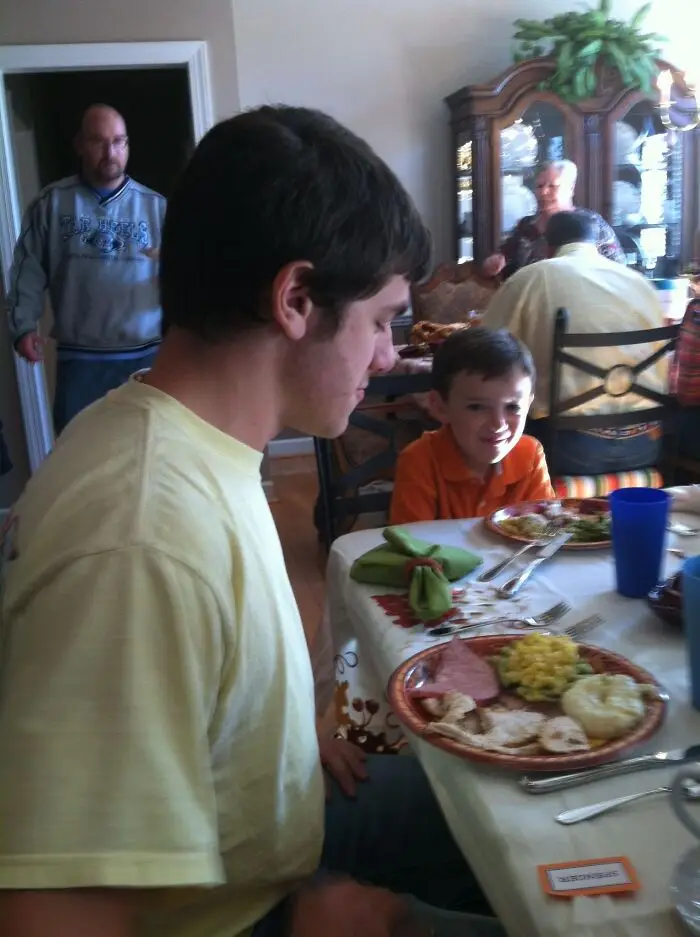
#1 My Roommate Is 23 Years Old And Still Has To Sit At The Kids Table For Thanksgiving
The story behind Thanksgiving begins in 1620, when a ship called the Mayflower arrived in what is now Massachusetts, carrying 102 English passengers hoping to establish a settlement. The group included religious separatists who wanted to practice their faith freely, along with other passengers looking for a new start.
Their first winter was brutal. Food was scarce, illness spread, and many settlers passed before spring arrived. By the following autumn, the survivors had grown enough food for a harvest celebration.


The settlers didn't get through those difficult early months entirely on their own. The Wampanoag people had lived in the region for generations, and their leader, Ousamequin, also known as Massasoit, eventually allied with the English.
The Wampanoag shared their knowledge of local crops and helped the settlers learn how to grow food in the unfamiliar environment. In autumn 1621, after the English had gathered their first successful harvest, a group of Wampanoag men joined them for a celebration.
The celebration lasted three days, and we have a description from English settler Edward Winslow, who wrote about the gathering in a letter later published in 1622. He explained that the governor had sent four men out to hunt birds, and they brought back enough to feed the settlement for almost a week.
The Wampanoag visitors also went hunting and brought five deer to the gathering. They also practiced shooting and did other activities, so it wasn't just three days of sitting around a table eating. Interestingly, this event wasn't called Thanksgiving at the time, and it wasn't repeated every year as an annual holiday. The name and the familiar traditions came much later.
It took more than 200 years for Thanksgiving to become a national holiday. One woman who helped make that happen was Sarah Josepha Hale, an editor and writer best known for writing "Mary Had a Little Lamb."
Starting in 1827, she campaigned for a nationwide Thanksgiving celebration, writing articles and sending letters to presidents for decades. Her efforts finally paid off in 1863, when President Abraham Lincoln issued a proclamation declaring the last Thursday of November a national day of Thanksgiving.
The country was in the middle of the Civil War, and Lincoln hoped the occasion would encourage people to reflect and pray for peace.
The date of Thanksgiving wasn't always as predictable as it is today. In 1939, President Franklin D. Roosevelt moved the holiday up a week because the last Thursday of November fell unusually late that year, leaving less time for Christmas shopping.
He hoped the longer shopping season would help businesses during the economic recovery. The decision caused quite a mess: 32 states followed the new date, while 16 stuck with the old one. Some Americans celebrated on one Thursday and others on the next, earning the earlier holiday the nickname "Franksgiving."
Congress eventually settled the matter in 1941 by making Thanksgiving the fourth Thursday of November.

The Macy's Thanksgiving Day Parade also has a surprisingly long history. Its first edition took place in New York City in 1924, but it was originally called the Macy's Christmas Parade. The department store organized it to celebrate its new flagship store and attract shoppers at the start of the holiday season.
Instead of the enormous character balloons we see today, the first parade featured employees dressed in costumes, floats, and live animals borrowed from the Central Park Zoo. The famous balloons arrived in 1927, with Felix the Cat becoming the first balloon character.
At the end of that parade, organizers released the balloons into the sky because they didn't yet have a way to deflate them. Thankfully, they eventually found a better plan, because chasing a giant balloon down the street would have made for a very different Thanksgiving morning.