



#21 Sometimes You Just Gotta Quit While You’re Ahead, Even If You’re Not Ahead At All

Ellis Digital social media manager Caitlin Jardine offered a similar perspective, but she added another key component: algorithms. As she explained, TikTok, in particular, is designed to be addictive and offers instant gratification through “endless personalized content.”
She added that TikTok rewards posts that provoke strong emotions, whether through shock value, empathy, or outrage, in addition to the multitude of viral trends. Jardine says this is one of the reasons why many creators “opt for sensationalism.”

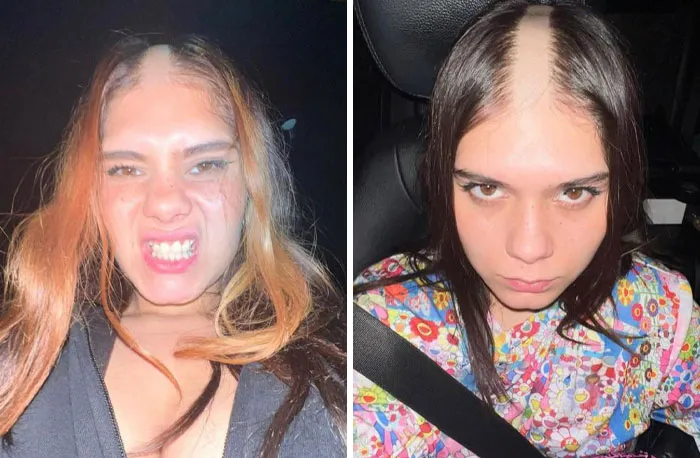
#23 Influencer Trying To Influence A New Hairstyle By Shaving An Exaggerated Part Into Her Scalp

Laura Riley, Clinical Director of Rolling Hills Recovery Center, offered insights based on her experiences as a mental and behavioral health volunteer for over two decades. As she noted, clout chasing before social media was more fleeting, unlike in today’s digital world, where engagements from audiences deliver dopamine hits.
“That cycle makes clout chasing more intense now than before, because once the brain ties in those metrics to a sense of self-worth, people feel compelled to escalate their efforts just to get the same rush,” she explained.
#25 Saw This TikTok Of Her Getting Her Makeup Done vs. What She Posts On Instagram

#26 She Went To The Ocean To Throw Her Dead Mother’s Ashes Into It And They Blew Back In Her Face


Likewise, New Leaf Detox psychiatrist Dr. Sanjai Thankachen shared his insights as a mental health and behavioral expert. He described clout chasing as a “complex psychological condition” wherein the individual requires affirmation and recognition.
In turn, social media plays its part in satisfying the psychological need for acknowledgement and appreciation through instant interactive returns in the form of engagements.
“Such attention-seeking behavior may be the result of social media-induced pressures to conform to the trend of a hyper-competitive social media global village, where everyone strives, not to, but beyond their perceived best,” Dr. Thankachen explained.


Doherty says such behaviors can only intensify, unless the powers that be (parents, educators, and the platforms themselves) can come up with more explicit guidance and stronger boundaries around what’s acceptable online.
Marygrove Awnings' Chief Marketing Officer, Josh Eberly, shared a similar sentiment, stating that social media platforms must be quick in removing harmful content to limit the spread of reckless challenges and pranks.



Eberly also emphasized the importance of having ethical role models who can demonstrate that one can build influence without compromising their personal safety or that of others.
“By combining stricter enforcement with more positive examples, the cycle of clout chasing can be slowed before it drives content into even more harmful territory,” he said.
#34 Océane Acting Like She’s Traveling In Business Class When She’s Actually In Economy. The Worst Part Is She Took The Time To Snap A Pic In Business Just To Flex