








Wild wolves share nearly all their DNA with domestic dogs. But thousands of years of human companionship have changed how dogs use their faces to talk to us.
It might seem like your dog is smiling when you come home. Or when you pull out a leash, it might turn its head and tilt its ears back, as if to say “I’m ready.”
Similarly, if you leave the house without them, they might press their snout against the window or rest their chin on the sill, their droopy lip folds radiating sheer betrayal — the classic “puppy eyes” look that many of us can’t resist.



When a dog tilts its head and gives you a pathetic look, it relies on a specific piece of anatomy that wild wolves lack. Scientists studying facial structure discovered a specialized muscle known as the levator anguli oculi medialis. Positioned just above the inner eye, this tiny muscle band contracts to pull the eyebrow upward and inward.
The movement instantly widens the eyes and gives dogs a vulnerable, baby-like appearance. In contrast, gray wolves have only a faint strand of connective tissue there, so they can’t pull off the same expressive brow-raise.



Professor Anne Burrows and her team at Duquesne University investigated the facial muscles around dogs’ and wolves’ mouths, specifically the orbicularis oris and the zygomaticus major. While both species have these mouth muscles, a dog’s facial muscles are composed almost entirely of fast-twitch fibers (around 90% or more). A wolf’s muscles, by contrast, rely on slow-twitch fibers.
Fast-twitch fibers contract rapidly and enable facial movements, letting dogs pull back their lips in a playful grin or fire off a series of rapid-fire barks. “This allows dogs to make that puppy-dog-eyes face. And wolves just don’t make that face,” says Burrows.
It’s a trait we humans share as fast-twitch face-makers ourselves.



This physical divide between wolves and dogs likely began during early domestication, around 30,000 to 40,000 years ago. As humans began living alongside ancient wolves, they naturally favored animals that could communicate effectively with them.
Professor Burrows suggests that early humans may have actively chosen dogs with fast-twitch muscle traits because they barked more effectively to sound the alarm when danger approached.
“When Upper Paleolithic people across Europe and Asia were domesticating the first dogs about 40,000 years ago, they seem to have selected dogs that had faces that moved very quickly,” she said.
She also notes that early humans might have simply fallen for the dogs that could make affectionate, emotive faces — accidentally selecting for the barking trait along the way.



The reason we can’t resist puppy-dog eyes is because gazing into them is known to release a hormone called oxytocin in humans and dogs.
Cats might share a similar facial-muscle toolkit, but they rarely use it to gaze up at us with that same longing intensity.
Research led by Miho Nagasawa and her colleagues at Azabu University in Japan shows that mutual gazing between a dog and its human mimics the emotional feedback loop of a mother–infant relationship. Because of this powerful biological bond, Nagasawa recommends that “dog owners not just say commands at their dogs, but to build up the relationship and consider the potentially beneficial role that mutual gaze can hold.”



Today, the ancient bond is stronger than ever. About 71 million US households — roughly 53% of all homes across the country — include at least one dog, according to data from the American Pet Products Association.
Practically all dog owners view their four-legged companions as true family members. In fact, 51% say their pets belong in the family “as much as a human member.”

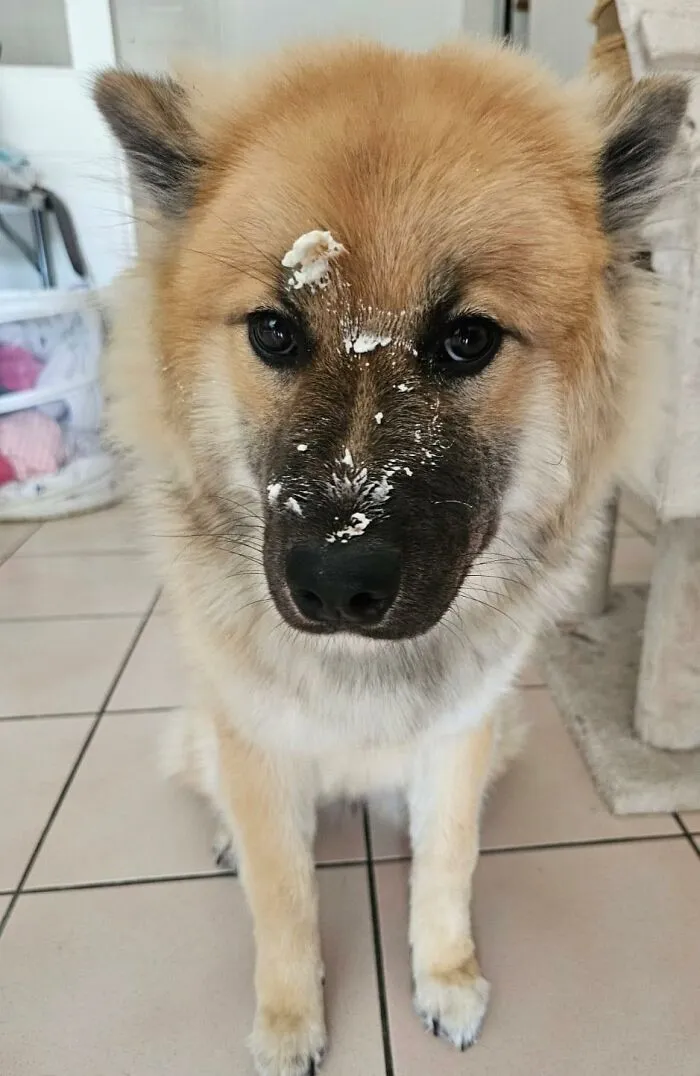
#20 "It Wasn't Me"

A 2025 study revealed that dog owners often rate their pets higher than human loved ones for companionship and emotional support. Owners reported far fewer negative interactions with their dogs than with their children, romantic partners, or closest relatives.
“Dogs offer a highly positive relationship with minimal conflict, strong social support, and the unique opportunity to have full control over another living being’s life,” said Prof Enikő Kubinyi, senior author of the research.