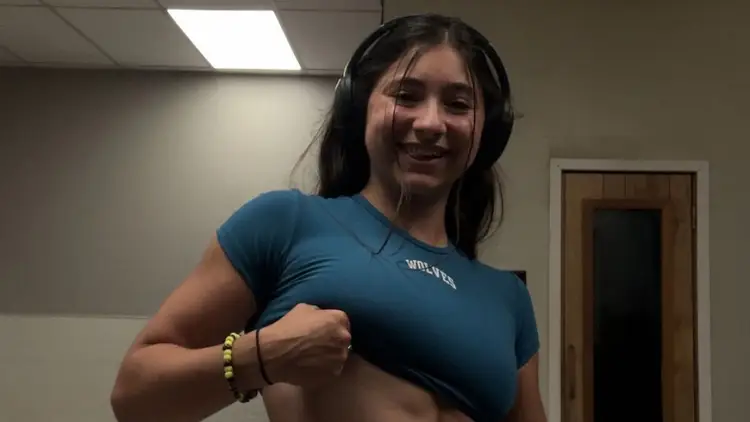
Fitness expert Kacey Green has a bone to pick with one of the most stubborn assumptions about six-packs. The fitness TikToker says women don’t have to be “paper-thin” to see their abs. And she’s using her own body to make the case. “The fitness industry doesn't seem to like it when I say that you don't have to be paper-thin to see visible abs,” she said in one video. Green has made this point repeatedly on TikTok, where she talks about giving the muscles underneath a chance to grow. “My biggest flex is that dragon flags worked, and I know you don’t have to be paper thin to have abs,” read the text on one of her most viral videos. Dragon flag, named after martial arts hero Bruce Lee, is a popular category of exercises that target the core muscles. kaceysfitness/TikTok The TikToker’s main focus is on “building” and “not just shrinking.” She said people can “achieve abs” at a higher body fat because “they build what’s underneath first, and then cut down!” Green argued that eating substantially less might make someone leaner, but that they may still see little definition of abs if they haven’t built up the muscle underneath. In another video, she claimed that more than a million people had tried her routine and come around to agreeing with her view. www.instagram.com Bored Panda asked three experts what makes abdominal muscles stand out, and why two women with the same body fat percentage can look so different. The answer starts with what people are actually seeing when they spot a six-pack. “You’re seeing the contours of the rectus abdominis. That’s the muscle that runs down the front of your abdomen,” Dr. Michael Ormsbee, a professor of nutrition and integrative physiology and the director of the Institute of Sports Sciences and Medicine at Florida State University, told Bored Panda. www.instagram.com “Bands of connective tissue divide it into sections, and their placement gives you your natural ab pattern,” he continued. When the muscle is thicker, the contours appear to stand out more, while the fat between the muscle and the skin can soften them, he added. “So you can build the muscle, but you don’t get to pick the layout,” he said. kaceysfitness/TikTok Exercise physiology expert Robert Girandola explained to Bored Panda that the “abs” or abdominal muscles are relatively flat in comparison to a muscle like the biceps. “Anatomically there is skin, connective tissue fat and muscle underneath,” he said. How much of the abs’ shape comes through depends in part on the layer of fat just beneath the skin, which varies in thickness and distribution from one person to the next. Ab definition depends in part on the thickness of the fat directly over the muscle. That layer is called subcutaneous fat, meaning fat beneath the skin. “People's anatomy differs,” he said, adding that “some people have more subcutaneous fat than others.” www.instagram.com When it comes to discussions about visible abs, the “body fat percentage” often makes an appearance. Body fat percentage is the proportion of a person’s total body weight that comes from fat. For example, if someone weighs 60 kilograms and 15 kilograms of that is fat, their body fat percentage is 25%. The figure describes the body as a whole, so two people with the same percentage can carry different amounts of fat around their abdomen. “Body fat percentage tells you how much fat you carry across your whole body. It doesn’t tell you where you carry it,” Ormsbee said. Andres Ayrton/Pexels (not the real image) Hence, two women can have the same overall percentage but may carry the fat in different places. “One woman might carry more of her fat around her hips and thighs and less over her abs. Another might carry more over her abdomen,” Ormsbee said. Even if their ab muscles are similarly developed, the woman with less fat over those muscles may show more definition. Another difference could be how much the muscles themselves have grown, according to muscle physiology expert Dr. David Behm. To have visible abs, Behm said there needs to be some muscle hypertrophy, which is the process of increasing the size of existing muscle cells. In practice, it means two women can carry a similar amount of fat over their stomachs and still see different levels of definition if one has more developed abdominal muscles. More developed muscles at the front of the abdomen (rectus abdominus) and along the sides (external obliques) can have more pronounced contours. “If two women have the same body fat % but one person has very little definition then their rectus abdominus and external obliques may not have the similar extent of hypertrophy,” he said. Behm also pointed to the body’s fluid levels, saying some competitive bodybuilders try to look more “shredded” by temporarily reducing the amount of water they carry. ROMAN ODINTSOV/Pexels (not the real image) “A person with less intracellular and extracellular water will also have an advantage in displaying their abdominals,” he said. “Bodybuilders use the term shredding or shredded when they decrease their fluid content.” “So what body fat percentage do you need to be to see abs?” It’s a question that sounds like it should have a simple answer. But as Ormsbee pointed out, there’s no “magic body fat number.” As a rough guide, it is estimated that some women may start to see a faint outline of their abs around 21–23% body fat, while more noticeable definition may show up around 18–20%, according to Female Fitness Systems, an online strength training and nutrition platform founded by certified personal trainer and nutrition coach Melanie Durette. Those ranges give a general idea of when definition might show. A woman at the higher end could have more visible abs than someone at the lower end if she carries less fat over her abdomen or has more developed muscles underneath. “Add differences in ab thickness and shape, and the same body fat percentage can look very different,” Ormsbee said. “That’s why I wouldn’t give someone a magic body fat number for a six-pack.”