



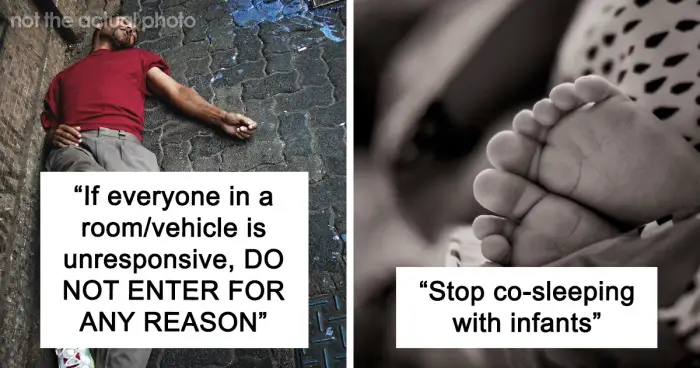


A first responder is a specifically trained person who usually arrives at the scene of an emergency or crisis before anyone else.
These folks include (but are not limited to) police officers, paramedics, and firefighters, since response times are often seen as a very important aspect of all three fields (law enforcement, fire suppression, and emergency medical services (EMS)). That's because these types of emergencies can escalate rapidly if nobody is able to do something to stop them. Sometimes, however, even a regular passer-by could help.
Recently, Reddit user u/PeachMilkshake2319 made a post on the platform, asking first responders to share some information about what you should and should not do in dangerous situations, and the advice they've received sound really valuable.
#21
Not something you could use to prevent a lot of casualties at once but very important information that people seem to immediately forget the moment they see someone get seriously hurt.
If you see someone lying on the ground after having an accident where they took a very nasty hit to the neck area or upper chest, do the victim a favor and leave them there. Obviously make sure they’re out of harms way but ***never*** move their head or try to lift them back up. A persons first instinct to help is to lift the person back up, if someone has a serious neck injury you can make it 100x’s worse by moving them.
Someone I know witnessed a car accident where the driver was hurled 20ft from their vehicle and landed on their upper chest. Once he’s lying on the ground everyone runs to help and everyone’s trying to help him up or sit him up. To everyone’s horror the moment he was lifted up his neck fell to the side with a loud crunch and any movement he might’ve had stopped a run toy like he was shocked with electricity.
The person helping him up snapped his neck paralyzing him, something that could’ve been avoided if they left it to the emt’s who are trained for this s**t.
Don’t f**k around with a persons body if they took a nasty hit to the upper chest.
Report
190points
#22
1. Drownings don’t look like they do on Baywatch. Don’t expect splashing, screaming or frantic waving. People who are drowning often look like someone being a bit of a weirdo playing by themselves, head going under then popping up like a buoy that’s weighted. 2. Drowning people are dangerous to your safety and you need to approach the situation by prioritising your own survival. It is the natural response of a drowning person to cling onto whatever they can to stay afloat. That includes you. Given the chance, they will climb on your head, and you need to approach a drowning person with the assumption that they absolutely will. Proceed with a floatation device for them to cling to. If you don’t have one, approach feet first, ready to push off if they try to clamber onto you. 3. Don’t jump into the water to save someone unless you know in absolute certainty that you can get both of you back out. The ocean doesn’t care how well you swim in bathers at the pool, it is an absolute force of nature. Don’t become a second victim to be saved, your best intentions don’t help anyone. 4. Don’t walk on the rocks. Don’t swim near the rocks. Don’t fish from the rocks. Stay off the damn rocks.
Report
150points
#23
I volunteered on a SAR team for several years and here are a few pretty strait forward things that if people had known may have saved their life.
- If you fall in swift water float on your back with your knees slightly bent and feet facing down river. This lets you push off rocks without breaking your legs or being pulled under. You can use your arms and legs to try to direct your path downstream to avoid obstacles.
- Avoid crossing areas of rock where the rock slope steadily increases to a cliff or drop. This is common in granite slabs in the Sierra mountains. Even on pretty gentle slopes there can be loose gravel and once you start sliding it can be extremely hard to stop. So always keep in mind what would happen if you were to slip.
- When lost in dense woods it is very easy to wonder in circles. To avoid this line up 3 trees in the line you want to follow. Move to the middle of the 3 trees and then select a new tree keeping it in line with the others. Keep doing this to navigate in a strait line.
- You do not need cell service for your smart phone to have GPS or for the compass to work. If you get lost take note of your gps cords and use the compass to get a sense of your surroundings. Then turn off your phone and save the battery. Check for cell service if you find a high point. Your phone may still have some maps loaded so check that as well. You may get lucky and be near a trail or road.
- If you are stuck out side and getting very cold you will start to shake pretty violently. This is a good thing and means your body is trying to warm you up. If you start to get tired or feel warmer even tho nothing had changed DO NOT fall asleep. Do literally whatever it takes to keep yourself awake. If you fall asleep there is a very low chance you ever wake up. Along these lines if you suddenly stop shivering and feel a bit drunk you may be in the final stages of hypothermia and are in serious trouble. Even warming up may not be enough, seek medical attention quickly.
Report
148points
#24

Stop co-sleeping with infants. They don’t need to be in the bed with you, even if you don’t plan to fall asleep. It’s crazy to me how many people argue that there’s nothing dangerous about it.
aldegundis replied:
The stories of a parent unknowingly suffocating their infant child are absolutely haunting.
138points
#25

How to perform a Heimlich on yourself, you're a goner without a doubt if you're by yourself and food gets too stuck.
BobRoss6995 replied:
1- try to cough the stuff up first. Hard, firm coughs.
2- if not successful, ball one hand into a fist and place it above the belly button.
3- cup with the second hand.
4- When performing the Heimlich, push both hands into the stomach and upwards towards the ribs. Hard and firmly. This is to push air upwards and push the object out.
5- If needed, add objects to aid in adding more pressure into step 4. This could be the edge of a dining chair. Lean into the object at a 30-45 degree angle. When doing the Heimlich, push into the object using your legs. Doing this, you’re using the object to push your hands further into your abdomen.
6- Repeat.
Report
132points
#26
Road safety is very underrated and emergencies are common.
Keep your cool. Warn others of a problem with emergency flashers. Stay well off the side of the road if you must get out of the vehicle. Keep your belt on unless you just get out of the vehicle
If you are walking, be aware of your surroundings. Don't get lost in your headphones. Walk against traffic. Stand off to the side of the road if it's narrow and a car is coming. Wear bright/reflective clothing, especially at night
If you are a driver, keep a safe following distance. Slow down in bad weather. Use you emergency flashers liberally for when traffic slows suddenly, weather is really bad, or around a road hazard.
WEAR YOUR Seatbelt! I've seen innumerable people die who would have lived if they had just buckled the f**k up.
Never drive under the influence!
I've seen more people die from road incidents than anything else, by far! (Lifestyle disease not included)
Report
125points
#27
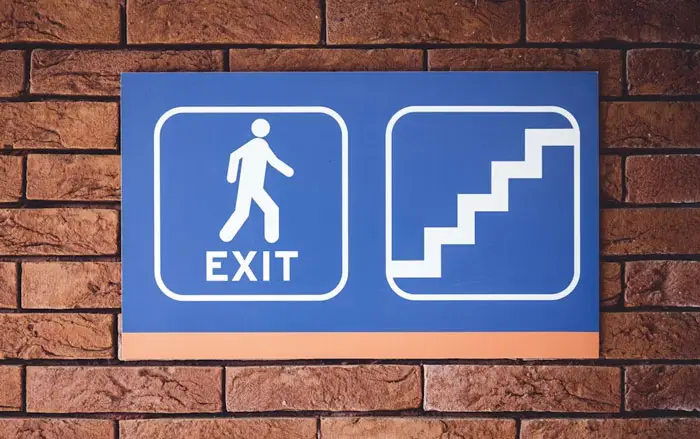
Know your emergency exits especially at crowded events, big stores. In case of fire or active shooter, etc... everyone will panic and go the main entrance (the way they came in) but there is emergency exits you should go to the closest safe exit.
Report
119points
#28
You don’t have to have phone service to dial an emergency number. It will be prioritised for any available network, so if there’s signal from anything it will get through, not just your network.
Similarly, if you don’t know the emergency number of a country you’re in, try the one for your home country. A lot of places will have common ones worldwide go through too.
Report
115points
#29
Children choking - every parent should assume at some point their child WILL choke on something and know how to handle such situation.
Charble675 replied:
I choked on a flinstone gummy when i was super young, my poor mom was scared as hell but to her credit acted fast and got me to cough it back up.
Report
103points
#30
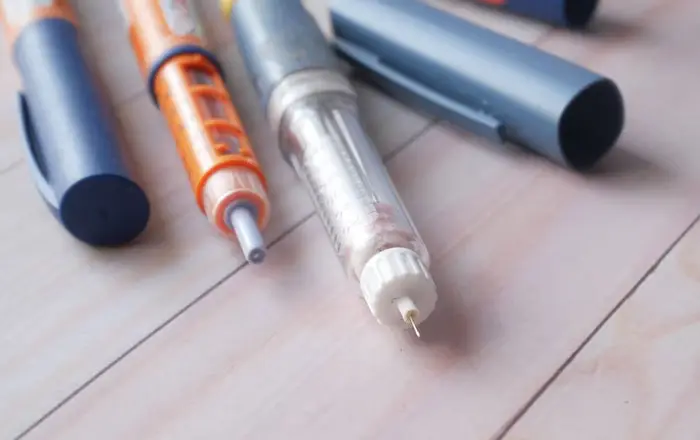
Know how to inject an epipen!
TerribleIdea27 replied:
Don't put your thumb on the end of the pen! Great way to stab yourself instead (although if you're stabbing yourself anyway an EpiPen to the thumb is still better than nothing)
Report
99points
