





Honey badgers are not actually named for their love of honey, in fact, they raid bee hives to loot the delicious, protein-rich larva inside, which seems like an overly complicated way to get protein.
In case you need to keep your little nieces and nephews entertained over Christmas, we’ve gathered some cute and interesting animal facts. So get comfortable as you scroll through, upvote and jot down your favorites, and be sure to share your own thoughts and examples in the comments down below.
#21
The Velvet Ant is actually a wasp that has a very painful sting that can cause hallucinations.
Report
9points
#23
Cuttlefish aren't color blind!
ok so apparently scientists used to think that cuttlefish were color blind because they lack multiple photoreceptors for different wavelengths of light (as seen in other vertebrates, including humans). but how do cuttlefish change their skin color?!?!?
Turns out, there's a new theory that cuttlefish actually can detect different wavelengths (aka colors) through a property of the lens in their eyes. instead of having different photoreceptors to detect different wavelengths, the cuttlefish can detect changes based on how the light wave bends, and which ones are "in focus." this is also thought to be related to their w-shaped pupils which enhances this effect.
In any case, cephalopods are so cool because they've demonstrated (1) an entirely distinct / separate evolution of "intelligence" compared to humans and (2) a separate method of color vision unbeknownst to humans.
Report
8points
#24
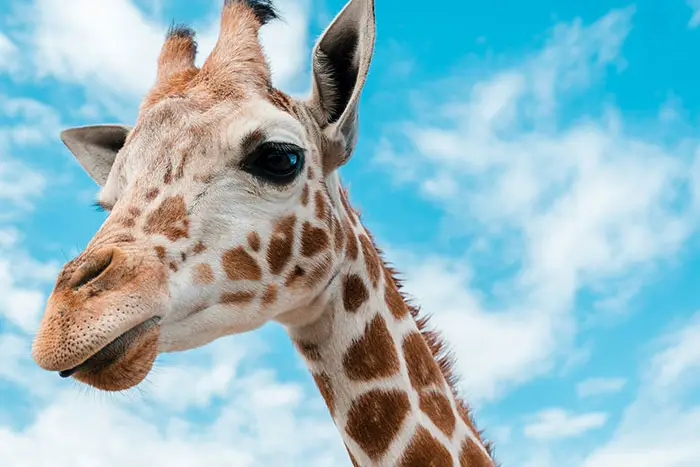
Did you know giraffes only sleep about 30 minutes a day?
They usually take super short naps, sometimes standing up, always alert for predators. Imagine living on just half an hour of sleep!
They usually take super short naps, sometimes standing up, always alert for predators. Imagine living on just half an hour of sleep!
Report
8points
#25
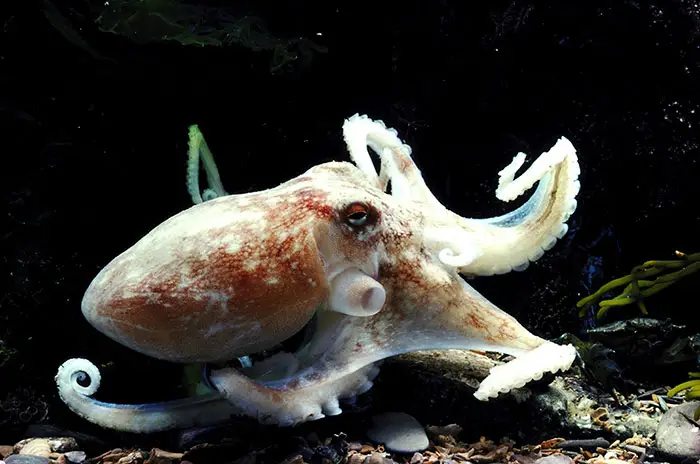
Octopuses have 9 brains (three quarters of their neurons are distributed throughout its eight limbs, and the central brain is found in the mantle).
Report
8points
#26
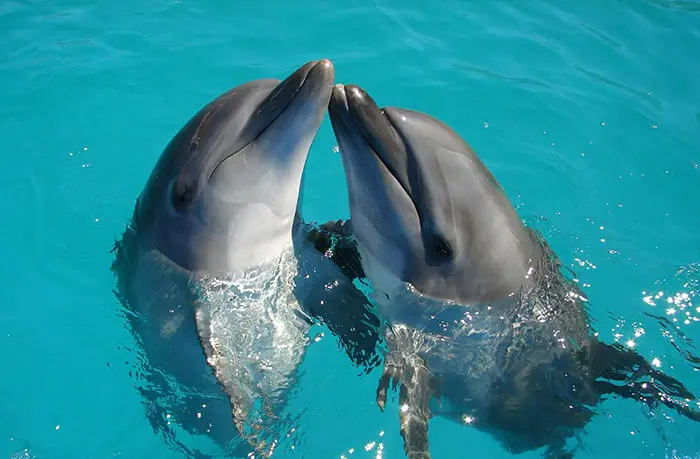
The reason why dolphins sleep with one eye is they only rest half of their brain at a time (unihemispheric sleep). One side of the dolphin's brain is "awake" while the other is in a deep sleep. During this time, the eye opposite the sleeping half of the brain is open while the other eye is closed.
Report
8points
#28
Why the Blue Whale Eats So Much?
The blue whale is the largest eater in the animal world. Even though it eats tiny krill, it can consume up to 4 tons of food in a single day. During feeding season, a blue whale takes huge mouthfuls of water filled with krill, then pushes the water out and swallows the food. Its large body needs a massive amount of energy, so it must eat constantly when food is available.
Evolution shaped the blue whale’s feeding habits over millions of years. Its ancestors were smaller, but whales that grew larger were better at surviving cold oceans and traveling long distances. To support their size, they needed more energy, so natural selection favored whales that could take in huge amounts of food quickly. This led to the development of their enormous mouths, throat grooves, and baleen plates.
Today, the blue whale is perfectly adapted to eating large quantities of small prey efficiently.
Report
7points
#29
Which animal has longest claws?
The animal with the longest claws in the world is the giant armadillo. Its middle claw can grow up to 20 centimeters, longer than a human hand. These enormous claws are powerful tools adapted for digging. The giant armadillo uses them to tear open termite mounds, dig burrows, and search for insects underground. Its claws are so long that the animal must walk on its knuckles to avoid damaging them.
Evolution shaped these impressive claws through constant pressure to find food and shelter. Early armadillo ancestors with slightly larger or stronger claws were better at breaking into hard termite colonies and escaping predators by digging quickly. These advantages increased survival and reproduction. Over millions of years, natural selection favored individuals with longer, more effective claws. This gradual development led to the giant armadillo’s remarkable claws, perfectly designed for life as a specialized insect-eater beneath the forest floor.
Report
7points
#30
Vampire bats, unlike Vampires, do not actually suck blood. They use their fangs to make a small, harmless puddle, then drink out of the puddle. Their saliva has something inside it to keep the animal’s blood flowing. This saliva is now being used to treat strokes.
Report
7points
#31
Cockroaches can survive without their heads for days.
Yup. They don’t bleed out because they have low blood pressure, and they breathe through holes in their body, not their mouth or nose.
Yup. They don’t bleed out because they have low blood pressure, and they breathe through holes in their body, not their mouth or nose.
Report
7points
#32
The African Elephant: Earth’s Biggest Land Eater.
The African elephant is the largest land eater in the world. An adult elephant can eat 150 to 200 kilograms of food every day. It spends up to 18 hours eating grasses, leaves, bark, and fruits. Elephants need so much food because their huge bodies require a lot of energy, and their digestive system is not very efficient. They must eat constantly to stay healthy and strong.
Evolution shaped elephants into big eaters over millions of years. Early elephant ancestors lived in open grasslands where food was spread out. Larger bodies helped them reach more plants and travel long distances for water. Natural selection favored elephants that could consume huge amounts of vegetation. Their long trunks also evolved to help them pull leaves, break branches, and grab food easily.
Today, the elephant’s size, trunk, and appetite work together, making it one of the greatest eaters on land.
Report
6points
#33
Bats are the only mammals capable of true and sustained flight. They're actually even more manoeuvrable than birds. What about gliding possums and flying squirrels, you say? Yes, they do glide in the air, but they cannot gain height and fly like bats do!
Report
6points
#34
Giants of Smell: How Elephants Evolved the Biggest Nose?
The animal with the biggest nose is the African , whose nose is the long, powerful trunk. An elephant’s trunk can reach over two meters and contains around 40,000 muscles, making it one of the most versatile organs in the animal world. This enormous nose evolved to help elephants survive in diverse environments. The trunk allows them to breathe, smell, drink, communicate, grab food, and even lift heavy objects. Its exceptional sense of smell helps elephants locate water from many kilometers away, an ability crucial in dry habitats.
Evolution shaped the elephant’s huge nose through environmental pressures and survival needs. Early ancestors with slightly longer or more flexible noses were better at feeding on tall branches, accessing water, and detecting danger. This gave them a survival advantage, allowing those traits to be passed on. Over millions of years, natural selection led to the development of the modern elephant trunk—an extraordinary tool for feeding, communication, and survival.
Report
6points
#35
How does the digestive system of birds support flight, and what adaptations make it efficient?
Birds have a uniquely efficient digestive system designed to keep them light for flight. Food first enters the crop, a storage pouch that lets birds eat quickly and digest later, reducing time spent vulnerable on the ground. It then moves to the proventriculus, where digestive enzymes begin chemical breakdown. Next comes the gizzard, a powerful muscular organ that grinds food—often with swallowed grit—so birds don’t need heavy teeth. This system lets them process food rapidly, extract nutrients efficiently, and stay lightweight. High metabolism demands fast digestion, and birds evolved exactly that: a streamlined gut perfect for energy-intensive flight.
Birds have a uniquely efficient digestive system designed to keep them light for flight. Food first enters the crop, a storage pouch that lets birds eat quickly and digest later, reducing time spent vulnerable on the ground. It then moves to the proventriculus, where digestive enzymes begin chemical breakdown. Next comes the gizzard, a powerful muscular organ that grinds food—often with swallowed grit—so birds don’t need heavy teeth. This system lets them process food rapidly, extract nutrients efficiently, and stay lightweight. High metabolism demands fast digestion, and birds evolved exactly that: a streamlined gut perfect for energy-intensive flight.
Report
6points
#36
Sometimes Emperor Penguins mistake snowballs for eggs and treat it as their new child.
Report
6points
#37
Mudskippers are amphibious fish that often spend more time on land than in water. In fact, they may drown if they are never able to leave the water. Mudskippers are known to engage in battles over territory and dominance, most often with their mouths open to demonstrate size and stamina.
Report
6points
#38
Crabs showed up during the Jurassic period, 200 million years ago. The average lifespan of a crab however is only 3 to 4 years.
Report
6points
#39
Seals can sleep underwater. To prevent drowning, they will close their nostrils when sleeping underwater.
Report
6points
#40

A horse barely breathes while galloping to preserve energy. No matter, just slosh the organs around so it rhythmically pushes the lungs to breathe! The sloshy organs can cause issues, though.
Report
5points
