



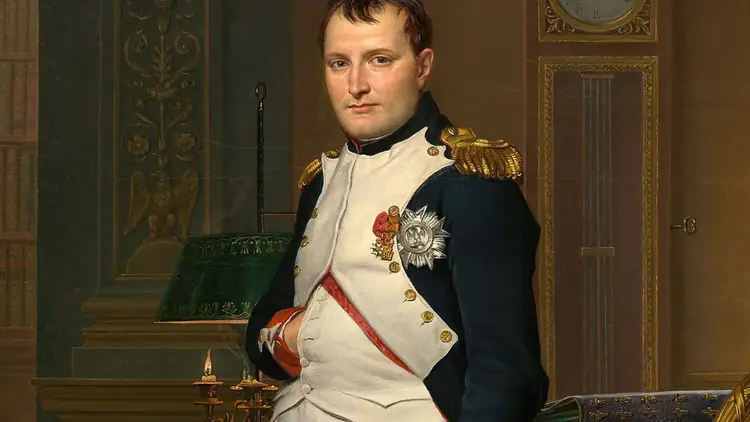


Many of us are victims of pseudohistory and might not even realize it. Pseudohistory is false history—historical facts that are presented as cold truth, even though they’re based on distorted or ignored evidence. A very popular example of this is the phrase “Let them eat cake,” which is attributed to Marie Antoinette, when in reality, the saying originated way before she was born.
After having learned this, you may start wondering what else we have been lied to about for the entirety of our lives. To find out, all you have to do is scroll down.
#21

Invention of perspective in art during the Renaissance when ancient Chinese an Greeks used it way before. All the medieval paintings were done that way due to that particular art style being favored at the time.
21points
#22

The sinking of the Lusitania garnered immediate US public support for WWI, and the US entered WWI shortly after.
In fact, the ship was sunk 7 May 1915, and Wilson didn't request a declaration of war until 2 April 1917 -- nearly two years later.
Report
18points
#23

That technology shortens work hours. From hunter gatherers to the industrial revolution the amount of time people spent working greatly increased. It is estimated that a hunter gatherer would work six hours a day, while I am not sure of the exact average, if you were working class during the industrial revolution it is very likely you would be working 12-14 hours a day. This has of course decreased in the developed world due to socialism and unionism creating legal and economic pressures to decrease working hours.
Report
18points
#24
No ancient source exists that says the Romans, under Scipio Aemilianus Africanus, plowed over and sowed the city of Carthage with salt after sacking it.
The salting of the earth at Carthage was invented in later stories strongly suggesting it never happened. Also, given that salt was a precious commodity during the Roman Republic/Empire it seems very unlikely that it would be used in such a way.
Report
17points
#25

There were only 300 Spartans at the Thermopylae, for each Spartan warrior there was about 8 Helots (Slaves) accompanying them, providing maintenance on equipment and acting as axillary. Also with them were several hundred Thespians and Thebans, the former chose to stay voluntarily with the Spartans whilst the latter were forced to stay as they were assumed traitors. So in all there were actually around 4000 Greeks left to fight the Persians in the final stand at Thermopylae, after the main Greek Force retreated.
Report
16points
#26

Actually, archers did use quivers, but they would stick the arrow in the ground during battle.
Report
16points
#27

The Spartans didn't fight for freedom and equality. they had slaves and they often used them as target practice.
Edit: As an aside, Xerxes the 1st, who is depicted as the villain in the movie '300' and his Jewish wife queen Esther, provided sanction and equal rights to jewish minorities in Persia (which was a zoroastrian empire at that time). Hence, you could go argue that he was far more tolerant of cultural diversity and freedom than the spartans.
Report
16points
#28

George Washington Carver did not invent peanut butter. The Aztecs were roasting peanuts before the colonists arrived and a Canadian guy was the first man to patent peanut butter.
Report
16points
#29

European Settlers bought Manhattan NY for beads from the Indians.
Christopher Columbus Discovered America.
There is a good book called "Lies my Teacher told me", though it is USA Centric, It is still a good book.
Report
14points
#30

The circumstances under which the Church of England was founded during the English Reformation was much more complicated than and not as related to Henry VIII seeking divorce as people claim.
Report
14points
#31

The Royal Air Force apparently made their incredible strides in destroying German planes at night because of all the carrots they ate...(methinks it was the radar, not the carrots)
Most people where I live are convinced this is true because 'it's historically proven to work' and so they eat a lot of carrots. Nothing wrong with eating veggies of course.
13points
#32

Rome burned while Nero fiddled. It's technically true so it doesn't fit the OPs question. However, most people seem to think Bero did that because he was crazy because ... Well Nero was cray-to-the-zee crazy. But the reality on this particular occasion is *much* more nuanced. Nero was already playing the fiddle when he heard the news of the fire in the tenements of Rome. This is important for a few reasons
*1. The tenements were housing the poor or the plebes as tge Romans referred to them. And like all powerful people in history Nero cared considerably less for the poor than the rich.
*2. The fire was in the tenements. Nero had been imploring people NOT to expand the tenements so much because the Romans had such a habit of expansion that it was fairly typical for the tops of buildings to be wider than the base because after all you can only expand so much at ground level before you run into the road. But three or four stories up its a different story and the owners of the tenements would often add more living quarters to the tops of the building to get more people in their buildings. As a result some tenements were sharing walls on the third and fourth floors with neighbors that were separated by N entire road. This led to more than a few collapses. That in turn prompted Nero to start trying to rally support from the other elite senators about town to outlaw such building practices. Right as that was going on the fire breaks out. In Neros mind the fire is yet another reason why the tenements are being built dangerously. And so he didn't react with shock because he'd been arguing for a little while that the tenements were dangerous.
Lastly. People say he fiddled while Romee burned implying that he did nothing. But the reality is that professional firefighting brigades didn't really come about until the early 20th century. Prior to that in say roman times fires got put out by volunteers who made ends meet by robbing the homes they were helping deal with fires. So even If Nero thought something needed to be done there was no force he could assign to combat the fire.
As a result Nero just kept on with his practice because there wasn't anything he could really do AND even if there was he wouldn't have wanted to because he felt the fire proved his point about the tenements being poorly constructed. NOT because he was crazy...for once.
Report
12points
#33
Napoleon was a warmonger (he never started a war, the monarchies of Europe simply didn't like the idea of a Republic), the Sphinx's nose was shot off by Napoleon (it was pried off for not being muslimy enough in the 14th century). There are very few mysteries involving the pyramids of Egypt, and those that do exist surround Sneferu's not the famous pyramids at Giza. Swords weren't heavy, they were about 3 lbs on average (perhaps heavy for urbanite redditors). European martial arts were every bit as refined and advanced as Asian examples.
Report
12points
#34
That the residents of people's temple committed s*****e by drinking poisoned Kool Aid. Whether or not they committed s*****e, it was flavor-aid.
Report
10points
#36

The first shots of the Civil War were not during the Siege of Fort Sumter, but rather many days before that when a battery along the shore approach to Charleston harbor, manned by Citadel cadets, opened fire on the Union steamer Star of the West, which had been dispatched to provide supplies and reinforcements to Fort Sumter. The cannonfire hit the ship but did no signicant damge, however the steamer turned and retreated. It's possible that if the ship had continued, it would have been fired on further, or if it had completed its mission, the Union soldiers in the Fort might have attempted to hold out for more time, which might have resulted in casualties on both sides. In reality, there were zero casualties during the fight and the fort was turned over to the South with a complete ceremony.
Report
9points
#37
Contrary to popular belief, the US never imposed an oil embargo against Japan prior to Pearl Harbor.
FDR was under a lot of pressure to apply an embargo. In a July 1941 cabinet meeting, he worried about how to explain oil rationing in California while still supplying Japan with oil. He insisted on this course of action, because he foresaw that an oil embargo could only lead to war. (The League of Nations had ruled that an oil embargo was a valid *cassus belli* when several nations tried to apply one against Italy for her invasion of Abyssinia/Ethiopia.)
What the US did instead was insist that Japan pay for her oil with "new" money, rather than from Imperial accounts which had been frozen. This demand seemed to confuse Japan, but they sent a single ship to test this new arrangement. The *Tatuta Maru* had been promised that it could come to the US without fear of seizure.
Once the *Tatuta Maru* docked, private parties filed suit in US courts, claiming ownership of her cargo. They filed a lien against the ship, holding it in harbor.
Japan released the cargo, and the ship was allowed to sail. But Japan never attempted to purchase any further oil from the US.
Report
9points
#38
JFK's "Ich bin ein Berliner" does not mean "I am a doughnut" any more than Angela Merkel saying "I am a New Yorker" would mean "I am a magazine".
Report
9points
#39

Gladiators didn't fight each other to death in the Colosseum.
Report
8points
#40

Truman didn't specifically approve the bombing of Nagasaki, and when he found out about it, he halted further bombings on Japan to allow the country time to process the damage and offer a surrender.
In other words, the second bombing came simply because the b**b was ready to go. It was an automatic decision made by the military.
8points