






Is there truly anything better than making yourself a giant mug of Earl Grey, cracking open a huge history book, and diving headfirst into the past while listening to the sound of rain outside your window? Seriously, that’s the perfect way to spend a cozy afternoon. However, we’re perfectly aware that not everyone’s a fan of dusty old tomes full of dates and cryptic paragraphs longer than summer evenings. Luckily for the internet, the ‘History Memes Explained’ Instagram project exists.
The brainchild of Cole Crosby, ‘History Memes Explained’ does exactly what it says on the tin: it shares awesome, weird, and interesting history-related memes while explaining the entire context. It’s fun. It’s educational. It’s seriously hard to put down. You really start to realize just how peculiar the past is, as you start cutting through misconceptions, one spot-on meme at a time.
Check out the best of ‘History Memes Explained’ and remember to upvote your fave memes. When you’re done, tell us about the coolest and most bizarre history facts you know in the comments. Oh, and if you’d to learn a bit more, we’ve got you covered: you’ll find Bored Panda’s previous feature of the HME Instagram account right over here.
#21
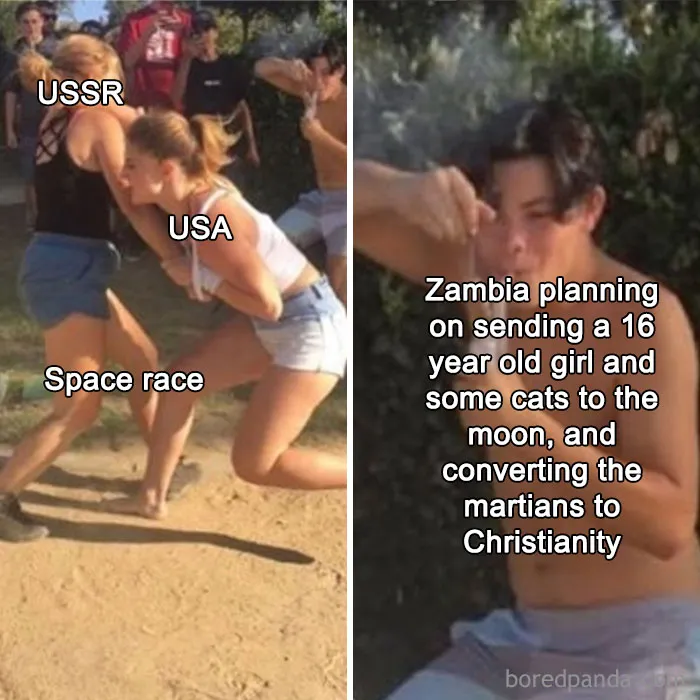
Broadly speaking, the "Space Race" of the 1950s and 60s involved two major players, the United States and the Soviet Union. But there were also minor players: for instance, the Zambian Space Program, the creation of just one man.
An Time magazine article published in November 1964 described Edward Mukuka Nkoloso as a "science teacher and the director of Zambia's National Academy of Space Research." Nkoloso had a plan "to beat the U.S. and the Soviet Union to the moon. Already Nkoloso is training Zambian astronauts, including a 16-year-old girl, by spinning them around a tree in an oil drum and teaching them to walk on their hands, 'the only way humans can walk on the moon.""
Born in 1919 in Rhodesia, Nkoloso got drafted into World War II by the British, took an interest in science during his service, and came home to illegally found his own school. He then spent time as a salesman, and a "political agitator," ending with his capture and imprisonment by colonial authorities. How on Earth could this all have convinced Nkoloso to aim for Mars? Some assume he experienced a psychological break due to torture endured as a political prisoner. Some see his interplanetary ambitions as a cover for the training he was giving his "Afronauts" for guerrilla-style warfare.
Whatever his purposes, the Space Program has attracted new attention in the years since. Footage of its facilities and very sketchy training procedures found its way to Youtube, where it has accumulated millions of views.
Report
65points
#22
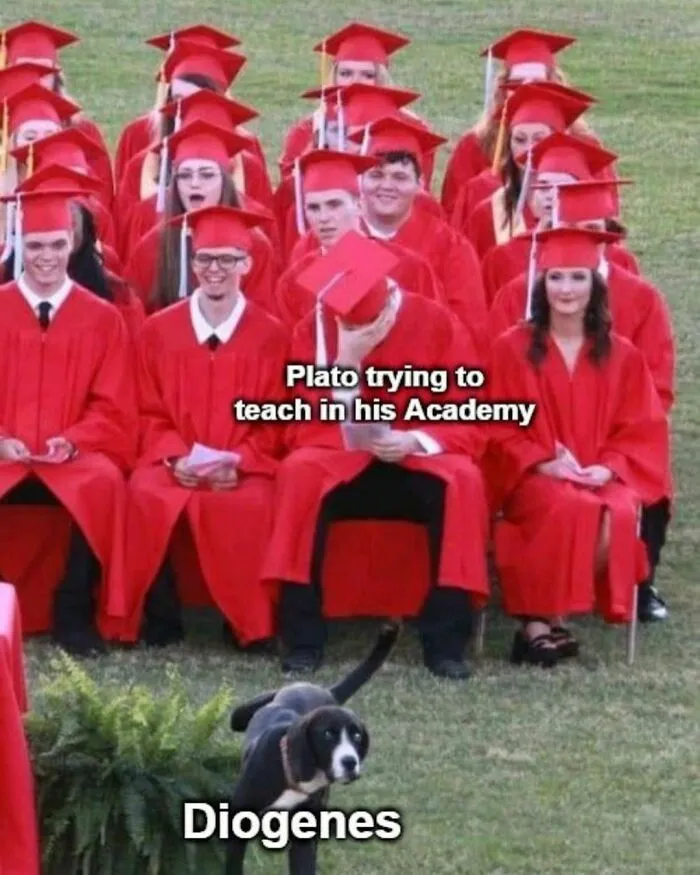
Diogenes was a Greek philosopher and one of the founders of Cynic philosophy. He was born on the coast of modern-day Turkey in 412 BC.
Diogenes was a controversial figure. he moved to Athens and criticized many cultural conventions of the city. He modeled himself on the example of Heracles, and believed that virtue was better revealed in action than in theory. He used his simple lifestyle and behavior to criticize the social values and institutions of what he saw as a corrupt, confused society. He had a reputation for sleeping and eating wherever he chose in a highly non traditional fashion, and took to toughening himself against nature. Diogenes made a virtue of poverty. He begged for a living and often slept in a large ceramic jar, or pithos, in the marketplace.
Diogenes became notorious for his philosophical stunts, such as carrying a lamp during the day, claiming to be looking for a man (often rendered in English as "looking for an honest man"). He criticized Plato, disputed his interpretation of Socrates, and sabotaged his lectures, sometimes distracting listeners by bringing food and eating during the discussions. Diogenes was also noted for having mocked Alexander the Great, both in public and to his face when he visited Corinth in 336 BC.
Diogenes was captured by pirates and sold into slavery, eventually settling in Corinth. There he passed his philosophy of Cynicism to many students. One of his students, Zeno, fashioned it into the school of Stoicism, one of the most enduring schools of Greek philosophy.
Report
60points
#23
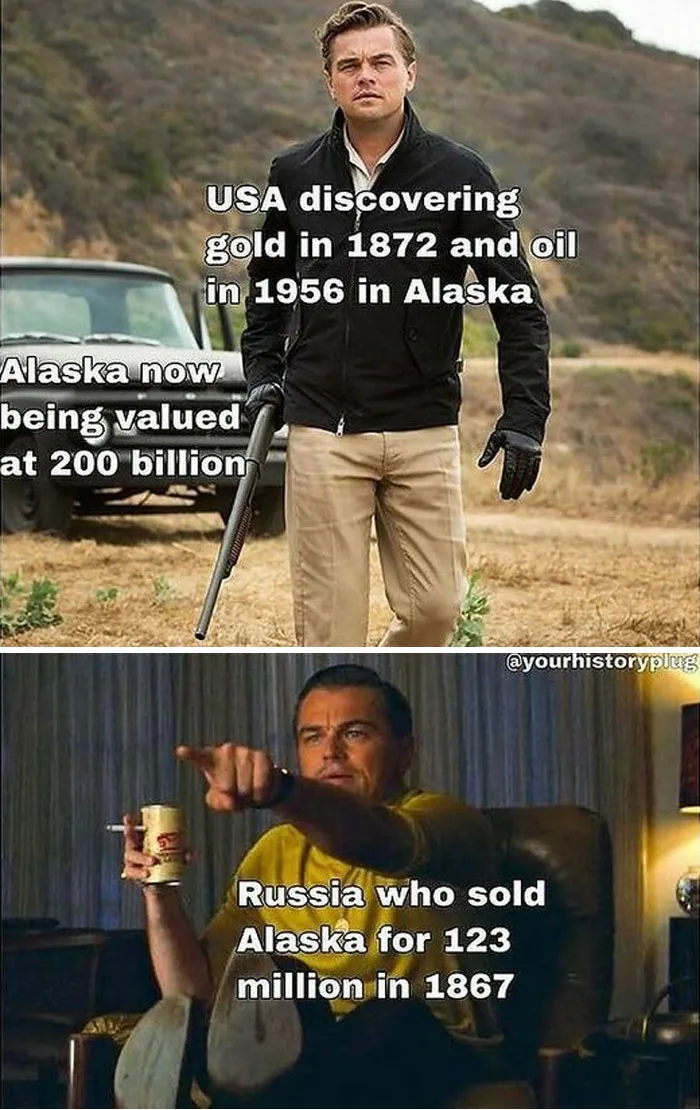
On October 18, 1867, the U.S. formally takes possession of Alaska after purchasing the territory from Russia for $7.2 million, or less than two cents an acre. The Alaska purchase comprised 586,412 square miles, about twice the size of Texas.
Russia wanted to sell its Alaska territory, which was remote, sparsely populated and difficult to defend, to the U.S. rather than risk losing it in battle with a rival such as Great Britain. Negotiations between U.S. Secretary of State William Seward (1801-1872) and the Russian minister to the U.S., Eduard de Stoeckl, began in March 1867. However, the American public believed the land to be barren and worthless and dubbed the purchase "Seward's Folly" and "The President's Polar Bear Garden," among other derogatory names.
Public opinion of the purchase turned more favorable when gold was discovered in a tributary of Alaska's Klondike River in 1896, sparking a gold rush. Alaska became the 49th state on January 3, 1959, and is now recognized for its vast natural resources. Today, 25 percent of America's oil and over 50 percent of its seafood come from Alaska. It is also the largest state in area, about one-fifth the size of the lower 48 states combined, though it remains sparsely populated.
The name Alaska is derived from the Aleut word alyeska, which means "great land." Alaska has two official state holidays to commemorate its origins: Seward's Day, observed the last Monday in March, celebrates the March 30, 1867, signing of the land treaty between the U.S. and Russia, and Alaska Day, observed every October 18, marks the anniversary of the formal land transfer.
Report
53points
#24
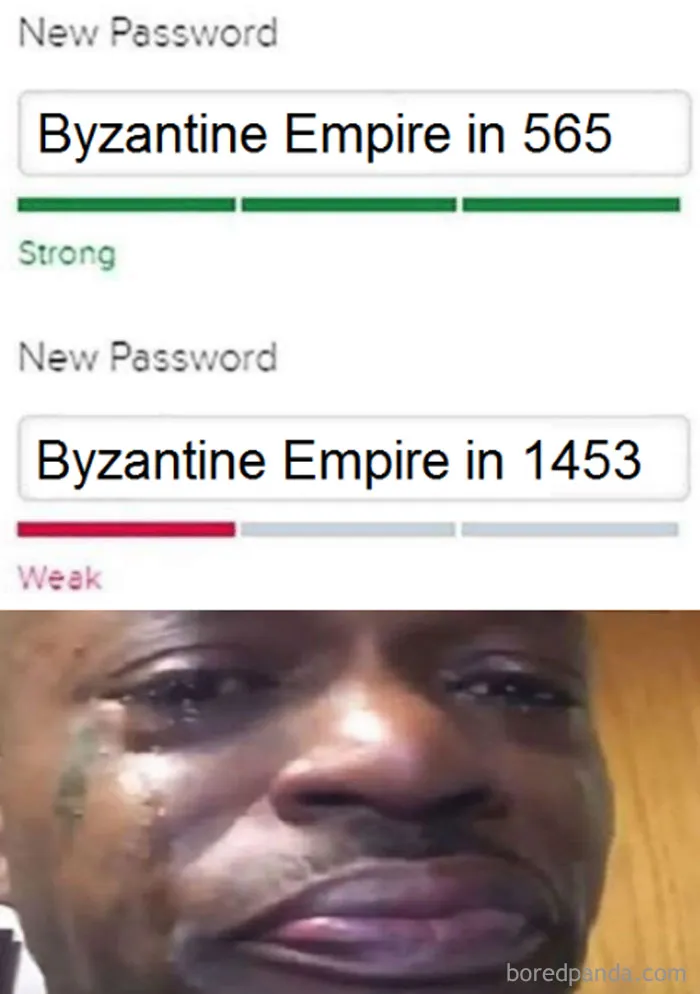
The Byzantine Empire was a vast and powerful civilization with origins that can be traced to 330 A.D., when the Roman emperor Constantine I dedicated a "New Rome" on the site of the ancient Greek colony of Byzantium. Though the western half of the Roman Empire crumbled and fell in 476 A.D., the eastern half survived for 1,000 more years, spawning a rich tradition of art, literature and learning and serving as a military buffer between Europe and Asia.
During the rule of the Palaiologan emperors, beginning with Michael VIII in 1261, the economy of the once-mighty Byzantine state was crippled, and never regained its former stature. In 1369, Emperor John V unsuccessfully sought financial help from the West to confront the growing Turkish threat, but he was arrested as an insolvent debtor in Venice. Four years later, he was forced-like the Serbian princes and the ruler of Bulgaria to become a vassal of the mighty Turks.
Under John's successors, the empire gained sporadic relief from Ottoman oppression, but the rise of Murad II as sultan in 1421 marked the end of the final respite. Murad revoked all privileges given to the Byzantines and laid siege to the Byzantine Capital, Constantinople; his successor, Mehmed II, completed this process when he launched the final attack on the city. On May 29, 1453, after an Ottoman army stormed Constantinople, Mehmed triumphantly entered the Hagia Sophia, which would soon be converted to the city's leading mosque. The fall of Constantinople marked the end of a glorious era for the Byzantine Empire. Emperor Constantine XI died in battle that day, and the Byzantine Empire collapsed, ushering in the long reign of the Ottoman Empire.
Report
52points
#25
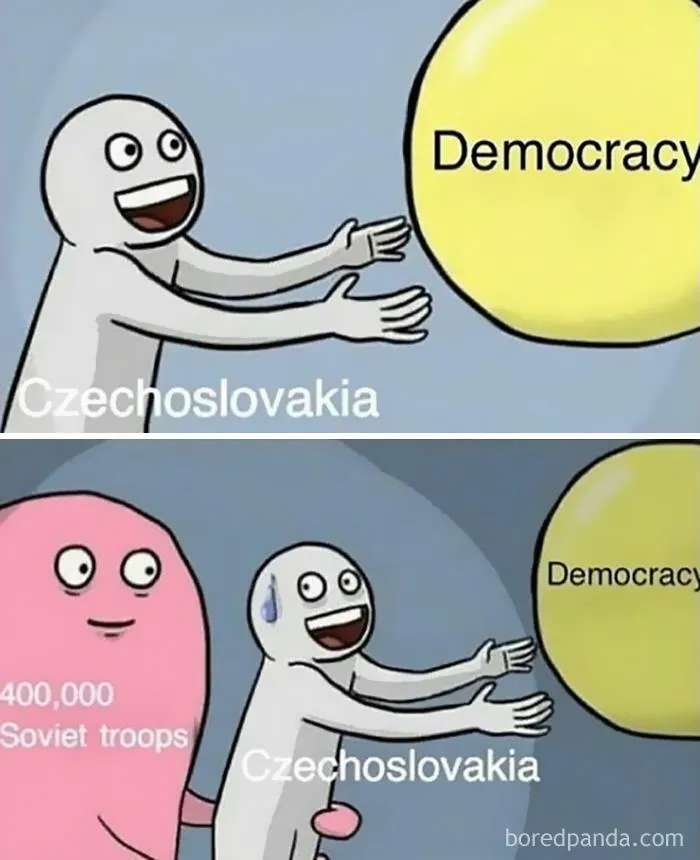
Before the Second World War, the nation of Czechoslovakia had been a strong democracy in Central Europe, but beginning in the late 1940s it faced challenges from the East. In 1948, Czech attempts to join the U.S.-sponsored Marshall Plan to aid postwar rebuilding were thwarted by Soviet takeover and the installation of a new communist government in Prague. For the next twenty years, Czechoslovakia remained a stable state within the Soviet sphere of influence; unlike in Hungary or Poland, even the rise of de-Stalinization after 1953 the did not lead to liberalization by the fundamentally conservative Czech government.
In the 1960s, however, changes in the leadership in Prague led to a series of reforms to soften or humanize the application of communist doctrines within Czech borders.
Soviet leaders were concerned over these recent developments in Czechoslovakia. Recalling the 1956 uprising in Hungary, leaders in Moscow worried that if Czechoslovakia carried reforms too far, other satellite states in Eastern Europe might follow, leading to a widespread rebellion against Moscow's leadership of the Eastern Bloc.
The Warsaw Pact invasion of August 20-21 caught Czechoslovakia and much of the Western world by surprise. In anticipation of the invasion, the Soviet Union had moved troops from the Soviet Union, along with limited numbers of troops from Hungary, Poland, East Germany and Bulgaria into place by announcing Warsaw Pact military exercises. When these forces did invade, they swiftly took control of Prague, other major cities, and communication and transportation links.
Although the Soviet crackdown on Czechoslovakia was swift and successful, small-scale resistance continued throughout early 1969 while the Soviets struggled to install a stable government.
In the years that followed, the new leadership reestablished government censorship and controls preventing freedom of movement, but it also improved economic conditions, eliminating one of the sources for revolutionary fervor. Czechoslovakia once again became a cooperative member of the Warsaw Pact.
The Soviet invasion of Czechoslovakia was significant in the sense that it delayed the splintering of Eastern European Communism and was concluded without provoking any direct intervention from the West.
Report
52points
#26
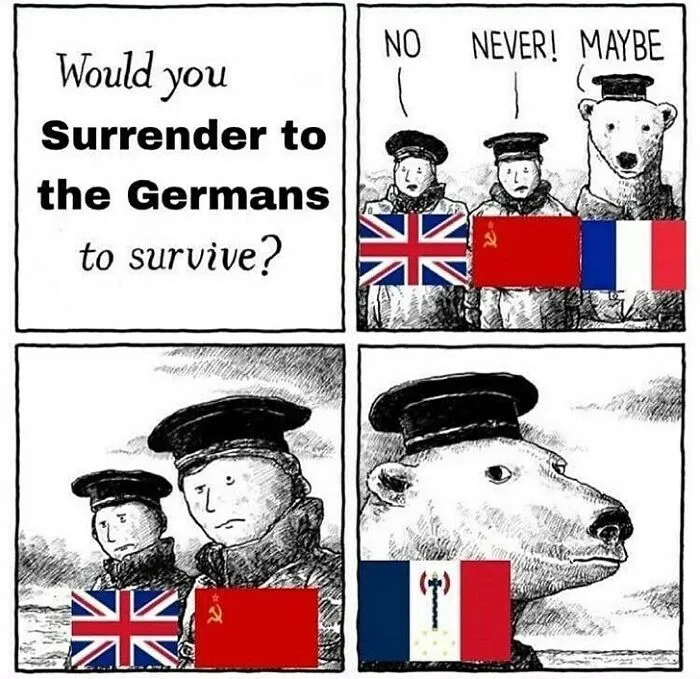
The French Third Republic was invaded by Nazi Germany beginning on 10 May 1940. The Nazis rapidly conquered France by bypassing the highly fortified Maginot Line and invading through Belgium. By July, the military situation of the French was dire, and it was apparent that the French had lost. The French government began to discuss the possibility of an armistice. Then prime-minister Paul Reynaud resigned rather than sign an armistice, and Marshal Philippe Pétain, a hero of World War I, became prime minister. Shortly thereafter, Pétain signed the Armistice of 22 June. On 10 July, the Third Republic was effectively dissolved as Pétain was granted essentially dictatorial powers by the National Assembly.
A resistance movement, working largely in concert with de Gaulle's movement outside the country, increased in strength over the course of the occupation. Following the Allied invasion of Normandy in June 1944 and the liberation of France later that year, the Free French Provisional government of the French Republic (GPRF) was installed as the new national government, led by de Gaulle.
The last of the Vichy exiles were captured in the Sigmaringen enclave in April 1945. Pétain was put on trial for treason by the new Provisional government, and [executed]; this was commuted to life imprisonment by de Gaulle. Only four senior Vichy officials were tried for crimes against humanity, although many more had participated in the deportation of Jews for internment in Nazi concentration camps, abuses of prisoners, and severe acts against members of the Resistance.
Report
51points
#27
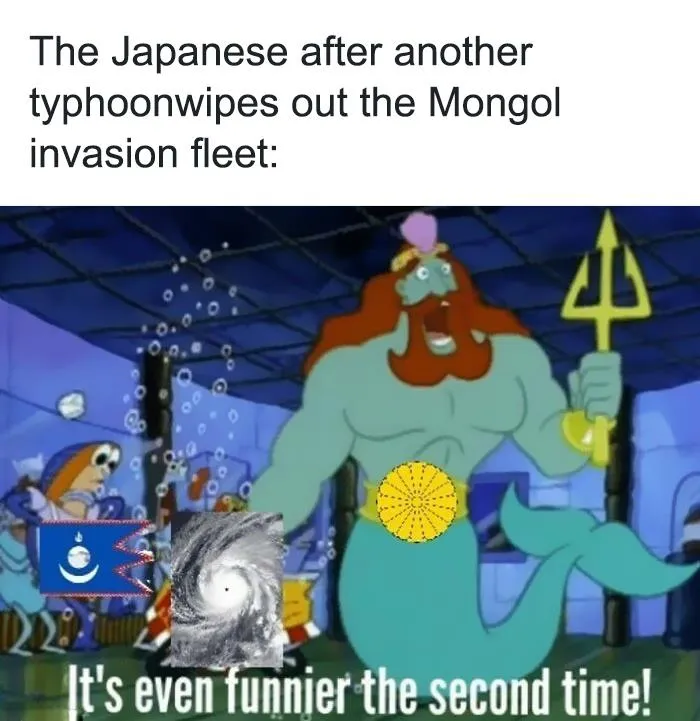
In the 13th century, Genghis Khan's grandson Kublai Khan had already conquered much of China and hoped to expand his Mongolian empire. To attack Kyushu, the southernmost of the four main Japanese islands, he amassed an enormous fleet of Chinese and Korean ships. It was one of the largest armadas the world has ever seen, with more than 140,000 sailors, according to Woodruff.
Yet twice, in 1274 and 1281, Kublai sent his overwhelming forces across the Korea Strait, and twice his fleet was destroyed.
Legend has it that Khan's ships were sunk when an emperor summoned two massive storms, the kamikazes.
The problem with this story, aside from the question of whether the storms were divinely ordained, is that powerful typhoons are relatively rare today in the part of western Japan that was attacked. Historians tend to give more credit to the Japanese troops who defended their land.
Scholars also note that modern popularization of the kamikaze story, in which an emperor summons the divine winds that project Japan, has an element of propaganda to it.
Emperor Hirohito resurrected the tale in the final hours of World War II, when he appealed to Japanese pilots to become his divine winds. So powerful was the legend that thousands of pilots known as kamikazes would sign up to protect Japan again, by crashing their planes in suicide missions against American ships.
Report
50points
#28
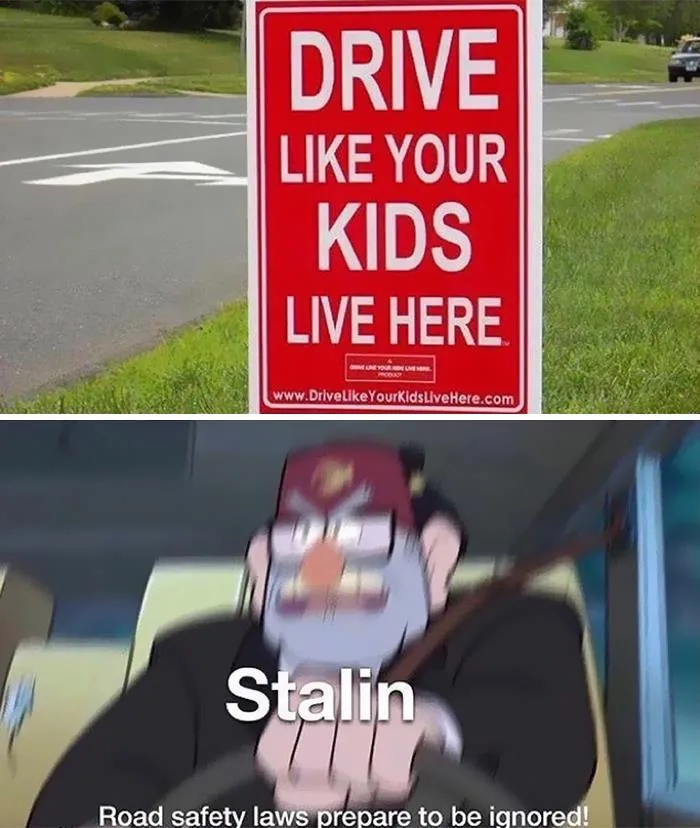
Everyone knows Joseph Stalin, but most aren't familiar with his familial life, particularly his eldest son, Yakov. The tumultuous relationship between father and son created a story that spanned a difficult youth, the German invasion of the Soviet Union and a Nazi concentration camp.
From his youth onward, Yakov and Stalin did not get along, with Stalin being quite judgmental of his son, looking down on him in almost every way. As a young man, Yakov [tried to take his own life] after a disagreement with his father over Yakov's Jewish fiancee, likely caused by Stalin's antisemitism.
Afterward, Stalin said that he no longer wanted to have any sort of a relationship with Yakov, as they had nothing in common.
Because of his father, though, Yakov did have a military career and was an officer in the Red Army. When Nazi Germany invaded the USSR during World War II, at the Battle of Smolensk, they captured him.
One would generally think that a powerful ruler would do whatever is necessary to retrieve his offspring from the enemy. This was not the case with Stalin and Yakov. Despite the Germans offering to trade Yakov for a German field marshal, or Hitler's nephew, Stalin refused both trade options.
In addition, Stalin did not entirely believe that his son had been captured. In fact, he thought that his son had given himself up, surrendering at the urging of his wife (whom Stalin later imprisoned and interrogated because of this).
Regardless of how he got there, Yakov did end up in a Nazi German concentration camp. Different rumors circulated regarding Yakov's [demise], but until recently it's not been fully confirmed how and when he died. Some thought that he may have [taken his own life] by running into an electric fence, or even jumping from a prison window onto an electric fence. Others thought that he may have been [assassinated]. More recently, though, it's thought that Yakov was shot by a guard for not obeying orders.
Sadly, Yakov was not the only family recipient of his father's anger. Yakov's brother, Vasili, received the same criticism that Yakov always had, and he drank himself to an early [demise]. One of Stalin's wives, Nadezhda, supposedly [took his own life] after having too much of her husband's cruelty, the final straw being forced to sit across him at the dinner table while he tauntingly flicked cigarettes in her direction.
Report
49points
#29
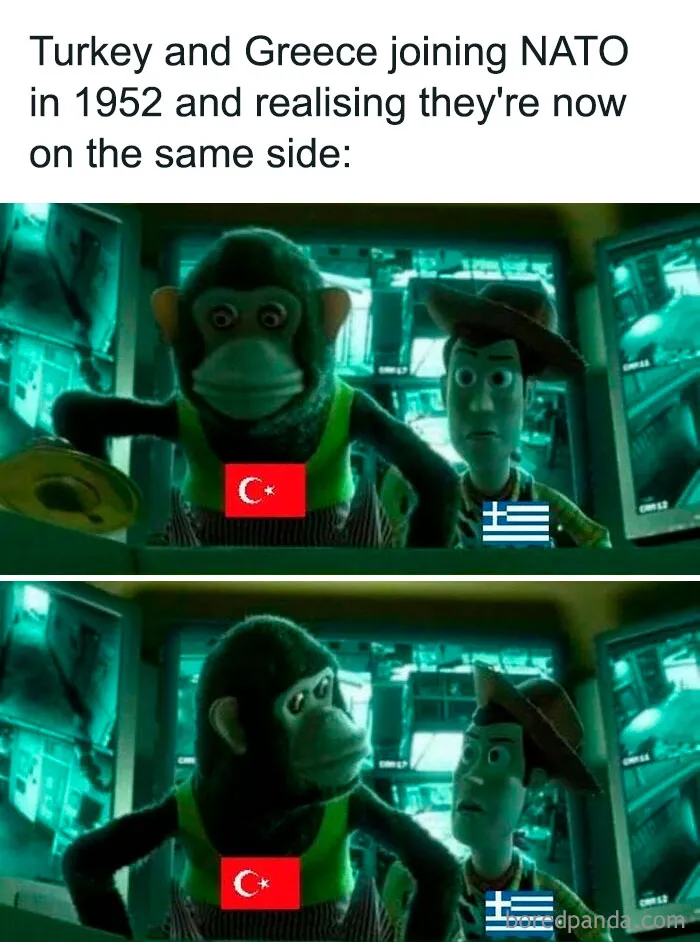
NATO finds itself with two member states that are officially allies, but whose suspicion of each other is never far from the surface.
When Greece and Turkey joined NATO in 1952, they did so based on NATO members' assumption that the two countries' membership of the alliance would pacify their behavior toward each other.
NATO's purpose as an organization is to ensure the collective defense of its members on the basis of its founding Washington Treaty. It was never designed to adjudicate disputes between its members. It should therefore not come as a surprise that NATO isn't stepping in to deal with the current Greece Turkey conflict.
NATO finds itself with two member states that are officially allies, but whose suspicion of each other is never far from the surface.
When Greece and Turkey joined NATO in 1952, they did so based on NATO members' assumption that the two countries' membership of the alliance would pacify their behavior toward each other.
NATO's purpose as an organization is to ensure the collective defense of its members on the basis of its founding Washington Treaty. It was never designed to adjudicate disputes between its members. It should therefore not come as a surprise that NATO isn't stepping in to deal with the current Greece Turkey conflict.
Report
46points
#30
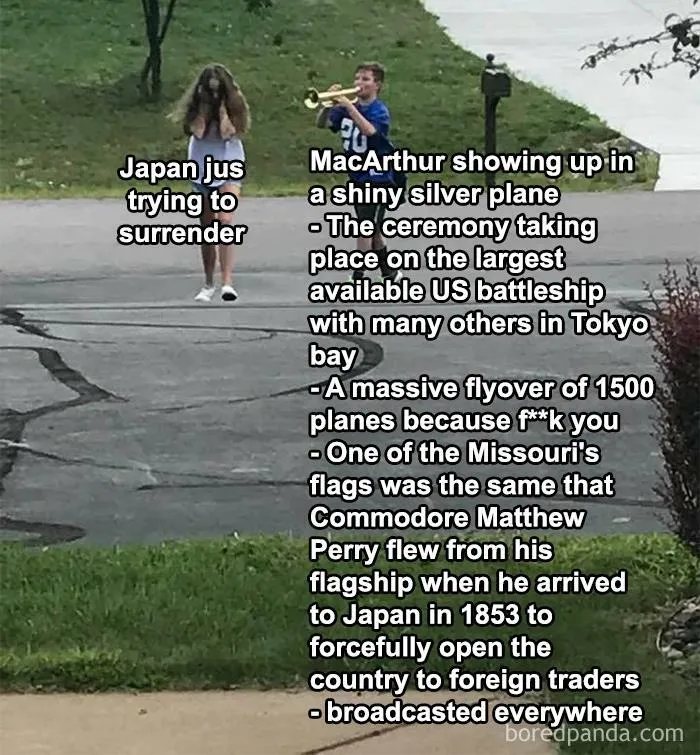
Just before midnight on August 9, Japanese Emperor Hirohito convened the supreme war council. After a long, emotional debate, he backed a proposal by Prime Minister Suzuki in which Japan would accept the Potsdam Declaration, which called for the surrender of all Japanese forces.
In the early hours of August 15, a military coup was attempted by a faction led by Major Kenji Hatanaka. The rebels seized control of the imperial palace and burned Prime Minister Suzuki's residence, but shortly after dawn the coup was crushed. At noon that day, Emperor Hirohito went on national radio for the first time to announce the news of his decision. The United States immediately accepted Japan's surrender.
President Truman appointed MacArthur to head the Allied occupation of Japan as Supreme Commander of the Allied Powers. For the site of Japan's formal surrender, Truman chose the USS Missouri, a battleship that had seen considerable action in the Pacific and was named after Truman's native state. On Sunday, September 2, more than 250 Allied warships lay at anchor in Tokyo Bay. The flags of the United States, Britain, the Soviet Union, and China fluttered above the deck of the Missouri. The gathered dignitaries were greeted by a massive flyover of over a thousand U.S. planes. Just after 9 a.m. Tokyo time, Japanese Foreign Minister Mamoru Shigemitsu signed on behalf of the Japanese government. General Yoshijiro Umezu then signed for the Japanese armed forces, and his aides wept as he made his signature. Admiral Chester W. Nimitz signed for the United States.
Report
44points