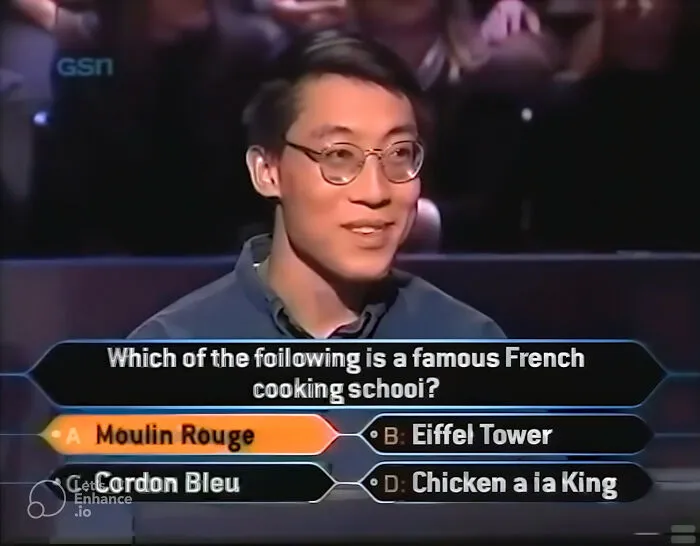






#3 Failed The No-Brainer Question. He Didn't Think Twice Before Saying "Final Answer". The Look On His Face As He Realizes His Mistake Is Beyond Priceless

We've all seen Who Wants To Be A Millionaire on our screens. After all, the show has been around since 1998, and nearly every country has its own version. Yes, we mean it. In fact, the 1998 television hit holds the Guinness World Record for the most international versions of a quiz show, with more than 100 regional adaptations.
But Who Wants To Be A Millionaire is hardly the first quiz show of its kind. According to experts, the concept of a public quiz show dates back to the 1930s. Information Please is often credited as the first popular trivia radio show, where listeners could send in questions in an attempt to stump a panel of experts. It aired in 1938 and even had special celebrity guests participating- how fun.

Aside from the entertainment factor, there are plenty of psychological reasons why we're so drawn to watching quiz shows and even playing along from the comfort of our own homes, like a sense of achievement and a competitive spirit. Perhaps the biggest one, however, is dopamine.
When you answer a question correctly, even before the contestant does, experts say your brain releases a small burst of dopamine, the brain's reward chemical. It gives you a quick sense of validation with zero financial or social risk, along with all the satisfaction of feeling smart without having to answer questions in front of a live audience and potentially fail.



As you can imagine, though, the cash prize is probably the biggest reason people sign up for the show. After all, who doesn't want to be a millionaire? Well, as it turns out, in very few countries do contestants actually receive the million promised in the title. In fact, most international versions don't award the equivalent of one million dollars at all.
In the U.S., for example, winners lose a significant portion of the $1 million prize to taxes. Meanwhile, in the United Kingdom, contestants receive the full £1 million because, under UK tax law, gambling and game show winnings are tax-free. In countries like Vietnam, however, the top prize is 150,000,000 Vietnamese đồng, which is roughly equivalent to just $6,000.


Despite the show's popularity and hefty cash prize, there have only been around 120 grand prize winners across all international versions of Who Wants To Be A Millionaire since 1998. Apparently, Japan has produced the most winners, with around 40 contestants taking home the show's top prize.
And while some contestants choose not to rely on the available lifelines, studies suggest that asking the audience can be a huge advantage. The audience is estimated to be correct around 90–95% of the time. So if you ever get the chance to compete on the show, don't be afraid to use those lifelines so you don't make the same mistakes as the people in this list.


Of course, if you ever do end up going on the show, remember this: high stress can get in the way of giving the right answer. So while it's funny to watch contestants miss obvious questions, experts say that extreme stress triggers the body's fight-or-flight response. This floods the brain with stress hormones, making it harder for the prefrontal cortex to function properly.
So it makes sense that staying calm in the hot seat isn't easy, especially when you know millions of people could be watching. At least I know I'd probably forget my own name. So, have you ever wanted to go on Who Wants To Be A Millionaire? If so, tell us why!