





These days, we seem to give things that appear entirely opposite to stupidity a whole lot of thought—we talk about think tanks, thought leaders, smart homes, and artificial intelligence. But we surely don’t need lists like this to remind us that there’s still plenty of stupidity around us, too. Humans have achieved some remarkable things, but that does not make us immune to doing dumb things.
In fact, as complexity researcher David C. Krakauer explains, “the degree of stupidity available to any system scales directly with the intelligence that system possesses—more intelligence begets greater feats of stupidity.” In other words, being as equipped as we are—with language, abstraction, technology, institutions, and ideology—only makes us capable of making even bigger blunders.

That’s because, as Krakauer points out, stupidity actually requires a surprising amount of intelligence. Someone who simply doesn’t know the answer to something is ignorant, not stupid. And there are now seemingly infinite ways to remedy that almost instantaneously (hello, Google). What is truly (and perhaps impressively) stupid, he explains, is taking an easy problem and, through complicated theories, elaborate beliefs, or sheer misdirected ingenuity, making it much harder than it needed to be.
As he puts it, “stupidity takes an easy problem and, with great effort and misdirected ingenuity, makes it hard.” In other words, there’s a difference between not knowing better and putting considerable effort or brainpower into making the wrong answer seem right.

#8 The Employees Kept Wondering Why My Wife And I Were Laughing Throughout The Store Like Idiots. About 25 Of These “Alternative Math” Signs


But Krakauer is also careful to point out that not every mistake is a sign of sheer stupidity. We get things wrong for all kinds of reasons. Sometimes we just don’t have enough information. Sometimes our wires get crossed and we’ve simply misunderstood. Or sometimes it’s an “honest misapplication” of something that worked in a different situation but no longer applies. All of these are just ordinary human errors, and probably nothing to be too hard on ourselves about.


#12 Guy Riding Down The Road Holding A Dresser On Top Of A Car On A 50 Mph Road

But if these are “the misfortunes of our lives about which we should be forgiving,” Krakauer sees stupidity as something more specific. He says: “Stupidity begins where error is elaborated, defended, refined, institutionalized, and made the foundation for further action.”
In other words, the problem isn’t necessarily getting something wrong in the first place; it’s what happens when we take that mistake and choose to build on it—doubling down or finding ways to justify it—instead of correcting course. In the process, we just make things even worse.

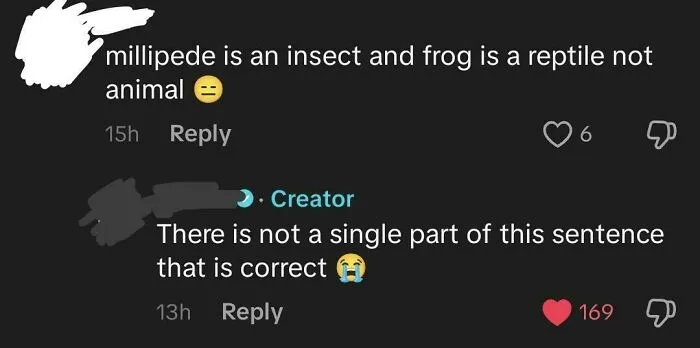
#14 Millipedes Are Not Insects, Frogs Are Not Reptiles, Arthropods, Reptiles, Amphibians Are All Animals

So perhaps one thing that separates a recoverable mistake from monumental stupidity is as simple as a serving of humble pie. In fact, David Robson suggests as much in his “guide to not being stupid,” written for the BBC. He, too, explains that “Even the smartest people can be fools.” One way to become “a little less stupid,” he suggests, is to practice intellectual humility: questioning the limits of what we know, examining the assumptions behind our decisions, seeking out information that might challenge our thinking, and considering whether there are other ways of looking at the situation.
#16 I Don't Know Dude, Where Could It Have Possibly Gone? I Think Something's A Little Shady Here

#17 Seriously? If You're Going To Roast Our System, At Least Understand Your Own


And perhaps part of that humility is also being able to laugh at our mistakes. As Cezary Pietrasik, author of Homo Idioticus: Why We Are Stupid and What to Do About It, shared with Jennifer Gerlach, LCSW, “Humor is a great tool in unearthing stupidity and showing the ridiculousness of our positions.”
And really, nowhere is that ridiculousness clearer than in this list.