





Not everyone is cut out to be a doctor. In fact, only about 41% of medical school applicants are even accepted. But there’s a good reason why this field is so competitive. In most other jobs, small mishaps are understandable, and they can be seen as learning experiences. However, when you’re taking care of a patient, any mistake might cost them their life.
Doctors and surgeons have been opening up on Reddit about the most terrifying “Oh no!” moments they’ve had on the job. From realizing that a patient lied about eating breakfast to nearly dropping a newborn, this list is full of reminders that not even surgeons are superhuman. Good luck getting through this list without increasing your heart rate significantly. And be sure to upvote the stories that give you an even greater appreciation for all of the wonderful doctors you’ve had!
#21
Someone else tragically lost their life years ago but the incident saved my sister's life about 10 years later.
Several years ago, my sister and I were in a car accident. I had visible injuries, she did not and was walking around without any problems, so we thought. Nine days later, she was preparing dinner, began to feel ill, vomited and then passed out. She was taken by ambulance to the hospital emergency and after talking to my brother-in-law for only a couple of minutes, he rushed my sister into surgery and removed her spleen immediately, it had ruptured in the accident but was a slow bleed.
My sister was in ICU for a couple of weeks but survived and is in good health today. Later, the admitting trauma surgeon said he recognized what was happening because of a mistake his college professor told the class she made as a surgeon years earlier.
A teenage boy had fallen from a cliff and hit rocks below, other than being bruised he was fine so did not seek medical help. Seven days later he was brought unconscious into ER, where the college professor was working as a surgeon at the time. She and her team were not able to quickly identify his symptoms of a ruptured spleen that had happened 7 days ago. The teenage boy died about an hour later.
She was always sure to share this particular incident with her students, thus saving my sister's life when one of her former students (my sister's doctor) showed up to class that day!
Several years ago, my sister and I were in a car accident. I had visible injuries, she did not and was walking around without any problems, so we thought. Nine days later, she was preparing dinner, began to feel ill, vomited and then passed out. She was taken by ambulance to the hospital emergency and after talking to my brother-in-law for only a couple of minutes, he rushed my sister into surgery and removed her spleen immediately, it had ruptured in the accident but was a slow bleed.
My sister was in ICU for a couple of weeks but survived and is in good health today. Later, the admitting trauma surgeon said he recognized what was happening because of a mistake his college professor told the class she made as a surgeon years earlier.
A teenage boy had fallen from a cliff and hit rocks below, other than being bruised he was fine so did not seek medical help. Seven days later he was brought unconscious into ER, where the college professor was working as a surgeon at the time. She and her team were not able to quickly identify his symptoms of a ruptured spleen that had happened 7 days ago. The teenage boy died about an hour later.
She was always sure to share this particular incident with her students, thus saving my sister's life when one of her former students (my sister's doctor) showed up to class that day!
Report
24points
#22
My grandmother has had diabetes for about 20 years, and takes a handful of meds to help control it. About 10 years ago, she developed a persistent cough. It wasn't bad, she said it felt like a constant tickle in the back of her throat.
She went to her doctor to find out what was going on, and he ordered a battery of tests concerned that she was developing pneumonia, lung cancer, etc. All the tests came back negative, so he prescribed a cocktail of pills to help combat it. Over the span of 5 years, she had tried about 35 different meds and none helped.
One day when she went it for a routine check-up, her normal doc was out and she saw one of the on-call residents. He looked at the barrage of pills she was on and asked why. When she explained, he replied, "Oh, the cough is a side effect of this one particular d**g you're on to regulate your insulin. If we change you to this other one, it will go away.".
She went to her doctor to find out what was going on, and he ordered a battery of tests concerned that she was developing pneumonia, lung cancer, etc. All the tests came back negative, so he prescribed a cocktail of pills to help combat it. Over the span of 5 years, she had tried about 35 different meds and none helped.
One day when she went it for a routine check-up, her normal doc was out and she saw one of the on-call residents. He looked at the barrage of pills she was on and asked why. When she explained, he replied, "Oh, the cough is a side effect of this one particular d**g you're on to regulate your insulin. If we change you to this other one, it will go away.".
Report
22points
#23
I was the patient.
I had a liver transplant and was having an ercp done to place a new bile duct stent.
Well apparently my anatomy is different than normal, and my lungs go more down my sides.
So he accidentally caused a nick, which caused a hemothorax. So when I woke up I couldn't breathe, they did an xray and had to do a chest tube. Eventually I was so exhausted I asked to be vented so he vented me. Apparently he cried he felt so bad about it all.
But it wasn't him being malicious or negligent, it was simply an accident.
I had a liver transplant and was having an ercp done to place a new bile duct stent.
Well apparently my anatomy is different than normal, and my lungs go more down my sides.
So he accidentally caused a nick, which caused a hemothorax. So when I woke up I couldn't breathe, they did an xray and had to do a chest tube. Eventually I was so exhausted I asked to be vented so he vented me. Apparently he cried he felt so bad about it all.
But it wasn't him being malicious or negligent, it was simply an accident.
Report
21points
#24
I was a 4th year resident and I was on call that day, around 5pm I went to do rounds and as I got to the first room I came in to find the 1st year resident on top of the very recently neck operated patient (that morning he had a tumour removed from his parapharyngeal space), the resident was kneeling next to the guys head with his hands and clothes completely covered in blood, there was blood on the roof on the sheets, on the bed, dripping onto the floor, you name it. I was instantly petrified, I went to OMFG I have never ever repaired someones carothid artery I am completely unqualified to help this guy! Someone please HELP US! I was the senior resident so I was the only one on call at the time and besides none could get there in time to help this guy, he was bleeding out so it was up to me alone to help him.
So I took the guy to the OR as fast as we could and I opened him up, all of the time praying and telling myself Its OK I can do this, I can do this! I was s******g my pants while everyone was looking at me to fix him, I open him up and I see the freaking facial artery loose, spraying blood all over so I clamped it, put a knot around it and that was it. We closed him up, bandage and transfuse the poor guy and I went to collapse on a stool.
So I took the guy to the OR as fast as we could and I opened him up, all of the time praying and telling myself Its OK I can do this, I can do this! I was s******g my pants while everyone was looking at me to fix him, I open him up and I see the freaking facial artery loose, spraying blood all over so I clamped it, put a knot around it and that was it. We closed him up, bandage and transfuse the poor guy and I went to collapse on a stool.
Report
21points
#25
"Not a surgeon, but" when I was a nursing student, I was on theatre prac. We had a guy in who needed humerus and elbow repair. I was pretty useless in everything but emotional support (as I wasn't qualified), so was chatting to him before he went under. He admitted to having an (un)healthy m**h habit. I informed the surgeon who shrugged it off. Apparently I should have told the anaesthetist, because this dude woke up mid surgery and was trying to reach for his open arm that the surgeon was working on. Super "Oh s**t" moment as we scramble to contain this guy's arm and stop it from touching anything sterile.
Report
21points
#26

8 years after finishing medical school and deferring student loans through residency and fellowship and realizing that I was closer to 40 than 30 with over $200,000 of debt.
20points
#27
Former medical student here. Rotating through General Surgery was mainly an enjoyable time. I remember one young patient, 22 years old, was re-visiting the ER, where he'd been seen 6 weeks prior for sustaining some abrasions and bruises after falling hard off a skateboard. He was all scraped up everywhere but had healed up OK.
But now he's in the ER again, feeling awful sick, vomiting and with a fever. As the 3rd year med student I was dispatched to the bedside and hung up the CT films on the lightbox, to much finger pointing and grunting among the surgeons. I had no idea how to read a CT at the time - wasn't even really sure what part of the body had been scanned. So when the surgical resident barked "prep him for surgery" I was nonplussed, decided to disguise my ignorance and just go for it, as was the approved way for students at this busy public hospital way back when.
We got him gassed and prepped and I scrubbed in. Surgeon said "Open" and I raised the #15 blade. He'd been prepped for a midline laparotomy but I guess I exposed my ignorance when I spoke up to confirm same - this was decades before timeouts, before "wrong site" became a "never event" - because everyone laughed.
I opened and it went uneventfully, reflected the omentum with its lovely arcades and exposed the viscera. "You remember how to perform the Kocher maneuver?" the attending barked. "Yes sir." "Well do it!"
I slid my gloved hand up into the splenic flexure, getting well ready to grab the entire sack of intestines and move it up and over - the opening salvo of the Kocher maneuver - but met unexpected resistance. I peered up, seeing in my confusion that everyone was edging away from the table. "What's the trouble young man, get your hand up there and complete the maneuver! Push harder!"
A spongy sort of barrier gave way and with a sickening stench, immediately recognizable as the locker-room aroma of *Staphylococcus aureus*, a gushing cascade of 2 liters of grey-brown, bloody pus roared out of the incision, soaking my gown, scrub pants and shoes before splattering on the OR floor and walls.
The splenic abscess, doubtless caused by the transient bacteremia from his skateboard accident, had been lysed, ruptured, evacuated and mostly cured. The attending finished up with the splenectomy and after some abdominal lavage the patient was good as new. I had to throw out my shoes.
But now he's in the ER again, feeling awful sick, vomiting and with a fever. As the 3rd year med student I was dispatched to the bedside and hung up the CT films on the lightbox, to much finger pointing and grunting among the surgeons. I had no idea how to read a CT at the time - wasn't even really sure what part of the body had been scanned. So when the surgical resident barked "prep him for surgery" I was nonplussed, decided to disguise my ignorance and just go for it, as was the approved way for students at this busy public hospital way back when.
We got him gassed and prepped and I scrubbed in. Surgeon said "Open" and I raised the #15 blade. He'd been prepped for a midline laparotomy but I guess I exposed my ignorance when I spoke up to confirm same - this was decades before timeouts, before "wrong site" became a "never event" - because everyone laughed.
I opened and it went uneventfully, reflected the omentum with its lovely arcades and exposed the viscera. "You remember how to perform the Kocher maneuver?" the attending barked. "Yes sir." "Well do it!"
I slid my gloved hand up into the splenic flexure, getting well ready to grab the entire sack of intestines and move it up and over - the opening salvo of the Kocher maneuver - but met unexpected resistance. I peered up, seeing in my confusion that everyone was edging away from the table. "What's the trouble young man, get your hand up there and complete the maneuver! Push harder!"
A spongy sort of barrier gave way and with a sickening stench, immediately recognizable as the locker-room aroma of *Staphylococcus aureus*, a gushing cascade of 2 liters of grey-brown, bloody pus roared out of the incision, soaking my gown, scrub pants and shoes before splattering on the OR floor and walls.
The splenic abscess, doubtless caused by the transient bacteremia from his skateboard accident, had been lysed, ruptured, evacuated and mostly cured. The attending finished up with the splenectomy and after some abdominal lavage the patient was good as new. I had to throw out my shoes.
Report
18points
#28
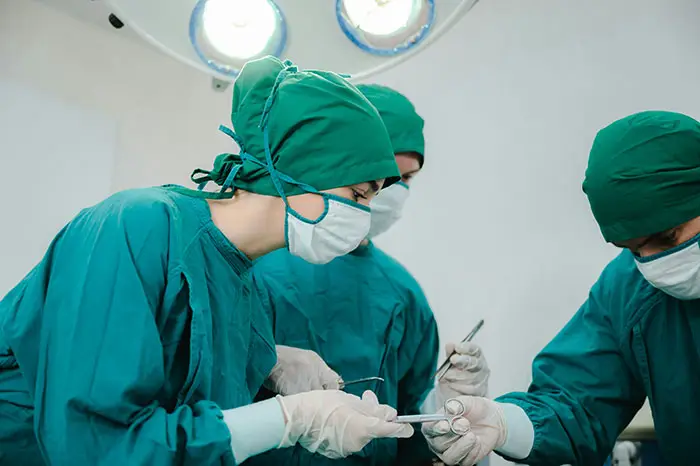
Not a surgeon, but was working in obstetric theatre in UK mid heatwave last year. This is important as maternity wards are kept quite warm as newborn babies aren't good at regulating their temperatures. Combine this with a heatwave and the fact that in Britain we're not exactly used to h**h temperatures and we have the perfect storm.
Mid emergency casarean the scrub nurse assisting the op starts feeling faint. This is unusual as this scrub nurse worked in these theatres full time so this was her bread and butter, so I can only conclude it was the heat. She has to step out so the SHO takes her place assisting the obs registrar with the section. This SHO looked extremely junior, as in first section ever. And they were trying to assist with the instruments in the uterus when they fainted. I had to jump in and grab the back of their theatre gown to stop them faceplanting the open uterus, and then sort of gently tug backwards to let them fall into me when someone else has taken over assisting.
This SHO was not exactly small. Thank God the baby was already out.
Mid emergency casarean the scrub nurse assisting the op starts feeling faint. This is unusual as this scrub nurse worked in these theatres full time so this was her bread and butter, so I can only conclude it was the heat. She has to step out so the SHO takes her place assisting the obs registrar with the section. This SHO looked extremely junior, as in first section ever. And they were trying to assist with the instruments in the uterus when they fainted. I had to jump in and grab the back of their theatre gown to stop them faceplanting the open uterus, and then sort of gently tug backwards to let them fall into me when someone else has taken over assisting.
This SHO was not exactly small. Thank God the baby was already out.
Report
17points
#29
Just an RN here. I was working in the ER and had a patient brought in by her husband. Apparently the woman had a fall a week prior and injured her face but refused medical care. Her husband finally forced her to come in. As soon as I see the wound on her face (from across the room) I think, "that does not look like any wound Ive seen." I approached her and realized maggots had infested the wound and were eating the rotting skin. A really simple and quick fix but I cant imagine her living conditions.
Report
17points
#30
I'm in the military, and as I've gotten closer to 40, it seems I've begun to develop high blood pressure. On-base doctor insisted I needed medication to control it, so he wrote a prescription. To be honest, I hadn't seen this doc before and seemed a bit.... off. Not sure how to describe it, but he just seemed a bit less than completely there.
Anyways, I walk down to the pharmacy area and wait my turn. I'm called forward and the pharmacy tech asks for my ID, looks up the order, and asks me some basic questions. "Name", "Date of Birth", and "Allergies". I told her I was allergic to penicillin and sulfa.
The prescription was for Hyzaar. Any medical student can probably tell you moronic this order was. Hyzaar specifically has side effects for those with allergies to penicillin or sulfa. I'm allergic to **both**.
The tech actually said out loud "What in the actual f**k!". She calls the doctor on the phone and starts chewing his a*s. Keep in mind she's a civilian and he's a commissioned officer. Neither of them "outrank" the other, so he's arguing back with her, and then she says, "Your pill popping is f*****g over. You could have k****d this patient today because you're always too high to know what's going on around you. I'm going to the wing commander over this."
To shorten the story a bit, it's brought before an ethics board and a court-martial. Seems he was "trading scripts" with other doctors in the area for pain pills, was high nearly every waking moment, and could have actually k****d me. He received a sentence of over 1 year. I'm being a bit purposefully vague to prevent anyone from tracking me down personally (as I had to testify).
Anyways, I walk down to the pharmacy area and wait my turn. I'm called forward and the pharmacy tech asks for my ID, looks up the order, and asks me some basic questions. "Name", "Date of Birth", and "Allergies". I told her I was allergic to penicillin and sulfa.
The prescription was for Hyzaar. Any medical student can probably tell you moronic this order was. Hyzaar specifically has side effects for those with allergies to penicillin or sulfa. I'm allergic to **both**.
The tech actually said out loud "What in the actual f**k!". She calls the doctor on the phone and starts chewing his a*s. Keep in mind she's a civilian and he's a commissioned officer. Neither of them "outrank" the other, so he's arguing back with her, and then she says, "Your pill popping is f*****g over. You could have k****d this patient today because you're always too high to know what's going on around you. I'm going to the wing commander over this."
To shorten the story a bit, it's brought before an ethics board and a court-martial. Seems he was "trading scripts" with other doctors in the area for pain pills, was high nearly every waking moment, and could have actually k****d me. He received a sentence of over 1 year. I'm being a bit purposefully vague to prevent anyone from tracking me down personally (as I had to testify).
Report
17points
#31
I woke up during a bronchoscope. That was interesting. Thankfully a scope and not an incision.
15points
#32
I was the patient. It was a kidney biopsy. I was d*****d up and out of it, but still awake. Laying on my stomach as my kidney doctor worked behind me. He warned me, “You’re going to hear a click and it will feel like Mike Tyson punched you in the back.” “Oh, Kay?”
I hear, click, feel the punch, then hear, “Oh, S**T. Get So n So on the phone now.” A nurse came up near my face to calm me, and maybe keep an eye on me. I don’t really remember everything.
Apparently he had knicked a blood vessel and I was bleeding internally at an alarming rate. I got to spend the night in the hospital and pissed what seemed like pure blood for about 24 hours.
Never try to fit your kidney biopsy in on a Friday before the doctor leaves for vacation.
I hear, click, feel the punch, then hear, “Oh, S**T. Get So n So on the phone now.” A nurse came up near my face to calm me, and maybe keep an eye on me. I don’t really remember everything.
Apparently he had knicked a blood vessel and I was bleeding internally at an alarming rate. I got to spend the night in the hospital and pissed what seemed like pure blood for about 24 hours.
Never try to fit your kidney biopsy in on a Friday before the doctor leaves for vacation.
Report
15points
#33
This thread is pretty depressing, so i'll lighten it up a bit. A few months ago, I accidentally ran a creatinine test on a patient when a comp metabolic wasn't ordered. It turns out that the guy was in renal failure, and no one knew. He was about to go in for surgery ( I believe it was a bypass, but could be wrong), but I got the results in in time to stop them from putting him under. S**t could have been messy. I'm glad I screwed up, and I'm sure he has no idea that he could have died.
Report
14points
#34
I'm a nurse. I've given an anticoagulant ( blood thinner) to the wrong patient. Over the the next day his red blood count Dropped. He ended up in ICU.
Report
14points
#35
When I was in pharmacy school I was doing my internal medicine rotation in my final year. My preceptor and I were doing med reviews in the ICU when one of the pulmonary docs was basically like "hey you wanna see something cool?" They were trying to extract a foreign object from a guy's lung in one of the rooms. So we go in and watch for a bit. About 6 people in the room. Tube down the guy's throat. Little grippers at the end. Two doctors watching a monitor and trying to control the grabbers and get it like a claw game. I watched for a bit then after a while I lost interest and went back out to what I was doing. A few minutes later I hear:
"Got it!"
*Cheers from the room*
"Oh it's a tooth!"
Dude aspirated his own molar. Doctor walks out with his trophy in a jar and it's a completely intact tooth root and all.
"Got it!"
*Cheers from the room*
"Oh it's a tooth!"
Dude aspirated his own molar. Doctor walks out with his trophy in a jar and it's a completely intact tooth root and all.
Report
13points
#36
Doctor here. I assume we mean medical errors and not general life decisions. No comment on life decisions. For medical error, I will not use a throwaway because I strongly think we should feel free to disclose our mistakes in order to improve quality and learn from each other.
My first week of my intern year (year one outside of medical school, when you're on call overnight and all that, AKA "Season One of Scrubs"), everyone "signs out" their team's patients to the doctor on call overnight. So that doctor (intern, with an upper-level resident also present overnight to supervise) is covering many patients they hardly know, maybe 60 or more. The situation was that a patient with dementia, unable to really communicate with people and clearly 'not there' but conscious, arrived from a nursing home with I think some agitation as the original complaint.
Basic labs ordered in the ER show the kidney function is worse than usual, which could be due to many things, but what really MUST be distinguished is between 'not enough blood pumped forward to the kidneys and rest of the body' (e.g. heart is failing and it's backing up into the lungs) VS 'not enough liquid in the blood TO flow' (e.g. due to vomiting a lot or something). This is critical to distinguish because for the first you give medicine to make them pee out the extra liquid, and in the second you give more fluid. Either treatment for the opposite problem is catastrophic. Fortunately it's usually easy to distinguish 'wet' from 'dry', based on listening to heart and lungs, chest x-ray (is there 'congestion' evidence?), blood pressure and heart rate (tend to drop BP and raise heart rate upon going from laying down to standing positions if you're too 'dry'), looking at neck veins while sitting up at an angle (they bulge if too 'wet'), and so on. This patient was unable to cooperate with exam, answer questions, and the X-ray was sort of borderline (unchanged from the last x-ray maybe several weeks ago). My resident instructed me to sign out the patient with instructions to continue a 500mL saline inflow, then re-assess to see whether the patient looked more 'wet' or less 'dry'. I signed this out, and forgot to make the order to stop the saline after 500mL, so it ended up running slowly in all night. The intern on call (also first week as doctor) forgot to re-assess at all or shut off the saline if it had been noticed because so busy with new admissions. We'd also ordered 3 sets of 'heart enzymes' meant to diagnose a heart attack, one reason for a patient suddenly getting 'wet' (i.e. heart pump failure), since the EKG was not interpretable (had a pacemaker which makes it impossible to tell). Lab f****d up too, because hospital policy was that if the first set of 'heart enzymes' was negative, apparently the 2nd and 3rd sets, each traditionally spaced 6-8hrs later to catch a heart attack if it starts to evolve and become detectable by blood test, were both cancelled.
I came in and first thing in the morning checked on this patient, who was screaming things nobody could understand and the nurses had chalked up to dementia and agitation. I checked the labs and saw the second and third heart enzymes hadn't been done. I went to the bedside and saw the IV fluids still running. I immediately ran to the overnight intern, who said things had been so busy and nobody had called to notify that things were wrong. We stopped the fluids, immediately got a heart enzyme test, learned this patient was by now having a massive heart attack made much worse by the addition of IV fluids all night to this frail failing pump. I can't get the screams out of my head, and cried a lot and was pretty depressed for a few weeks at least after this. The patient died because the status ended up being decided as not to resuscitate based on what the nursing home had on file, although no family members were known at all. This patient was totally alone, and spent the last night of their life in physician-induced agony. But I acknowledge the failure of two interns, the nurses, and the lab. Ultimately the blame fell on the lab and I think someone was fired, but I made clear to everyone that I felt to blame and wanted quality improvements made to prevent future errors, or at least catch them early if they happen. That's I think the best you can do when you make a mistake.
There's a Scrubs episode where as I recall at the end there's a brief scene where the ghosts of dead patients representing medical errors follow around the physicians like little trains. It's very poignant, but I can't find the clip. That's what it's like though.
My first week of my intern year (year one outside of medical school, when you're on call overnight and all that, AKA "Season One of Scrubs"), everyone "signs out" their team's patients to the doctor on call overnight. So that doctor (intern, with an upper-level resident also present overnight to supervise) is covering many patients they hardly know, maybe 60 or more. The situation was that a patient with dementia, unable to really communicate with people and clearly 'not there' but conscious, arrived from a nursing home with I think some agitation as the original complaint.
Basic labs ordered in the ER show the kidney function is worse than usual, which could be due to many things, but what really MUST be distinguished is between 'not enough blood pumped forward to the kidneys and rest of the body' (e.g. heart is failing and it's backing up into the lungs) VS 'not enough liquid in the blood TO flow' (e.g. due to vomiting a lot or something). This is critical to distinguish because for the first you give medicine to make them pee out the extra liquid, and in the second you give more fluid. Either treatment for the opposite problem is catastrophic. Fortunately it's usually easy to distinguish 'wet' from 'dry', based on listening to heart and lungs, chest x-ray (is there 'congestion' evidence?), blood pressure and heart rate (tend to drop BP and raise heart rate upon going from laying down to standing positions if you're too 'dry'), looking at neck veins while sitting up at an angle (they bulge if too 'wet'), and so on. This patient was unable to cooperate with exam, answer questions, and the X-ray was sort of borderline (unchanged from the last x-ray maybe several weeks ago). My resident instructed me to sign out the patient with instructions to continue a 500mL saline inflow, then re-assess to see whether the patient looked more 'wet' or less 'dry'. I signed this out, and forgot to make the order to stop the saline after 500mL, so it ended up running slowly in all night. The intern on call (also first week as doctor) forgot to re-assess at all or shut off the saline if it had been noticed because so busy with new admissions. We'd also ordered 3 sets of 'heart enzymes' meant to diagnose a heart attack, one reason for a patient suddenly getting 'wet' (i.e. heart pump failure), since the EKG was not interpretable (had a pacemaker which makes it impossible to tell). Lab f****d up too, because hospital policy was that if the first set of 'heart enzymes' was negative, apparently the 2nd and 3rd sets, each traditionally spaced 6-8hrs later to catch a heart attack if it starts to evolve and become detectable by blood test, were both cancelled.
I came in and first thing in the morning checked on this patient, who was screaming things nobody could understand and the nurses had chalked up to dementia and agitation. I checked the labs and saw the second and third heart enzymes hadn't been done. I went to the bedside and saw the IV fluids still running. I immediately ran to the overnight intern, who said things had been so busy and nobody had called to notify that things were wrong. We stopped the fluids, immediately got a heart enzyme test, learned this patient was by now having a massive heart attack made much worse by the addition of IV fluids all night to this frail failing pump. I can't get the screams out of my head, and cried a lot and was pretty depressed for a few weeks at least after this. The patient died because the status ended up being decided as not to resuscitate based on what the nursing home had on file, although no family members were known at all. This patient was totally alone, and spent the last night of their life in physician-induced agony. But I acknowledge the failure of two interns, the nurses, and the lab. Ultimately the blame fell on the lab and I think someone was fired, but I made clear to everyone that I felt to blame and wanted quality improvements made to prevent future errors, or at least catch them early if they happen. That's I think the best you can do when you make a mistake.
There's a Scrubs episode where as I recall at the end there's a brief scene where the ghosts of dead patients representing medical errors follow around the physicians like little trains. It's very poignant, but I can't find the clip. That's what it's like though.
Report
13points
#37
My brother is a surgeon, and during part of his residency, he had to work in the pediatric unit. He was working with two newborns. One was getting much better and fighting for life. He was going to make it just fine. The other baby was hours from death. He wasn't going to make it. My brother was in charge of informing the families. My brother realized about 15 minutes later that he had mixed up the families. He told the family with the healthy baby that their baby wasn't going to make it, and he told the family with the dying baby that their baby was going to be just fine. He then had to go back out to the families and explain the situation to them. How devastating. To be given a glimmer or hope and have it ripped away from you not even an hour later. That was most upset I've heard my brother. He felt destroyed.
Report
13points
#38
During my third year of medical school i was stitching up the wound after breast cancer surgery and the anesthesiology nurse woke the patient too early as i was making my last stich and i felt the patient moving her arm and trying to sit up. Patient was still covered in surgery draping and cables and still intubated. Luckily most people do not remember much from the first moments after waking up but i got quite nervous from the patient starting to move.
Report
12points
#39
Not me, but my mom. She just retired as an ob/gyn and she told me about a time early on in her career when, while not a real medical mistake, she still almost ruined the operation. She was performing a c-section I think, and she dropped her scalpel on the floor. Before she could think, she blurted out "oh s**t" as a reaction. The mother, thinking something was wrong with the baby, started panicking. It took a team of nurses, the husband, and the mother of the patient to calm her down.
Edit: This was very early in her career, and she practiced for another 25 years without major incident.
Edit: This was very early in her career, and she practiced for another 25 years without major incident.
Report
12points
#40
PharmD here. Couple different quick stories.
Heard of a pharmacist who filled a fentanyl patch incorrectly and the dose was so high that the patient went into severe respiratory depression and died. They're still practicing.
Worked with another pharmacist back in the mid 2000's when I was still a tech who filled a script for Prozac solution (concentrated it is 20mg per mL. Average adult dose is 20 mg.) instead of 1 mL once daily he filled it for one teaspoonful (5 mL). The child got serotonin syndrome and almost died. He is no longer working to my knowledge.
Heard of a pharmacist who filled a fentanyl patch incorrectly and the dose was so high that the patient went into severe respiratory depression and died. They're still practicing.
Worked with another pharmacist back in the mid 2000's when I was still a tech who filled a script for Prozac solution (concentrated it is 20mg per mL. Average adult dose is 20 mg.) instead of 1 mL once daily he filled it for one teaspoonful (5 mL). The child got serotonin syndrome and almost died. He is no longer working to my knowledge.
Report
12points
