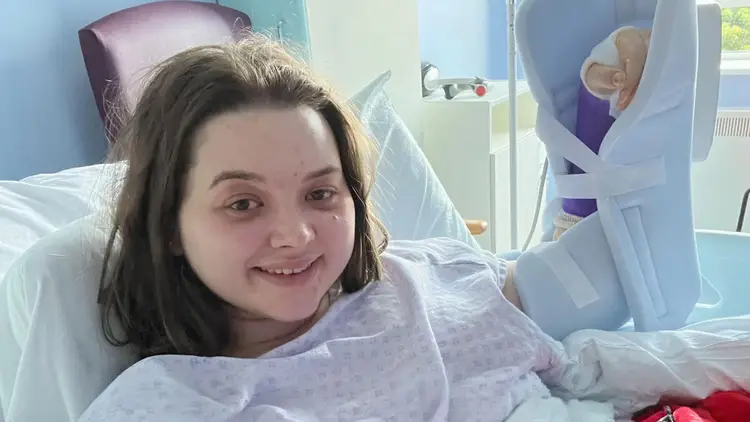
At 24, Amy Pohl was a primary school teacher with no idea that a routine hospital visit would leave her facing years of unimaginable pain, eventually making her feel as though one part of her body “didn't belong to” her. In 2017, she was admitted with a respiratory infection. But during her hospital stay, an attempt to insert an IV cannula allegedly went wrong, setting off a chain of complications that would change her life. What followed was far beyond what anyone would expect from a simple needle insertion. Bored Panda spoke to nurses, infectious disease and pain specialists, and representatives from CRPS UK to understand what could go wrong during cannula insertion and why the consequences can sometimes be life-changing. amyepohl In late 2017, Amy was 24 and working as a primary school teacher when she became unwell with adult croup, a respiratory infection. She was admitted to University Hospital Coventry and Warwickshire for treatment. During her stay, she also experienced a severe reaction to medication and was taken to intensive care. It was during this hospital admission that a failed cannula insertion became the beginning of another medical ordeal. According to Amy, a doctor struggled to find a suitable vein and reused the same needle on a second attempt. She later developed an infection around the insertion site in her left hand. RDNE Stock project/Pexels (not the actual photo) The swelling worsened, and an abscess formed, leaving her needing surgery to drain it. The infection proved difficult to treat. Amy underwent multiple operations and received antibiotics, but even after the infection was brought under control, the problems with her hand continued. In a 2023 interview with The Guardian, she reflected on how unlikely she believed such an outcome was: “The chance of someone getting an infection if a needle is reused in their own body is really slim. It happens to be that I was that one in a million.” However, the infection itself was not the end of Amy's ordeal. The pain that followed would become a much longer battle and a reminder that serious complications can follow an event that patients may otherwise consider routine. amyepohl IV cannulas are commonly used to deliver fluids and medication, but inserting one still requires careful technique and attention to infection prevention. Mercedes Denham, an RN, BSN, with 17 years of nursing experience and founder of Swan Hydration, explained that a “suitable insertion site should have a stable vein” and be away from areas that bend frequently. She told Bored Panda, “The skin should be intact, and clinicians must follow hand hygiene and skin-preparation procedures before inserting the device.” She also stressed that “patients' experiences during insertion should not be dismissed. Sharp, sh**ting pain, tingling or numbness can be warning signs that a needle may have irritated or injured a nerve.” “In such circumstances, the clinician should stop, remove the device and reassess rather than push through the discomfort.” Denham said a withdrawn cannula should not simply be reinserted. According to her, “once it has been removed, it can no longer be assumed to be sterile. Reusing it can introduce microorganisms from the skin into deeper tissue, creating an avoidable risk of infection.” amyepohl There is also a mechanical concern when the metal needle, or stylet, is pushed back into a plastic catheter that has already been partly advanced. The process can damage the catheter, potentially causing a fragment to break away. This is one reason clinicians should follow the device's instructions and use a new sterile device for another attempt. The same precautions matter after the cannula has been placed. Denham advised patients to seek urgent medical attention if they notice “increasing pain, spreading redness, swelling, warmth, fever, or a loss of feeling or movement around the site.” An IV insertion should not be treated as something patients have to endure regardless of what they feel. “Speaking up when something seems wrong” can give clinicians an opportunity to reassess the situation before a complication progresses. amyepohl After the infection and surgeries, Amy continued to experience severe pain in her left hand and arm. She was eventually diagnosed with Complex Regional Pain Syndrome, or CRPS, a chronic pain condition that can develop after an injury or medical procedure. The condition can cause pain that is far more intense than would normally be expected from the original injury. It may also bring swelling, changes in skin color and temperature, stiffness, and extreme sensitivity to touch. Amy described how her hand would swell and change color, and how even the sensation of air against it could become excruciating. In The Guardian, she said that for months, “opening a window or going outside could be impossible” because of the discomfort. The pain became so severe that she struggled to recognize her own hand as part of her body. “I felt that it didn't belong to me, and it wasn't mine,” she told the publication. amyepohl At the worst point, Amy was taking oral morphine as often as 12 times a day, yet she still struggled to find relief. She eventually reached a point where she begged doctors to amputate the affected limb. Chronic pain specialist Jason Winkelmann explained that CRPS can involve a process known as central sensitization. In simple terms, the nervous system becomes increasingly sensitive to pain signals, and stimuli that would not normally hurt can begin to feel intensely painful. Winkelmann described the experience as “the body's pain-dampening systems failing to regulate signals as they should.” He added, “The nervous system has several mechanisms that normally help filter or reduce pain messages. When these mechanisms are disrupted, sensations such as clothing brushing against the skin or a light breeze can become unbearable.” The pain is not imagined or simply a reaction to discomfort. It changes how the nervous system processes sensation. Stéf -b/Pexels (not the actual photo) One of the most difficult aspects of CRPS is that pain severity does not necessarily correspond to the size of the original injury. Georgios Matis, Director of Interventional Pain Management, Spasticity and Neuromodulation at Hygeia Hospital, explained that “CRPS can involve several overlapping processes,” including “inflammation around injured nerves, changes in the autonomic nervous system, and increased sensitivity in the spinal cord and brain.” After tissue trauma, sensory nerves can release inflammatory substances that contribute to swelling and irritation. If pain signals continue, the nervous system may become increasingly responsive to them. Over time, this can help sustain pain even after the original tissue injury has healed. Matis explained that this process “can become self-perpetuating - the initial injury may be relatively small, but the nervous system's response can continue amplifying the pain.” amyepohl That is why CRPS has been reported after different types of trauma, including fractures, surgery and, in rare cases, routine needle procedures. A medical procedure does not automatically lead to the condition, but a seemingly minor injury does not rule it out either. Winkelmann also cautioned against assuming that an initial injury's severity predicts how much pain someone will experience later. CRPS can follow relatively minor injuries, and the eventual pain response may be disproportionate to the original physical damage. There is no single explanation for every case. The condition is complex, and specialists continue to investigate how peripheral nerve injury, inflammation, and changes in the central nervous system interact. amyepohl For Amy, the condition affected more than how her hand felt. Over time, her wrist and hand became contracted, leaving them bent inward. Matis explained that “longstanding CRPS can involve movement problems such as muscle spasms, abnormal postures, and fixed contractures.” These changes can develop alongside persistent pain and reduced use of the affected limb. CRPS can also affect the skin and tissues. Some patients experience changes in skin color or temperature, swelling, altered sweating, and changes in hair or nail growth. The exact symptoms vary, and not everyone develops the same complications. Rebecca Boot, treasurer and co-founder of CRPS UK, said the condition “can be profoundly disruptive because it affects both the body and a person's ability to carry out everyday activities.” For some, “symptoms improve significantly” with rehabilitation; others continue to experience severe pain and physical changes for years. Amy's experience also extended beyond her arm. In 2018, she began developing weakness, balance problems, and numbness in her legs before becoming paralyzed from the waist down. However, her later mobility loss was linked to other health problems, including severe vitamin B12 malabsorption and thoracic spinal issues. It should not be confused with the complications following the cannula insertion. After years of hospital stays and rehabilitation, Amy gradually reduced her medication and moved into an adapted home in County Durham. She remains a wheelchair user and continues to manage CRPS symptoms, but has spoken about finding ways to live more independently. amyepohl If a procedure or injury can precede CRPS, why do most people recover without developing the condition? The answer is not yet fully understood. Boot said, “CRPS can follow an injury, surgery or medical procedure, but it can also occur without an obvious trigger.” Researchers are still investigating why some people develop it while others do not. Matis described susceptibility as multifactorial, with possible contributions from genetic, physiological, and psychological factors. Clinical factors such as prolonged immobilization and significant physical or psychological stress may also “play a role in some cases.” amyepohl Winkelmann discussed how a person's pain-processing systems can be influenced by a range of factors, including inflammation, hormones, nutrition and emotional stress. He also explained that “fear of movement and prolonged immobilization can complicate recovery,” although these factors should not be treated as proof of why any one person developed CRPS. Amy has also spoken publicly about living with Ehlers-Danlos syndrome. While research has explored a possible association between EDS and CRPS, that does not establish that EDS caused Amy's condition. For now, no simple checklist can reliably predict who will develop CRPS after an injury. The uncertainty makes awareness and early recognition especially important. amyepohl Matis also said CRPS is diagnosed clinically, using a set of criteria known as the Budapest criteria. Doctors look for persistent pain that is disproportionate to the initial injury, alongside symptoms and signs across categories including sensory changes, altered temperature or skin color, swelling or sweating changes, and movement or tissue changes. No single blood test or scan confirms CRPS. Clinicians must assess the person's symptoms and rule out other possible explanations. Early recognition matters because treatment may be more effective before pain-processing changes and physical complications become entrenched. Matis described a multimodal approach that can include “specialized physiotherapy, medication for nerve pain, selected pain-management procedures, and psychological support.” amyepohl He added, “Treatment is individualized. Some patients with persistent symptoms may be considered for neuromodulation, including spinal cord stimulation or dorsal root ganglion stimulation.” “These approaches use electrical stimulation to modify pain signaling and may help selected patients, but they are not suitable for everyone and do not reverse every physical change caused by CRPS.” Winkelmann also emphasized that treatment should look beyond simply suppressing pain. He described approaches that consider the nervous system, physical rehabilitation, lifestyle, and the emotional impact of living with persistent pain. He noted that there is no single treatment pathway and that different patients may need different combinations of care. Kindel Media/Pexels (not the actual photo) For patients undergoing an IV insertion, Denham advises paying attention to what the body is telling them. Report sharp or electric-shock-like pain, tingling, or numbness during insertion immediately. After insertion, worsening pain, redness, swelling, warmth, discharge, or fever can point to an infection that needs prompt medical assessment. Infectious disease physician Dr. Johnny Lieberman explained that catheter-related infections “can range from local skin infections and abscesses” to infections involving the vein or surrounding tissue. In some cases, “an infection can spread beyond the insertion site.” The appropriate treatment depends on its extent and may involve antibiotics or surgical drainage. Lieberman stressed the importance of recognizing changes around an indwelling catheter, including increasing pain, redness, swelling, drainage, or pain when an infusion is given. He added, “Patients should alert their healthcare team rather than wait for symptoms to settle on their own.” Boot also urged people to seek medical advice “when pain does not improve as expected or seems disproportionate to the original injury,” particularly if it is accompanied by unusual sensitivity, swelling, or changes in skin temperature or color. Amy's experience was an unusual and devastating outcome, not an inevitable consequence of having an IV inserted. Most cannula procedures do not lead to complications of this severity. But her story highlights why sterile technique, careful insertion, and listening to patients matter.