



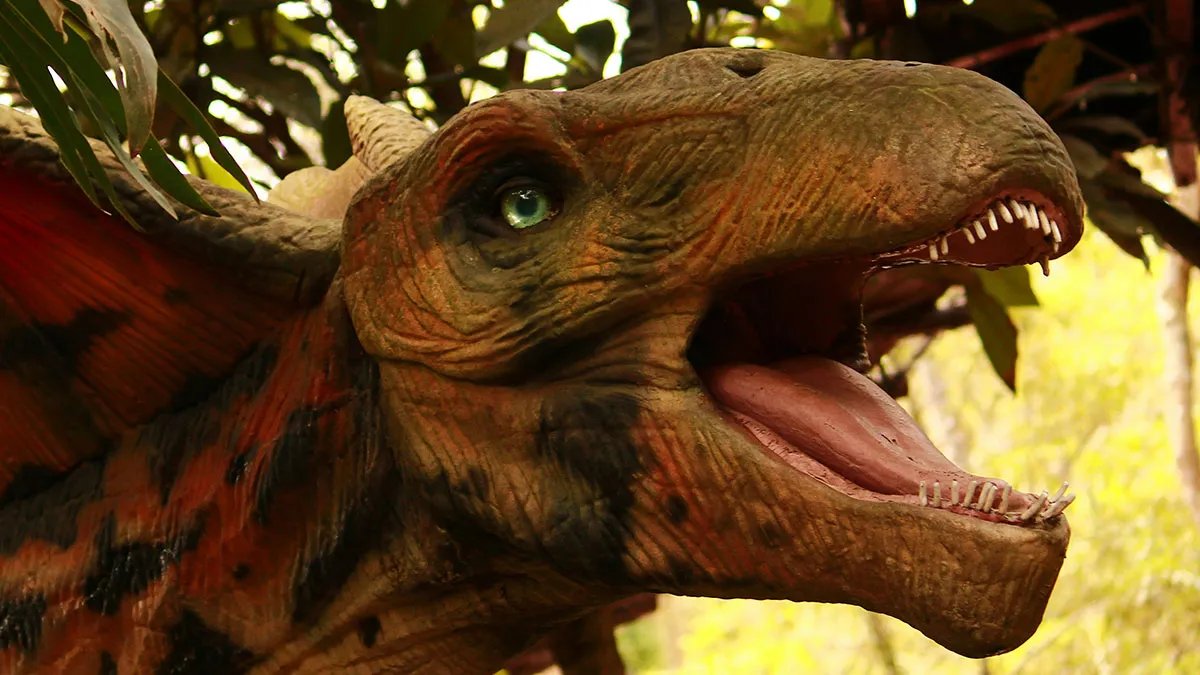




Imagine the sound of a dinosaur roaring... Super loud, right? Wrong... It turns out the giant prehistoric creatures almost certainly didn't roar. You might be surprised to hear that some scientists believe they cooed, whistled and gargled instead. Strange but true.
And the parts of Jurassic Park when the dinos have their mouths wide open, sending rumbles through the jungle? Also unlikely to have happened in real life. Those in the know say it's far more plausible that non-avian dinosaurs communicated with their mouths closed by inflating the soft tissues of their throats.
If you found that interesting, keep scrolling. They're among the fun facts we've put together for anyone looking to add something extra to their database of dinosaur knowledge. Upvote your favorites and tell us in the comments below how many of these you already knew.
#21 Velociraptors More Likely Had Feathers Than Scales

Scientific evidence suggests that Velociraptors were likely covered in feathers, not scales as commonly depicted. This characteristic is also believed to be true for Deinonychus, another dinosaur species. This understanding shifts the visual representation of these creatures from reptilian to more bird-like.
Report
13points
#22 It Is Estimated That 65 Million Years Ago Is When Dinosaurs Became Extinct

The leading theory for the dinosaurs' demise points to a massive asteroid impact, though large-scale volcanic eruptions and gradual climate shifts may have also played significant roles. This major extinction event, which occurred approximately 65 million years ago, is still a subject of ongoing scientific study. The combination of these factors likely led to the end of the dinosaurs' reign.
Report
13points
#23 Hadrosaurs Were Much More Dangerous Than We Think

Despite common portrayals of Hadrosaurs as gentle, approachable creatures, paleontologist Dr. Lacovara warns that these duck-billed dinosaurs were, in fact, dangerous. He emphasizes that the idea of them being friendly "gentle giants" is a misconception and that no dinosaur should be considered safe. According to Dr. Lacovara, an encounter with a Hadrosaur in reality would likely be perilous.
Report
11points
#24 Most Dinosaurs Could Fend For Themselves As Soon As They Hatched

Certain dinosaur species, such as titanosaurs, were precocial, meaning their young were self-sufficient almost immediately after hatching, much like an antelope calf today. This contrasts with other dinosaurs whose offspring were altricial, born helpless and entirely dependent on parental care, similar to a baby robin. This variation in early development highlights different survival strategies among dinosaur groups.
Report
11points
#25 Herbivores Made Up A Large Portion Of The Biggest Dinosaurs

Many of the most massive dinosaurs to ever exist, such as the Brachiosaurus and Apatosaurus, were actually plant-eaters. These enormous creatures sustained their huge bodies solely with a vegetarian diet.
Report
11points
#26 "Dinosaur" Comes From Greek

The name "dinosaur" itself comes from two Greek words: "deinos," meaning terrible, and "sauros," which translates to lizard. Thus, the term directly means "terrible lizard," a fitting description for formidable species like the T-Rex, even if not all dinosaurs were aggressive carnivores. This Greek origin provides the well-known classification for these ancient creatures.
Report
11points
#27 The Longest Dinosaur Name Is Micropachycephalosaurus

With a genus name consisting of 23 letters, Micropachycephalosaurus holds the distinction of having the longest dinosaur name. When its full scientific binomial is considered, the letter count impressively reaches 37. This lengthy name makes Micropachycephalosaurus notable in paleontological records.
Report
11points
#28 Dreadnoughtus Could Crush Predators Under Their Colossal Weight

Weighing an estimated 65 tons, the massive Dreadnoughtus was so colossal that it could overpower even formidable predators like a T-Rex simply by using its immense weight. This makes it about nine times heavier than a T-Rex and roughly ten times heavier than a Boeing 737. Its sheer size meant it could crush its adversaries, for instance, by pressing a T-Rex against a tree.
Report
10points
#29 The Argentinosaurus Was The Biggest Dinosaur To Live On Land

Reaching lengths of up to 40 meters and standing as tall as 21 meters, the Argentinosaurus holds the distinction of being the largest known dinosaur to have lived on land. To put its immense scale into perspective, an average blue whale measures only about 4 to 5 meters long. This truly massive herbivore was a colossal presence in its environment.
Report
10points
#30 Ankylosaurs Probably Fought Each Other With Their Club Tails

The prominent tail clubs of Ankylosaurs likely played a significant role in conflicts between individuals of the same species. While these bony appendages could also have served as a defense against predators, recent research indicates that competition among Ankylosaurs themselves may have been the primary driver for the evolution of this iconic feature. Thus
10points
#31 Dinosaurs Were Wiped Out By An Asteroid

The prevailing scientific theory attributes the extinction of the dinosaurs to the impact of a massive asteroid. Evidence of this cataclysmic event includes a colossal crater, approximately 110 miles (or 180 kilometers) wide, situated off the coast of Mexico. This impact event is understood to have caused widespread devastation, ultimately leading to the end of the dinosaurs' reign.
Report
9points
#32 We Don't Really Know What Colors Dinosaurs Were

The exact colors of dinosaurs remain largely unknown to scientists. To make educated guesses, researchers often look at the coloration of very large animals alive today, such as whales, hippos, and rhinoceroses. Since these modern giants tend to be gray or have otherwise subdued, drab colors, it's probable that many of the enormous dinosaurs shared a similar, less vibrant appearance.
Report
8points
#33 One Of The Large Predatory Dinosaurs Was The Dilophosaurus

Dilophosaurus was a notable apex predator of its time, a large carnivorous dinosaur reaching about 2 meters in height and 7 meters in length. Contrary to popular depictions, scientific understanding indicates it was not venomous and did not possess a neck frill. Furthermore, a 2020 re-examination of its skull revealed that Dilophosaurus had a surprisingly powerful bite.
Report
7points
#34 Dinosaurs Ate All Kinds Of Things

The dietary habits of dinosaurs were quite varied, with some species consuming only plants as herbivores, while others were meat-eaters, known as carnivores. Additionally, certain types of dinosaurs were omnivores, meaning their diet included both vegetation and animals. This diversity in food sources was a key feature of prehistoric ecosystems.
Report
7points
#35 Dinosaurs Roamed All Of Earth, Even Belgium

Dinosaurs inhabited every part of the globe, with their remains found even in places like modern-day Belgium, because their reign began when Earth's landmasses were joined as the supercontinent Pangea around 230 million years ago. Throughout the 165 million years that dinosaurs existed, this massive landform gradually broke apart. The ongoing process of plate tectonics drove this continental drift, eventually scattering dinosaur habitats across the forming continents we recognize today.
Report
5points