






If you really want to understand something, merely reading a sentence about it won’t cut it. We need the “who,” the “what,” the “when,” the “where,” and the “why.”
So we invite everyone who enjoys interesting facts about the world to take a look at some of our favorite posts on the Instagram account “Detailed Explanation.”
It strives to break things down in a clear, accessible way and is perfect for when you have a minute or two and would hate to simply waste them.
More info: Instagram


#63
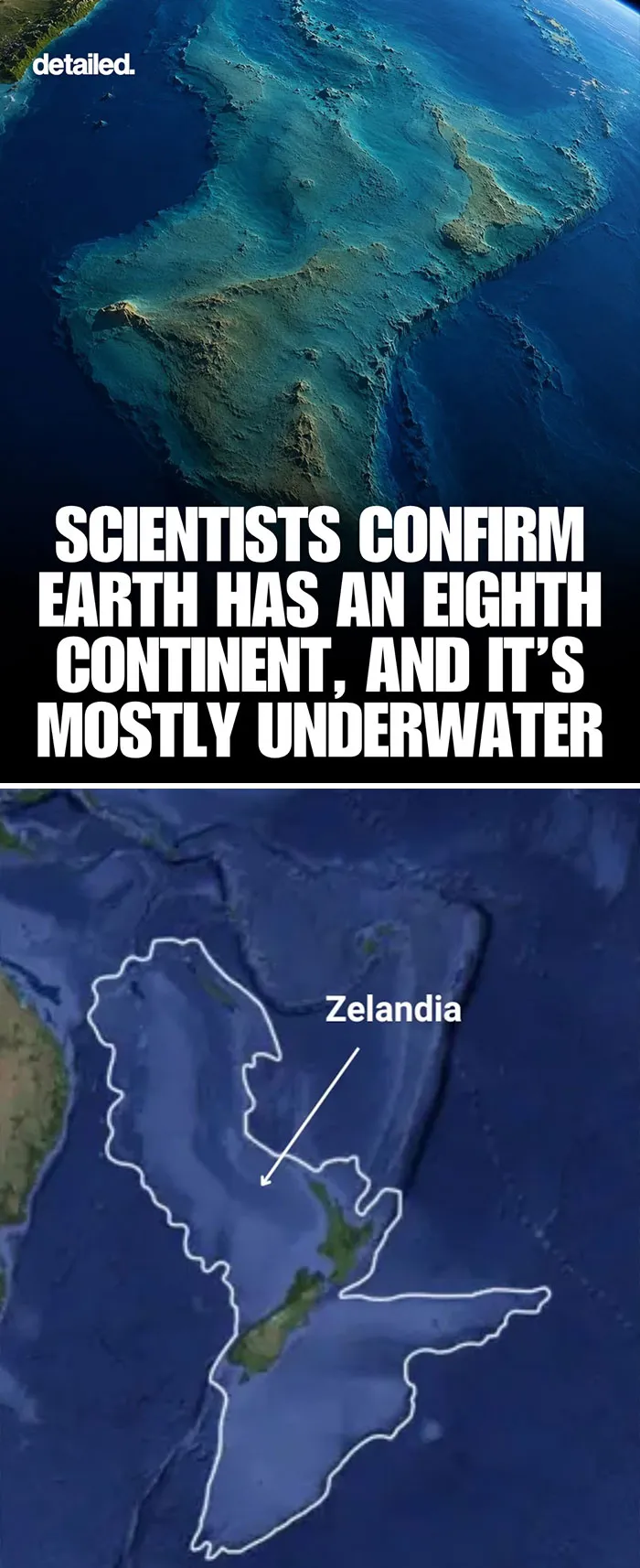
Scientists have officially confirmed the existence and full extent of Zealandia, widely regarded as Earth’s eighth continent — a vast, mostly submerged landmass beneath the South Pacific Ocean.
Covering nearly 5 million square kilometers (about 2 million square miles), Zealandia is roughly the size of India. Only around 5% of it rises above sea level, primarily forming the islands of New Zealand and New Caledonia. For decades, geologists debated whether this region qualified as a true continent or merely scattered fragments. Recent research has settled the question by demonstrating that Zealandia possesses all the defining geological characteristics of a continent.
Zealandia began separating from the ancient supercontinent Gondwana approximately 85 million years ago. Tectonic stretching thinned its crust, causing much of the landmass to gradually subside beneath the ocean while remaining structurally intact. Researchers mapped its boundaries using rock samples dredged from the seafloor — including sandstone, volcanic rocks, and basalt dated between 145 and 34 million years old — combined with magnetic anomaly data from the crust. These “magnetic fingerprints” revealed a coherent geological structure across the entire region, confirming it is not ordinary oceanic crust but a unified continental block shaped by ancient volcanism and plate tectonics.
Because most of Zealandia has remained submerged for tens of millions of years, it offers a unique window into processes of continental rifting, thinning, and breakup that are difficult to study on dry land.
Report
14points


#70

The Star Wars galaxy is a lot closer than you think .
Tatooine was Tunisia. Hoth was a real glacier in Norway. Yavin 4 was a 2,500-year-old Mayan temple complex in Guatemala.
Naboo’s royal palace was the Caserta Palace in Italy, while Anakin and Padmé’s lake retreat was Villa del Balbianello on Lake Como, originally an 18th-century monastery.
Every one of these locations is still standing. Every one of them is still visitable.
Report
13points
#71

NASA has uncovered some truly unsettling facts about our universe, dark energy driving a runaway expansion, rogue planets drifting alone in the void, black holes lurking in the center of almost every galaxy, the eerie silence of a cosmos filled with trillions of worlds, stars that die and somehow reignite, gamma-ray bursts that could erase a planet in seconds, and massive asteroids that slip past Earth before we even see them.
Report
13points


#80

We’re officially at the cosmic halftime show.
Earth is 4.5 billion years old, meaning we’ve hit the midpoint of its habitable life. In about 1 billion years, the Sun’s luminosity will increase by 10%, triggering a runaway greenhouse effect that evaporates our oceans.
Earth is 4.5 billion years old, meaning we’ve hit the midpoint of its habitable life. In about 1 billion years, the Sun’s luminosity will increase by 10%, triggering a runaway greenhouse effect that evaporates our oceans.
Fast forward 5 billion years, and the Sun expands into a Red Giant, likely consuming Earth entirely.
Report
12points
