






#1
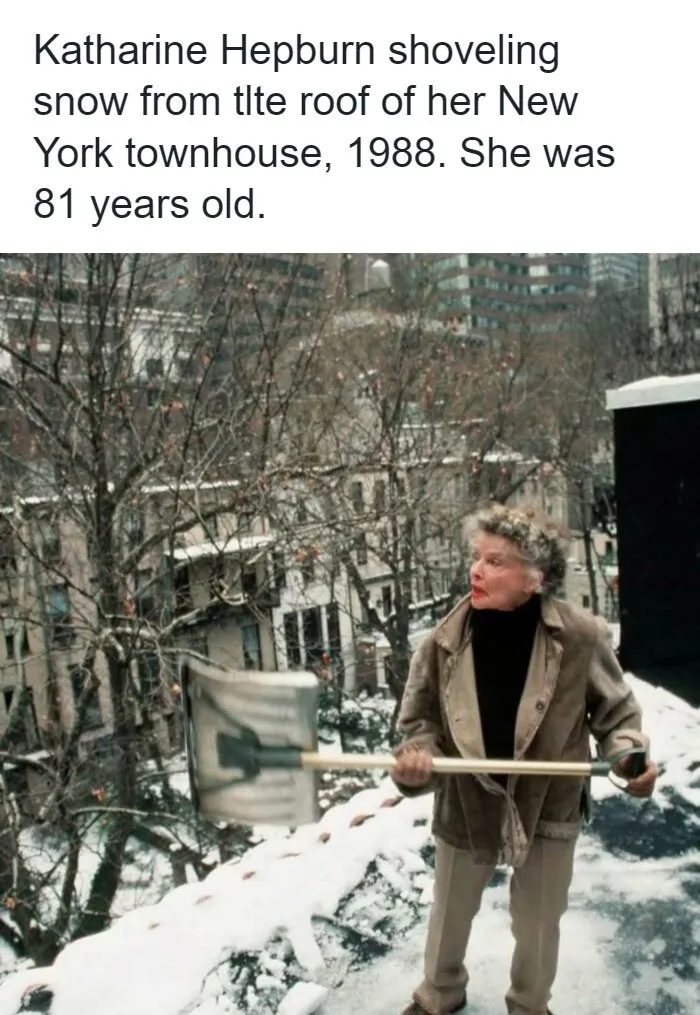
She purchased her Manhattan townhouse in the Turtle Bay neighborhood in 1931 and made it her New York home for decades. Hepburn was famously independent and intensely private, preferring a relatively ordinary neighborhood life despite being one of Hollywood’s biggest stars.
Her career was anything but ordinary. Hepburn won four Academy Awards for Best Actress, a record that still stands, for Morning Glory, Guess Who’s Coming to Dinner, The Lion in Winter and On Golden Pond. She received 12 acting nominations over a career spanning more than 60 years.
She also rejected many of Hollywood’s expectations for women, wearing trousers when they were still considered unconventional and cultivating an image based more on intelligence and independence than glamour.
Added Fact: Hepburn remained in her Turtle Bay townhouse until the final years of her life. After her death in 2003 at age 96, the intersection of East 49th Street and Second Avenue was named Katharine Hepburn Place in her honor.
#2
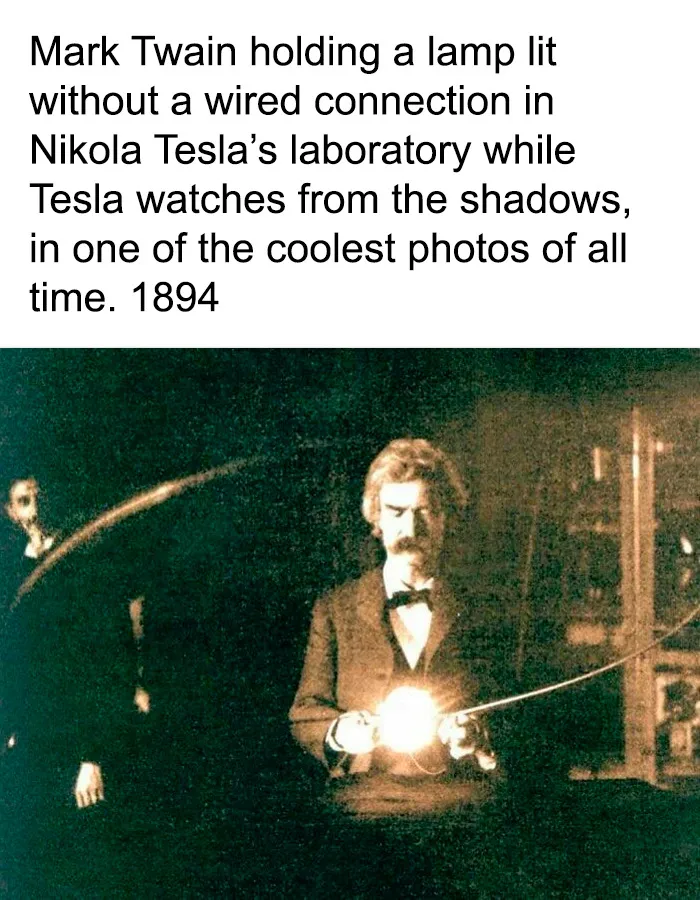
Twain (whose real name was Samuel Clemens) stands in Nikola Tesla’s New York laboratory holding an experimental vacuum lamp, while Tesla’s face appears from the darkness behind him.
Although the lamp had no conventional connection to a wall socket, it was not operating entirely without wires. It was attached to a loop of wire that received electromagnetic energy from Tesla’s h**h-frequency equipment elsewhere in the laboratory.
The electrical field induced a current in the loop, causing the lamp to glow without a direct connection to its power source.
To people living in the 1890s, demonstrations like this could appear almost supernatural.
Tesla regularly used dramatic displays to show how alternating current and electromagnetic fields could transmit energy. Twain, who was fascinated by science and new technology, became a frequent visitor to Tesla’s laboratory.
The two men developed a friendship based on mutual admiration: Tesla had reportedly enjoyed Twain’s writing since his youth, while Twain eagerly participated in the inventor’s experiments.
The photograph was later published in an April 1895 Century Magazine article examining Tesla’s oscillators, lighting systems and electrical inventions.
Added fact: Tesla reportedly attempted to photograph Twain using an early gas-discharge tube during his experiments with radiation, but the resulting image captured only a metal s***w inside the camera.
#3
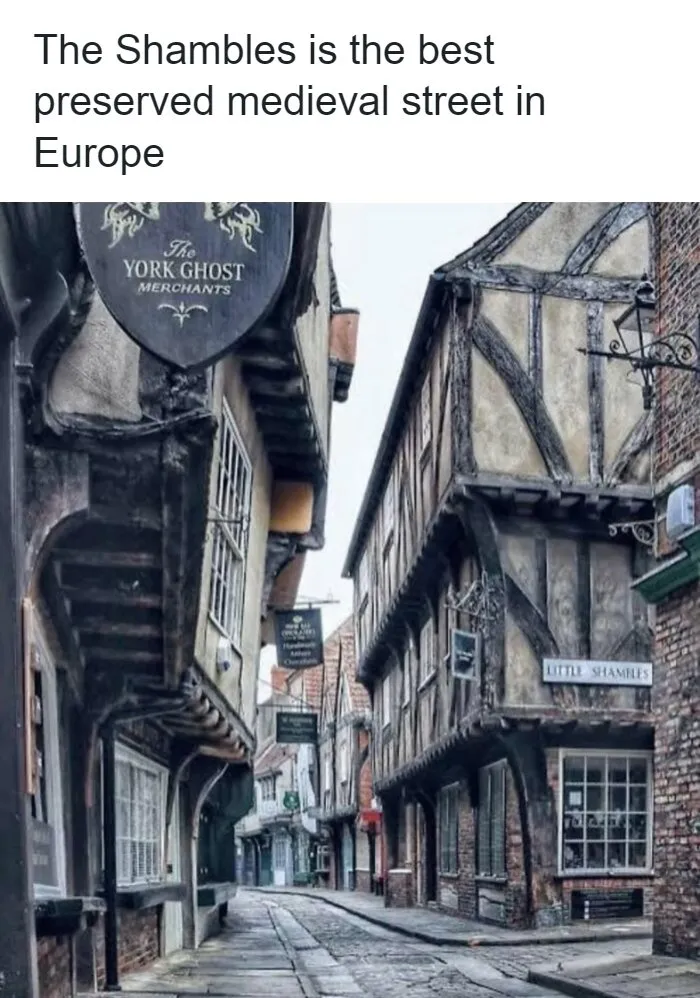
The street’s narrow design and dramatically overhanging upper floors were practical. Expanding a building outward created additional living space without occupying more valuable ground. In some places, the upper stories extend so far that neighbors could nearly reach across the street and touch one another’s houses.
For centuries, the Shambles was dominated by butchers.
Many shops had slaughterhouses behind them, while cuts of meat were displayed on shelves and hooks outside. The word “Shambles” comes from an old term for a market bench or stall, which eventually became associated specifically with meat markets.
Waste from the butchers flowed into channels along the street before being washed away. The closely packed buildings also helped block direct sunlight, keeping displayed meat cooler before refrigeration existed.
By 1885, the Shambles still contained 31 butcher shops. None remain today, and the historic buildings now house cafés, boutiques, bakeries and souvenir stores.
Added Fact: Several storefronts still preserve their original outdoor meat hooks and shelves, providing visible reminders of the street’s centuries as York’s main butchering district.
History Feels has a considerable following across different mediums, with over 100,000 subscribers on YouTube and over 920,000 followers on TikTok. While history can be compelling, what makes History Feels stand out is the stories they focus on.
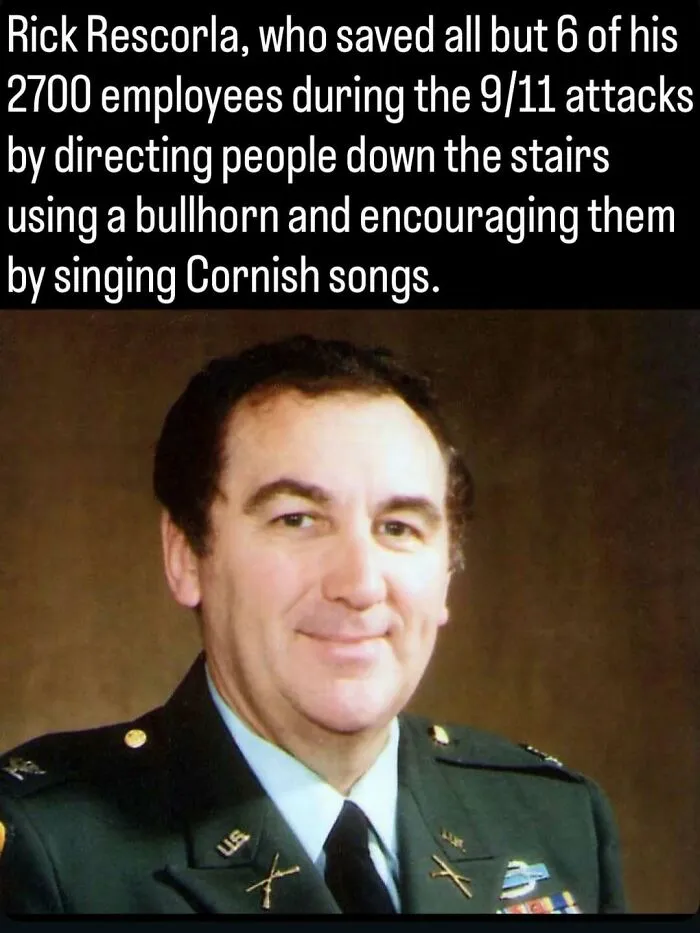
One of their most captivating posts was about Rick Rescorla, the Morgan Stanley security director who evacuated employees from the South Tower during the tragic events of September 11, 2001. Rescorla, who lost his life in the attacks, is widely regarded as one of the heroes of that day.
#5

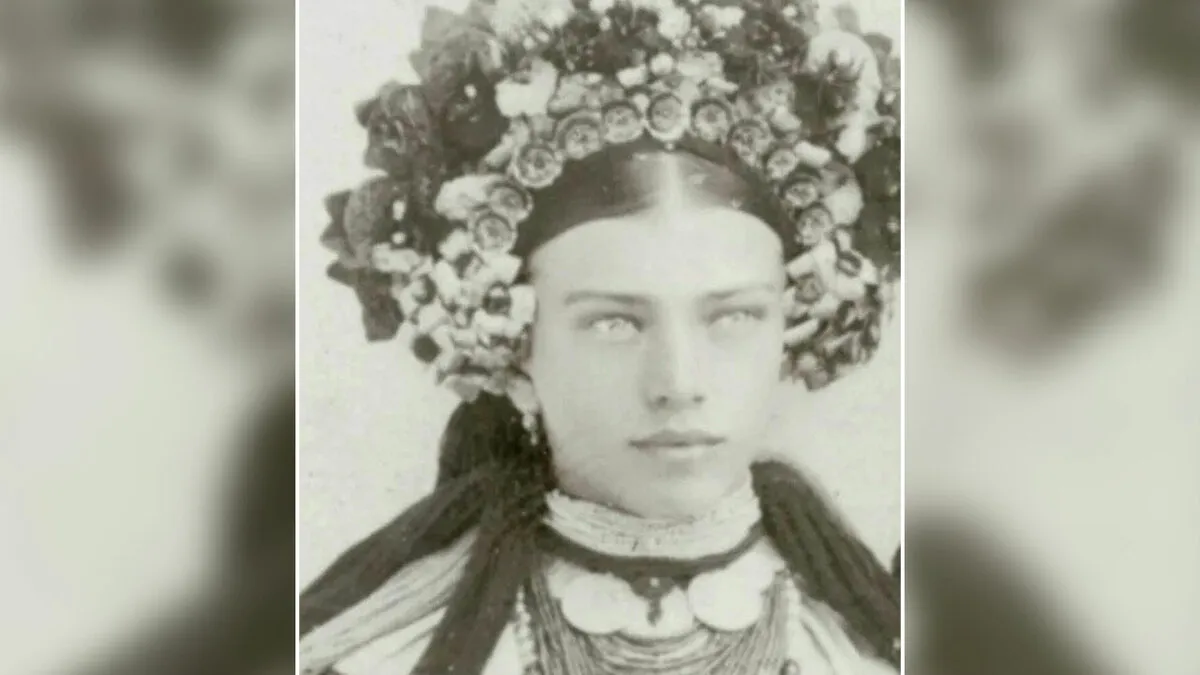
The woman’s elaborate clothing reflects the extraordinary textile traditions of western Ukraine. Traditional dress in this part of the country could communicate where a person came from. Embroidery, jewelry, fabrics and styles of headdress often differed from one community to another.
The area around Kosiv became particularly famous for its craftsmanship, including embroidery, woven textiles, ceramics, carved wood, leatherwork and metal jewelry. Many of these traditions were passed down through generations.
The layers of jewelry around her neck were also more than decoration. In communities across the Carpathian region, jewelry could reflect wealth, family background and local tradition, and valuable pieces were often passed from one generation to the next.
What we apparently do not know is her name. Surviving descriptions of the photograph identify her simply as a woman from Yabluniv. More than a century later, her face has survived in remarkable detail even though her story will have to be lost to time.
Added fact: The photograph is credited to J. Dutkevych, whose name is also transliterated as Yu. Dutkevych in some surviving references.
#6

This particular experiment contained 41 different types of polymers. Because many were stacked several layers deep, there were 205 individual pieces of material in total.
They remained outside the ISS for nearly four years.
During that time, the samples endured radiation, thousands of hours of sunlight and roughly 22,800 cycles of heating and cooling.
But one of the biggest threats was something that sounds surprisingly harmless: oxygen.
In low-Earth orbit, ultraviolet light breaks oxygen molecules apart, creating highly reactive individual oxygen atoms.
As the ISS travels around Earth at roughly 17,000 mph, exposed surfaces repeatedly slam into these atoms. Over years, the effect can literally erode certain materials away.
The difference in the before-and-after photographs shows just how severe that damage could become. Six of the 41 polymers were partially or completely eroded through.
Added fact: One material performed particularly badly. NASA reported that all four layers of its polybenzimidazole, or PBI, sample were completely eroded away during the experiment.
Another post that stood out from the History Feels archive was a photograph of a receipt showing what appeared to be the last sale ever made at the World Trade Center during the attacks.
It was a purchase of two magnets made at the Lechters Housewares on the shopping concourse beneath the North Tower. The transaction happened nine minutes after the first plane hit.
#7

Richard Loving, a white man, and Mildred Jeter, a woman of Black and Native American ancestry, married in Washington, D.C., in June 1958 because interracial marriage was illegal in their home state of Virginia. After returning home to Caroline County, police entered their house during the night and arrested them for violating Virginia’s Racial Integrity Act.
The Lovings pleaded guilty in 1959. Rather than sending them to prison, the judge suspended their one-year sentences on the condition that they leave Virginia and not return together for 25 years. They moved to Washington, D.C., but desperately missed their families and rural Virginia home.
Eventually, Mildred wrote seeking help, and attorneys took up their case. It reached the U.S. Supreme Court as Loving v. Virginia.
On June 12, 1967, the Court ruled unanimously that laws banning interracial marriage violated the Fourteenth Amendment. The decision invalidated remaining state bans on interracial marriage and allowed Richard and Mildred to return home legally as husband and wife.
Added fact: Richard reportedly never attended the Supreme Court arguments. His message to his attorney was simple: tell the justices that he loved his wife and that it was unfair they could not live together in Virginia.
#8
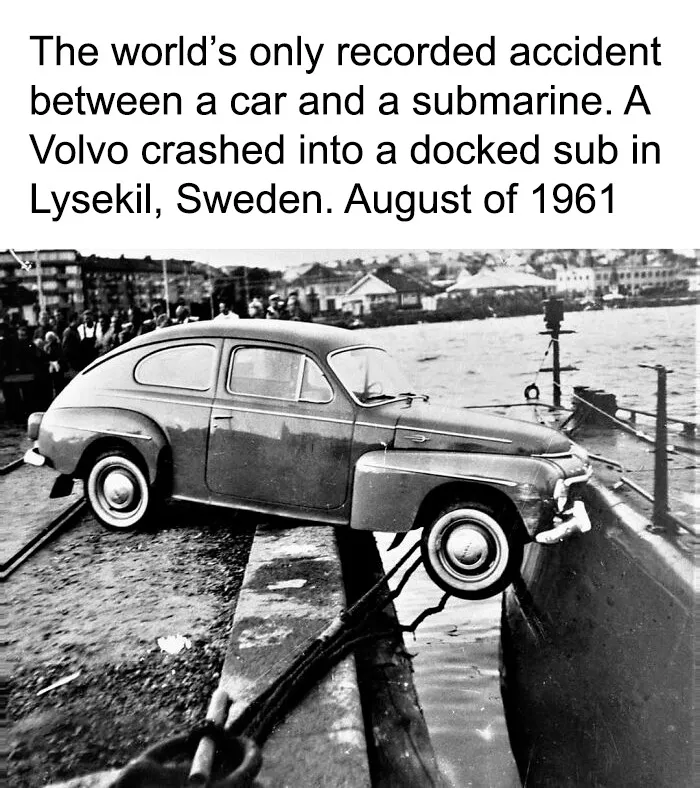
The handbrake hadn’t been properly secured.
With the road sloping toward the water, the empty Volvo PV544 began to roll. There was nobody behind the wheel to stop it. It crossed the harbor road, picked up momentum, and headed directly toward the edge of the pier.
Normally, the story would have ended with a car sinking into the harbor.
But there happened to be a Swedish Navy submarine tied up exactly where the Volvo was headed.
The submarine was HMS Bävern.
The runaway car slammed into its bow and became wedged between the pier and the submarine, leaving its front wheels hanging over the water. By the time people gathered around, the scene looked almost staged: a family car seemingly involved in a collision with a military submarine.
Nobody was injured. The Volvo took most of the damage, while Bävern reportedly suffered only minor damage to its railing. The submarine went right back to doing what submarines do, remaining in Swedish naval service until 1980.
Photographer Hans Johansson captured the aftermath, preserving what has become one of Sweden’s most unusual traffic photographs.
Added fact: The coincidence gets even better. Both the Volvo and HMS Bävern dated to 1958, meaning a three-year-old car had somehow managed to crash into a three-year-old submarine.
#9
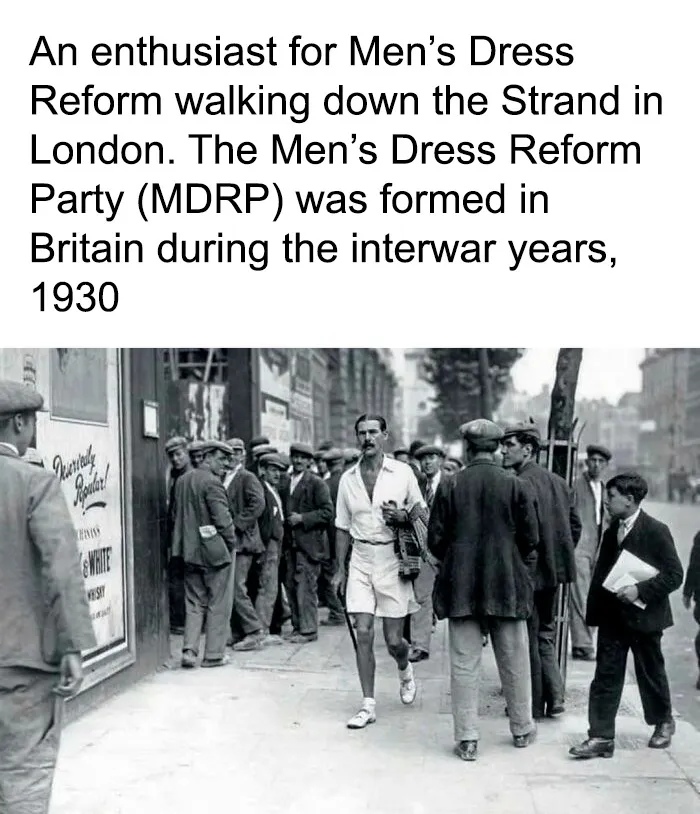
The movement attracted doctors, artists, architects, and progressive thinkers who viewed clothing reform as part of a broader effort to improve public health and modernize society. While newspapers often treated the campaign with amusement, the MDRP published pamphlets, organized public demonstrations, and staged highly visible walks through London to challenge public perceptions of masculinity and fashion.
Although the organization remained small and never transformed British menswear, many of its ideas anticipated later changes. Open-collar shirts, shorts, sportswear, and lightweight summer clothing became increasingly accepted after the Second World War.
Added Fact: Similar dress reform movements emerged across Europe during the early 20th century. Many promoted sunlight, fresh air, and freedom of movement, believing that restrictive clothing contributed to poor health, reduced physical fitness, and unnecessary social conformity.
Some posts on the History Feels social media sites also draw enough attention to get people talking. Take this one example featuring the 1977 mugshot of tycoon Bill Gates.
As the story goes, Gates was pulled over for a traffic violation in New Mexico. The image then went on to be one of the most infamous in tech history, so much so that Microsoft used it as the default profile pic for Outlook 2010.
#10
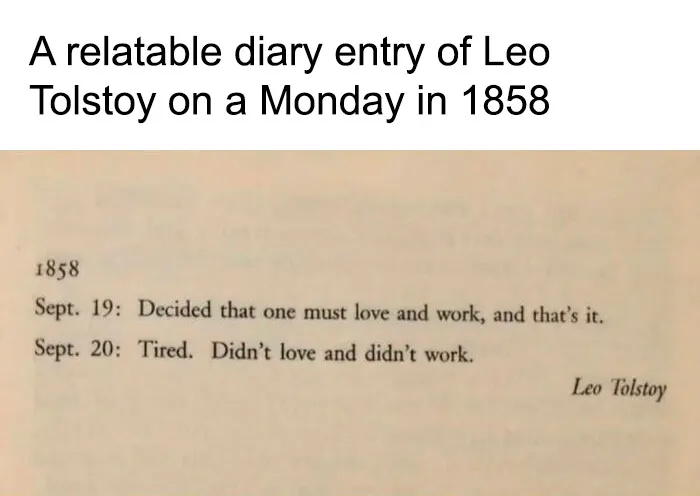
By then, he had already served in the Caucasus and during the Crimean War, published several early works, and developed the habit of keeping detailed diaries about his behavior, goals and failures. He frequently recorded rules for himself involving work, discipline, gambling, s*x, drinking and morality.
That makes these two entries especially characteristic of Tolstoy. On September 19, he reduced life to a simple rule: “one must love and work.” The next day, he admitted he had done neither.
His journals repeatedly show this cycle of strict self-improvement followed by frustration when he failed to meet his own standards.
Decades before his later religious writings, Tolstoy was already obsessed with the question of how a person should live.
Just like many of us.
#12
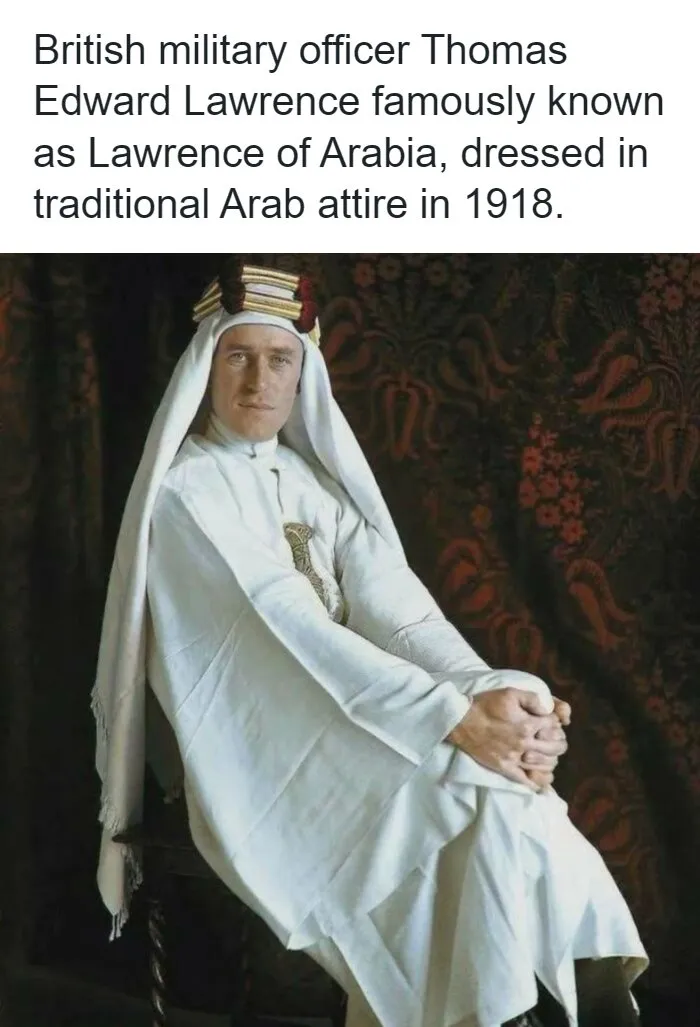
The white robes and headdress seen here were not a costume for publicity. They were presented to Lawrence by Emir Faisal, later King Faisal I of Iraq, as a mark of respect and alliance. The clothing was practical for desert travel and also symbolized Lawrence’s acceptance among many of the Arab fighters with whom he lived and campaigned.
After the war, Lawrence became an international celebrity through newspaper coverage and the writings of American journalist Lowell Thomas. Despite the fame, he disliked public attention and later enlisted in the Royal Air Force under an assumed name.
Added Fact: Lawrence’s autobiography, Seven Pillars of Wisdom, is considered one of the greatest memoirs of the twentieth century and remains a classic account of the Arab Revolt.
History Feels and other similar platforms with huge followings prove that humans are inherently fascinated, even preoccupied, with the past. According to research by Dartmouth College cognitive neuroscientist Jeremy Manning, people are more fixated on past events than the future.
Manning shared his findings in an article for Scientific American, noting one distinct reason why people fixate on the past: we stick to what we know.
#15
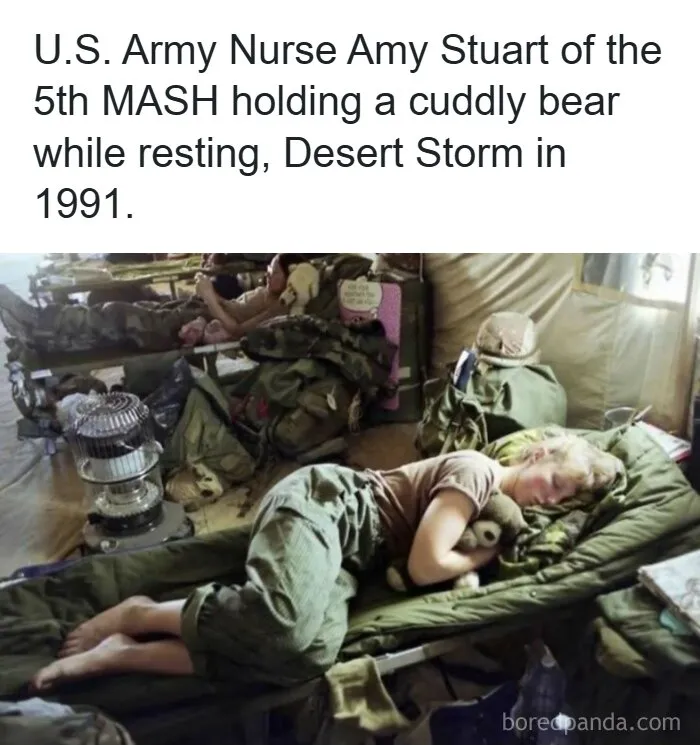
Around her are the everyday realities of deployment: military packs, helmets, blankets, a portable heater and rows of tightly arranged cots. The bear offered a small reminder of home in a place where Stuart and her fellow medical personnel lived under the constant expectation that wounded soldiers could arrive at any moment.
The 5th MASH had deployed from Fort Bragg, North Carolina, and became the first fully operational U.S. Army hospital established in Saudi Arabia during the crisis.
Designed to move with advancing forces, the hospital provided emergency surgery and stabilized critically wounded patients before they could be transported to larger medical facilities.
The photograph was taken on February 22, 1991, near the end of the Gulf War’s weeks-long aerial campaign. Just two days later, coalition forces launched the massive ground offensive to drive Iraqi troops from Kuwait.
Added Fact: During the offensive, the 5th MASH moved forward with the U.S. Army’s 24th Infantry Division, setting up surgical facilities close to the advancing front lines.
Manning pointed out that while being more inclined towards past events may lead to negative biases, rewinding from the present also has a practical purpose.
“When something people are experiencing in the present shares some aspect of their past, it can cause them to spontaneously relive those earlier moments,” Manning wrote. “These reminders of times past influence behaviors, helping people to navigate complex situations or environments using cues that were useful in the past.”
#18
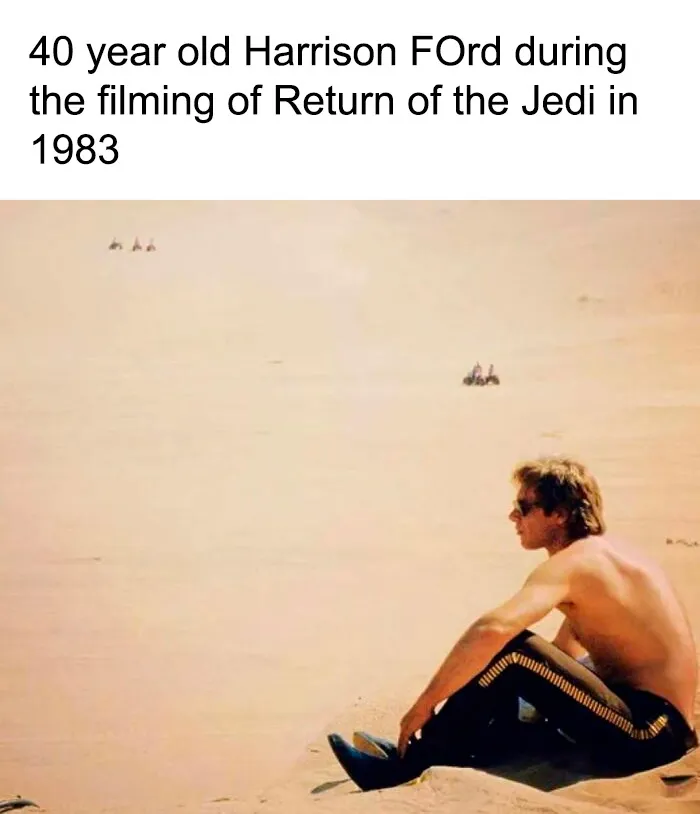
He had turned 40 in July 1982, when much of the movie was actually being filmed, before its theatrical release in May 1983.
The desert sequences involving Jabba the Hutt’s sail barge and the Sarlacc were filmed among the Imperial Sand Dunes near Yuma, along the Arizona California border.
The enormous dunes doubled for the desert planet Tatooine, where Han Solo, Luke Skywalker and Chewbacca are sentenced to be thrown into the Sarlacc pit.
Filming there was a major undertaking. A huge full scale exterior representing Jabba’s sail barge was constructed in the dunes, while hundreds of cast and crew members worked in intense desert conditions.
Ford had already become one of Hollywood’s biggest stars by this point, playing both Han Solo and Indiana Jones within the span of just a few years.
Added fact: To keep the production secret, Return of the Jedi was filmed under the deliberately misleading working title “Blue Harvest,” complete with fake signage describing it as a horror movie.
We tend to remember history as individual moments, whether it’s a political upheaval, technological breakthrough, or a disaster that left a mark on society. A photograph freezes those moments and makes them tangible.
That’s why these photos from History Feels draw so much curiosity. They help us discover a much bigger story that isn’t visible on the surface.
#19
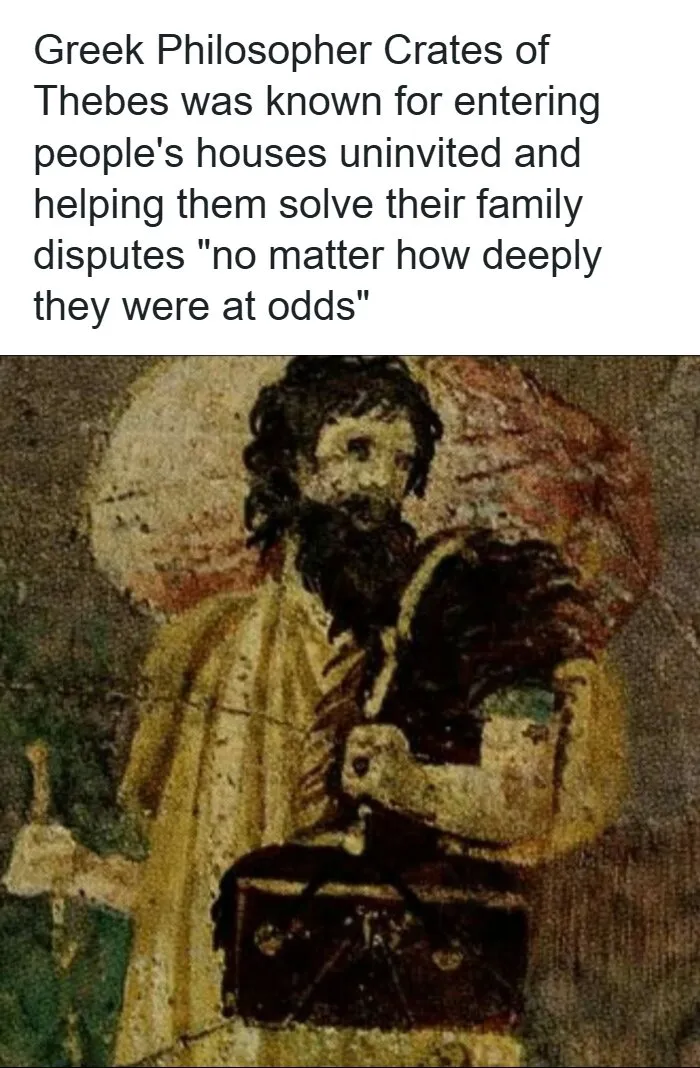
Born into a wealthy family around 365 BC, Crates eventually gave away his fortune and embraced the radical simplicity of Cynic philosophy.
He became a follower of Diogenes of Sinope, living with few possessions and openly rejecting wealth, status and many of the social conventions of Greek society.
But Crates developed a reputation that went beyond philosophy. Ancient accounts say he became known as the “Door-Opener” because he had a habit of walking directly into people’s homes, often without being invited, and offering advice. Somehow, instead of resenting the intrusion, Athenians reportedly welcomed him. Later traditions describe him helping settle arguments and family disputes before simply moving on to the next house.
His cheerful personality was a major reason. Unlike the famously abrasive Diogenes, Crates seems to have practiced Cynicism with humor and warmth, using his own poverty as an example rather than merely attacking others.
Added fact: Crates became the teacher of Zeno of Citium, who went on to found Stoicism. That makes this eccentric philosopher who wandered into strangers’ homes one of the important links between Cynicism and one of the most influential philosophical schools in Western history.
#20
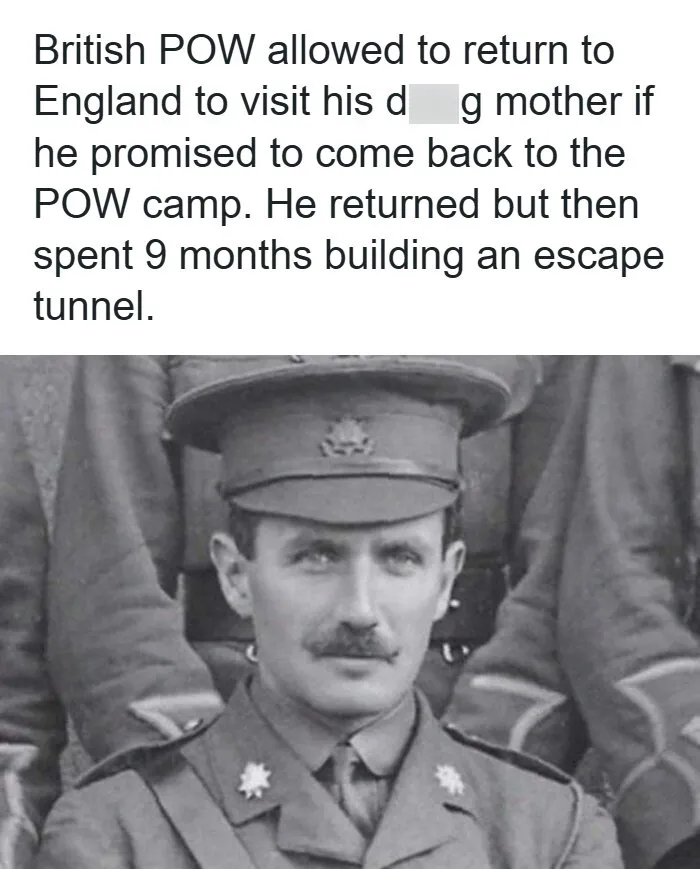
After two years in captivity, Campbell learned that his mother, Louise, was dying of cancer at her home in England. Desperate to see her one final time, he wrote directly to Kaiser Wilhelm II requesting compassionate leave.
Remarkably, the Kaiser granted him two weeks away from captivity on one condition: Campbell had to give his word as a British officer that he would return. Campbell traveled through the neutral Netherlands and reached England in November 1916. He spent approximately one week with his mother before voluntarily returning to Germany, despite having safely reached his own country. His mother died several months later.
The most fascinating part is what happened next. Although Campbell believed honor required him to keep his promise and return, that promise did not prevent him from trying to escape afterward.
He and several other prisoners reportedly spent nine months digging a tunnel out of the camp. They escaped and traveled toward the neutral Netherlands but were recaptured near the Dutch border.
Campbell remained a prisoner until the war ended in 1918.
Added fact: Campbell later returned to military service during World War II, serving as a chief observer in the Royal Observer Corps on the Isle of Wight.