

For generations, parents have pushed their sons into sports. Many believe it builds teamwork, fosters healthy competition, and opens doors to college scholarships. Others simply view athletics as the only acceptable hallmark of masculinity.
A woman found this environment brewing in her house when her husband started threatening their 14-year-old son into joining a sports team. He was disappointed that his son was more interested in art and writing.
Stuck in the middle, the woman turned to the internet for some advice. Read the full story to learn how far her husband went with his threats and how she ultimately handled the situation.
A woman said her husband is threatening to disown their 14-year-old son

The reason for his threats is that their son refuses to join a sports team and is more interested in art













Why boys are pushed into sports more than girls?
It’s natural for parents to push their kids toward sports and extracurriculars. Stats from the National Survey of Children’s Health show that more than half of American kids ages 6 to 17 play organized sports. And honestly, the perks sound great on paper. Research shows that active kids tend to stay healthier — both mentally and physically — and score better grades.
However, all that encouragement can easily turn into pressure. Research from George Washington University shows that nearly 70% of kids drop out of youth sports by middle school simply because the joy is gone.
Instead of building confidence, sports can end up causing massive anxiety. A 2023 study of high school athletes found that a 91% felt stressed about their sport, with 58% calling that pressure moderate to extreme.
Researchers also found that young athletes tie their self-worth to their performance on the field rather than who they are as a person.
Michael Kehler, PhD, Werklund Research Professor, Masculinities Studies at the University of Calgary, notes that sports has become another “bastion of the male elite” where boys and men “establish themselves within the hierarchy of masculinity.”
“There’s a long narrative around boys dominating the field and boys being trained to be men. And sport and athleticism were yet another arena in which boys and men could publicly demonstrate strength, domination, and power over other men,” he says.
Outdated ideas about gender only heighten the parental pressure.
A team of researchers at the University of Michigan surveyed over 3,000 young people and their parents, discovering that roughly a third of parents still believe boys are naturally better at sports than girls. Parents whose kids do not play sports are even more likely to think girls lack competitiveness and that athletics simply matter more for boys.
“Sport is the most popular extracurricular activity in the United States for both boys and girls. Yet, we see this gender gap in participation persist, and parents may be driving some of this,” says Philip Veliz of the University of Michigan School of Nursing.
Traditionally, sports became a test of physical strength, while art was seen as purely emotional. Pop culture built on this divide, sorting kids into opposing boxes: the tough “jock” versus the quiet “nerd.”
But calling creative fields “unmasculine” makes zero sense. Men have always dominated the arts. Legendary writers, directors, and animators — from Ernest Hemingway to Walt Disney — built huge careers on pure imagination.
Framing art as purely passive also ignores the immense physical drive and mental endurance it demands.
Parents who try to live vicariously through their kids
If parents project their own unfulfilled dreams onto their kids, the emotional toll adds up fast. The moment a child realizes they’re only out on that field to keep a parent happy, the whole point of playing changes. Mistakes can start feeling like direct personal failures. The constant strain can also chip away at a kid’s self-worth.
A study from University College London found that adults who grew up with psychologically controlling parents had noticeably poorer mental health down the line. Researchers even likened the psychological weight of that control to the grief of losing someone close to you.
Warm, responsive parenting builds healthy self-worth. But controlling parents stifle their kids’ independence and keep them from learning how to navigate real-life mistakes. This emotional toll often persists throughout their entire lives.
Instead of dragging kids toward personal goals they never asked for, experts say parents need to focus on their own growth.
Michael W. Austin, Ph.D., a professor of philosophy at Eastern Kentucky University, offers straightforward advice for overinvested parents: “If you love sports, play them… parents should try to carve out time, if possible, to do just that. Read a book, learn a new skill, take a class, do something that enables you to continue to grow and develop as a person. Not only will having a more fulfilling life be good for you, it will help you to be a better parent as well.”
“More seriously, it will take the pressure off of your children and allow them to explore and enjoy sports, music, art, or whatever it is that they choose to pursue in their quest for a good and fulfilling life.”
At the end of the day, a good parent’s love cannot be conditional. It shouldn’t depend on whether a child picks up a football, paints a canvas, steps into a ballet studio, or grabs a pair of pom-poms.
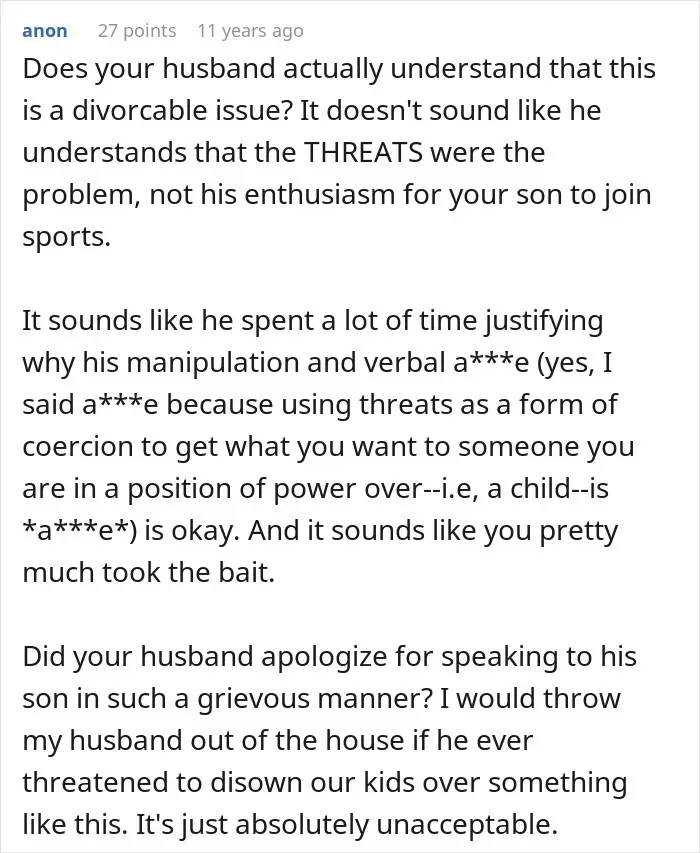
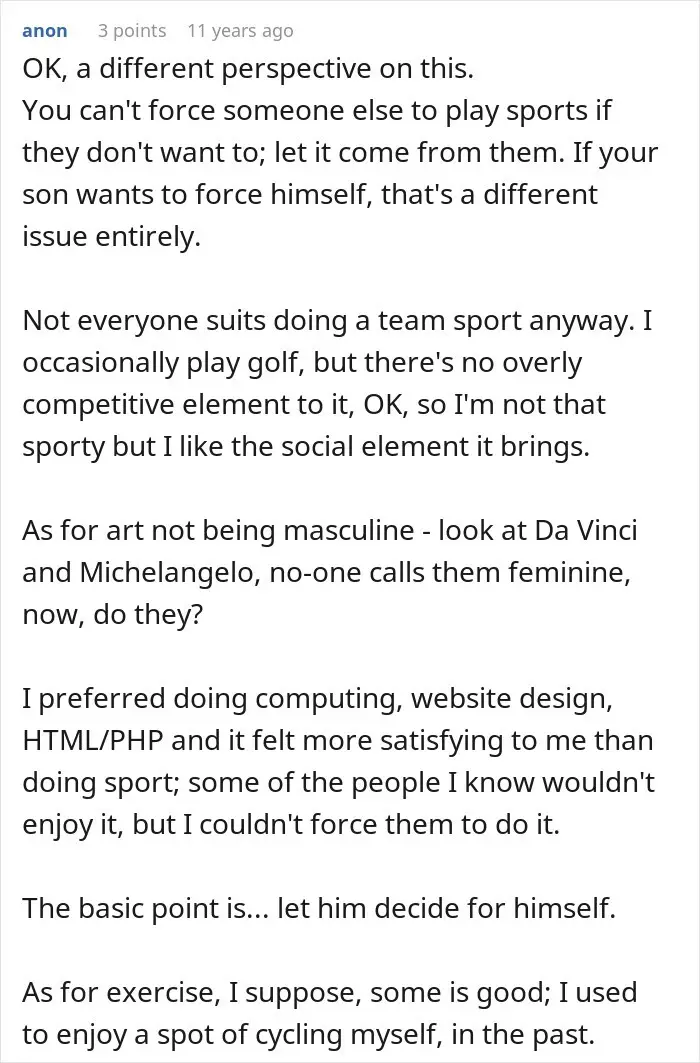
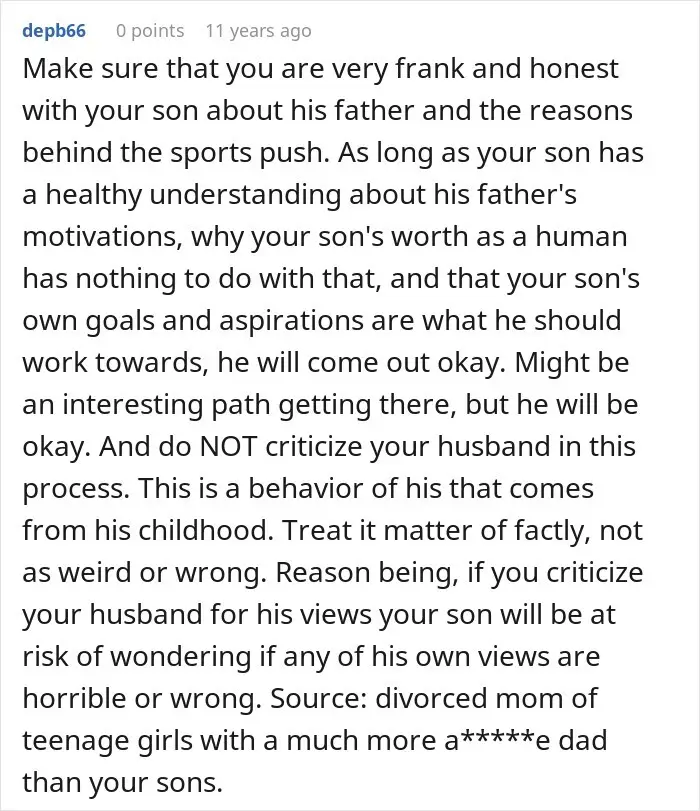
Some people shared helpful advice, while others judged the husband




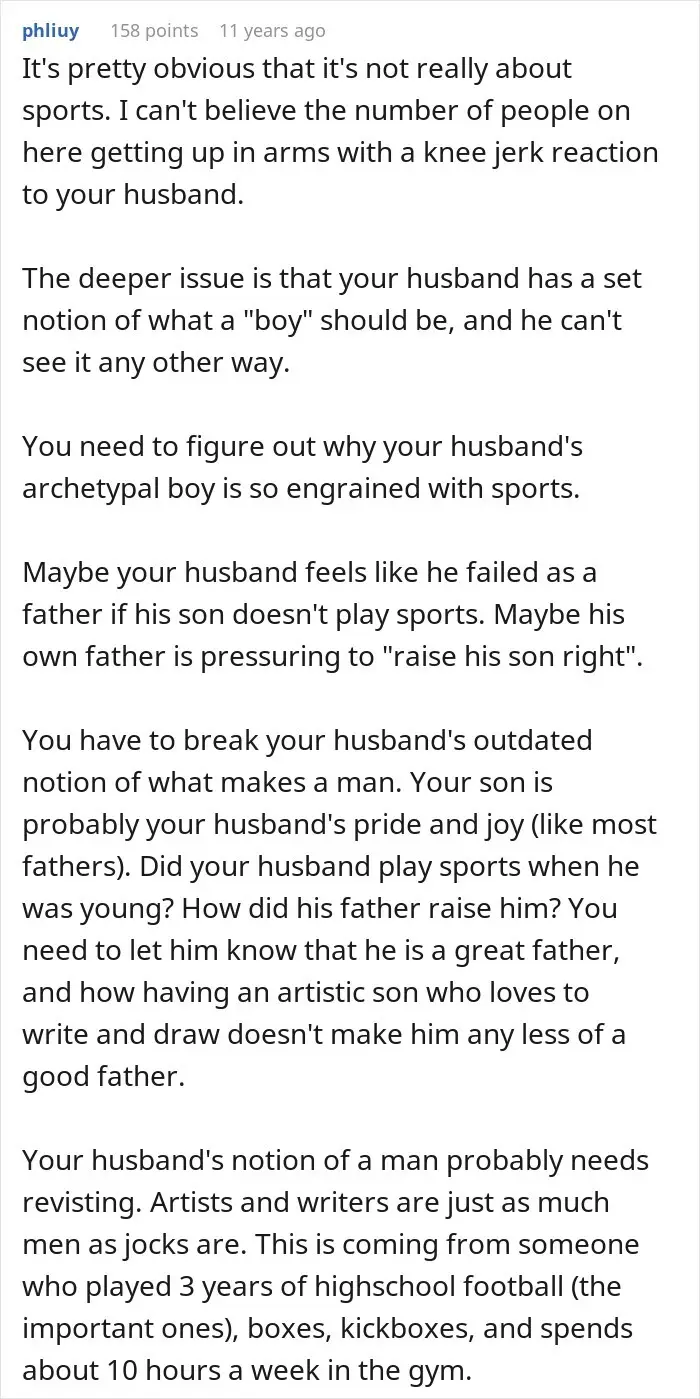
























The woman took the internet's advice and decided to have a proper conversation with her husband















She gave some more info in response to the comments


There were some mixed opinions in the comments section