






This post may include affiliate links.
#1
#2
If you find it hard to click away from lists like this one, it's often because of morbid curiosity—the natural urge to learn about frightening, disturbing, or tragic events in an attempt to better understand them.
According to behavioral scientist Dr. Coltan Scrivner, author of Morbidly Curious: A Scientist Explains Why We Can't Look Away, we've all felt it at some point.
"Usually, we don't want to look [at such gruesome things] because we fear that what we see will not be pleasant. You see this play out frequently with horror movies. There's a jump scare and the killer is on the screen. Half the audience covers their eyes in terror, while the other half is glued to the screen. However, even the people that are covering their eyes peek through their fingers from time to time to keep an eye on the killer," Scrivner explains.
"To avoid danger, you must first know something about it. The more you know about something, the better you can predict it. And the better you can predict it, the better you can deal with the consequences if it does occur," the scientist adds.
"It would be difficult to drive by this without staring. This is where curiosity steps in. I don't want to be in a car wreck myself to find out how bad a car wreck is. I also don't want someone else to be in a car wreck. But if they are, I do want to know how bad it is. This could inform my current decisions and behavior."
#3
#4
#5
#6
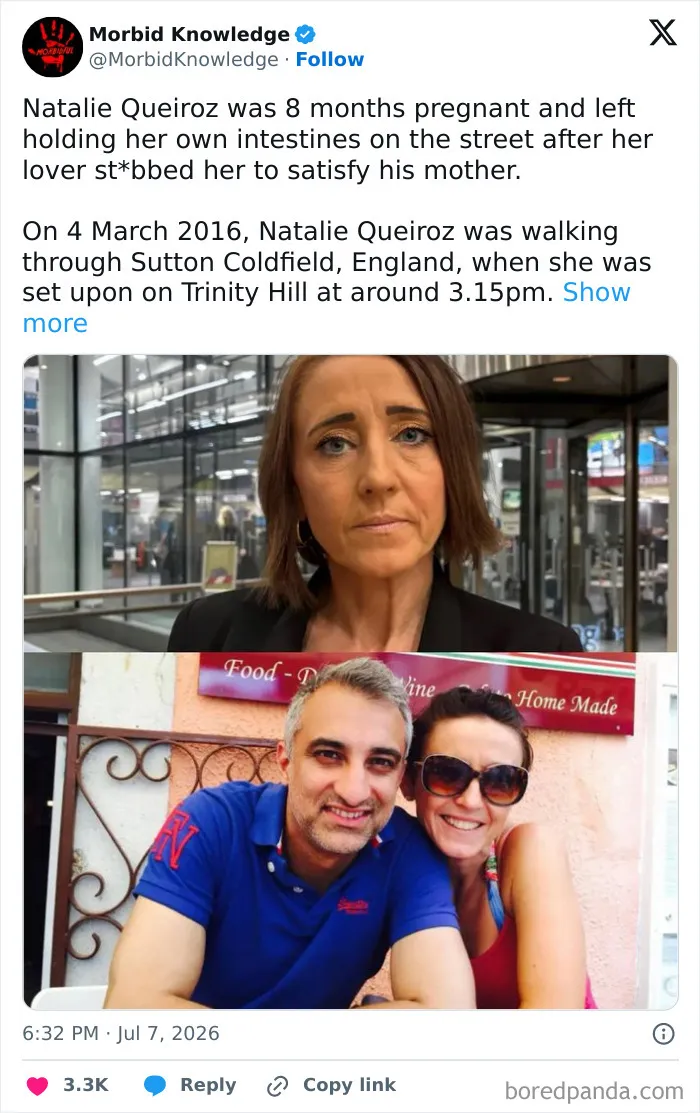
She was st*bbed 24 times by her then partner, Babur Karamat Raja, known as "Bobby." She was 37 weeks pregnant, just over three weeks past her 40th birthday.
Natalie and Raja had known each other since their school days in Birmingham, had got together as adults, and in August 2015 had thrown a party to announce her pregnancy.
But Raja had been concealing the truth about his life. Natalie later described him as having lived a "double or triple life" and that hidden world, along with the collapse of their relationship, formed the backdrop to the attack.
The a***ult was sustained and frenzied. He st*bbed her 24 times in the heart, lung, liver and uterus, and attempted to slit her wrists, survivors' accounts describe it as lasting around nine minutes.
The wounds were so severe that her abdomen was opened, she was left holding her own organs in the street.
What saved both lives was the courage of passers-by and the speed of the medical response.
Three bystanders, John Mitchell, Anthony Smith and Callum Gibson, stepped in to wrestle the carving knife away from Raja.
Of the 24 wounds, one was just 2mm from their unborn daughter.
A Midlands Air Ambulance crew landed on Sutton Coldfield High Street to reach her, and she was airlifted to the Queen Elizabeth Hospital in critical condition.
Natalie was in a coma when her daughter was delivered by Caesarean section shortly before 8pm; she underwent emergency surgery and pulled through.
Mother and baby both survived against the medical odds.
Justice came swiftly. Raja was charged with attempted m**der and attempted child destruction of his biological daughter, pleaded guilty to both, and was jailed for 18 years on 23 June 2016.
The most extraordinary chapter is what Natalie did afterwards. Within 18 months of the attack, she completed a mud run and an abseil to raise money for the air ambulance charity that helped save her, despite having only limited use of one hand.
She went on to be appointed MBE for services to young people and the prevention of knife crime, became a victims' advocate for West Midlands Police.
#7
#8

#9
#10
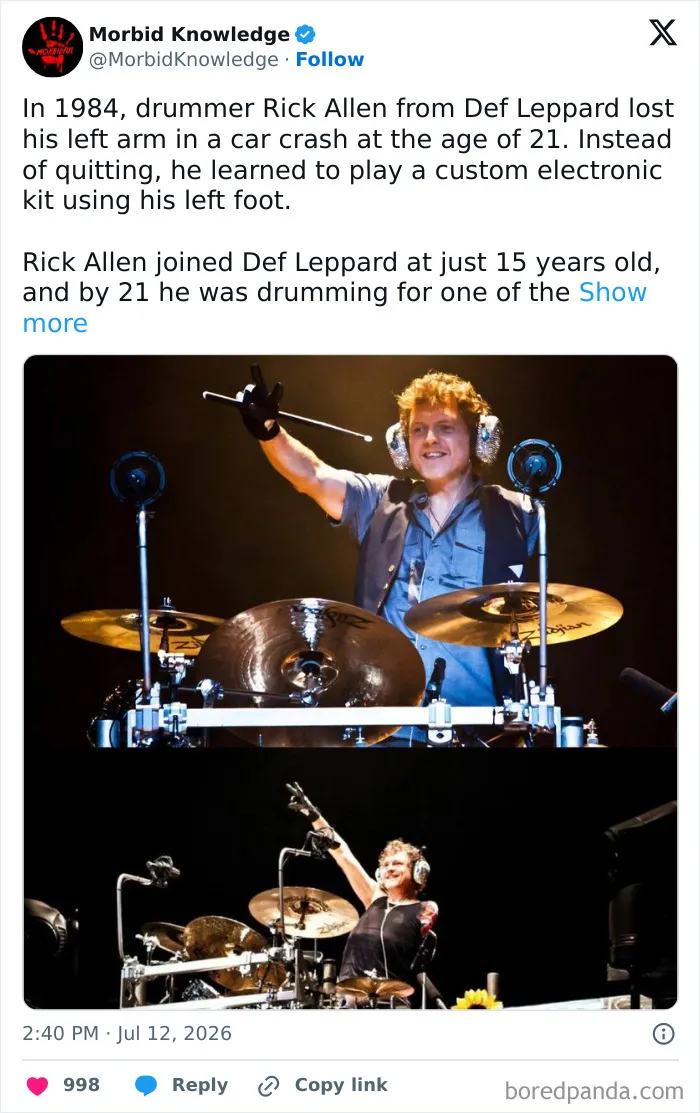
Then came New Year's Eve, 1984.
Rick was driving back from Ladybower Reservoir near Sheffield with his girlfriend Miriam Barendsen when he lost control of his left-hand-drive Corvette Stingray on a sharp bend, hitting a wall.
The car flipped. His seatbelt came undone, and as he was thrown through the sunroof, it tore off his left arm at the shoulder.
What few people know is that he'd also badly broken his right arm, and at one point doctors warned him there was a chance he could lose that one too.
The man who made his living with his hands was staring down the possibility of having none.
Surgeons initially reattached the arm, but on 4th January 1985, it had to be amputated due to infection.
Within three months of the accident, he was drumming again, working with engineers to build something the world had never seen.
Drum manufacturer Simmons collaborated with him to design a custom electronic kit that reassigned his left-hand parts to a series of foot pedals, so his one arm and both feet could cover what most drummers need two arms to do.
#11
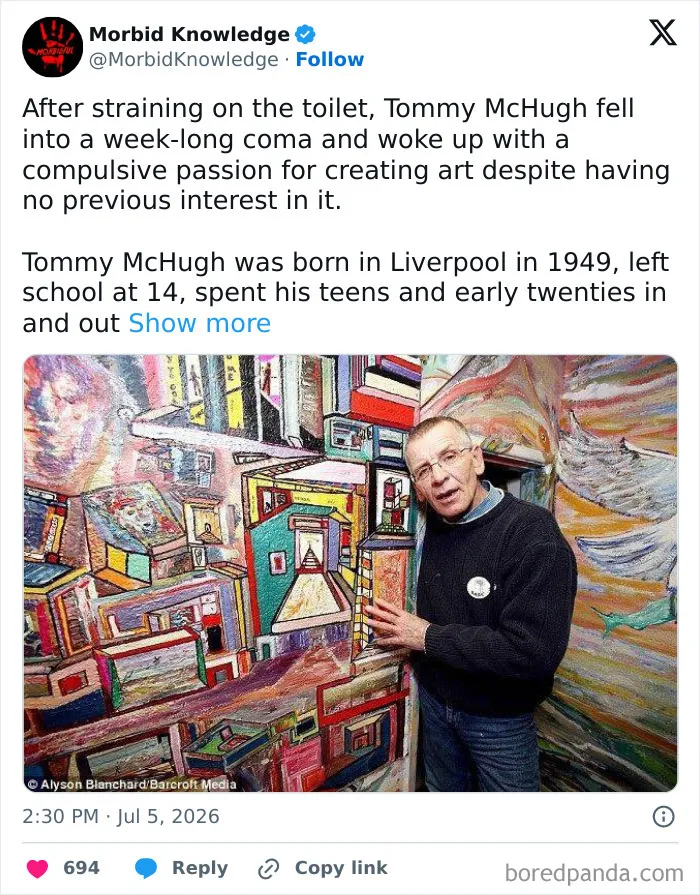
He had never painted, never written a poem, and had no interest in either. He once joked that the only reason he'd ever entered an art gallery was to case it.
In January 2001, Tommy was sitting on the toilet when a knock at the door made him strain to finish quickly.
The sudden pressure severed arteries in both the frontal and temporal lobes of his brain.
In his own words: "I suddenly felt an explosion in the left side of my head and ended up on the floor. I think the only thing that kept me conscious was that I didn't want to be found with my pants down. Then the other side of my head went bang."
His wife Jan found him and called an ambulance. He underwent five hours of emergency neurosurgery and spent a week in a coma.
When he came round, he looked out of the hospital window and saw a tree sprouting numbers, 3, 6, and 9.
Then he started talking in rhyme and couldn't stop. Within days he was painting compulsively, covering walls, ceilings, and floors with vivid murals. No surface in his house was safe. He worked for up to 18 hours a day.
Neurologist Dr. Alice Flaherty from Harvard, who studied McHugh, said the aneurysms had altered the temporal lobes l, the parts of the brain linked to visual processing and emotional response, and that his case was extremely rare.
“He's pretty straightforward and says this wasn't a talent that was hidden," she said. "He had no interest in art. And I have to believe him."
His case is one of only three known examples in the world of "sudden artistic output following brain injury."
#12
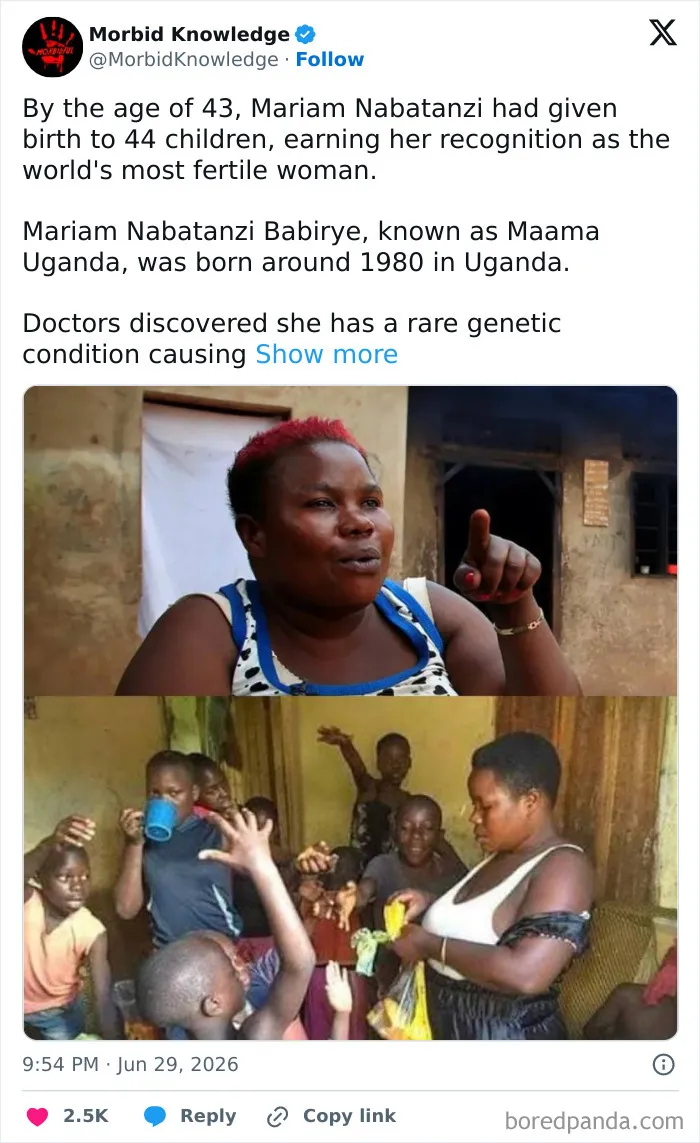
#13
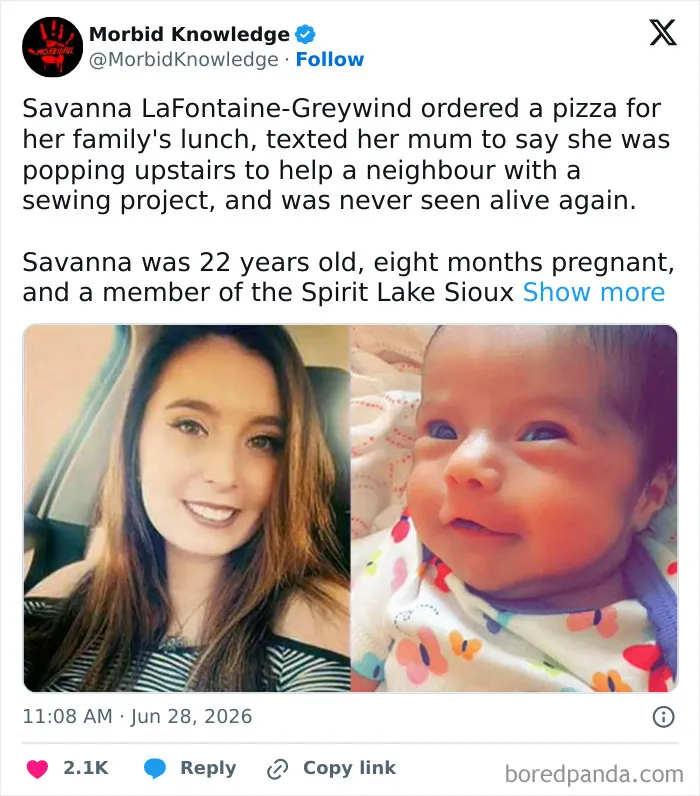
#14
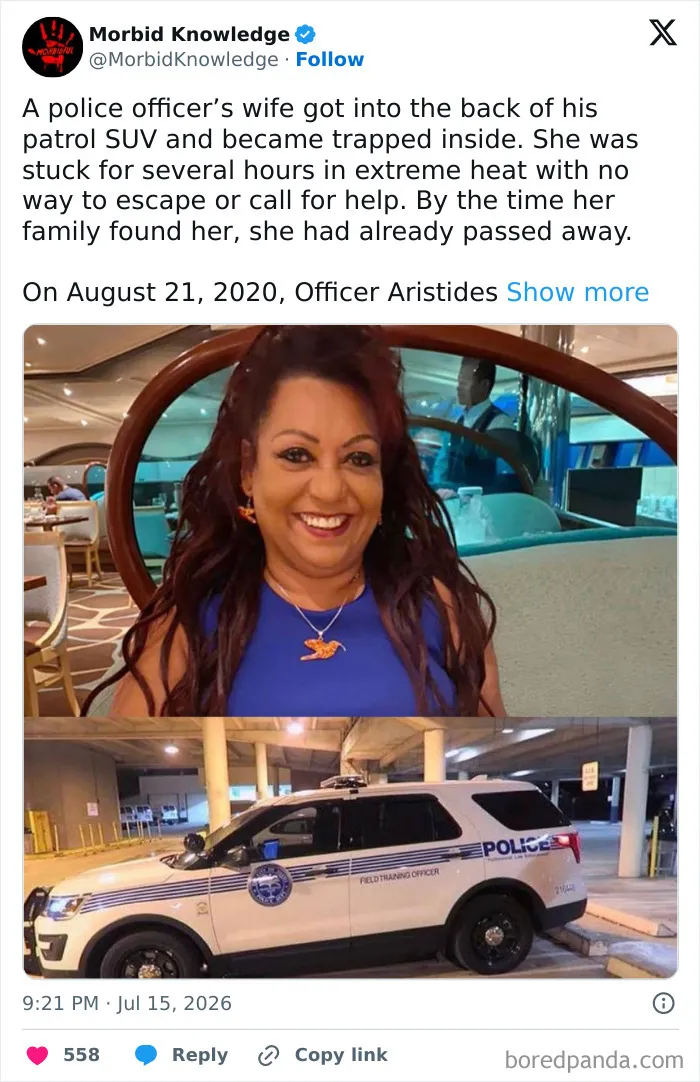
#15
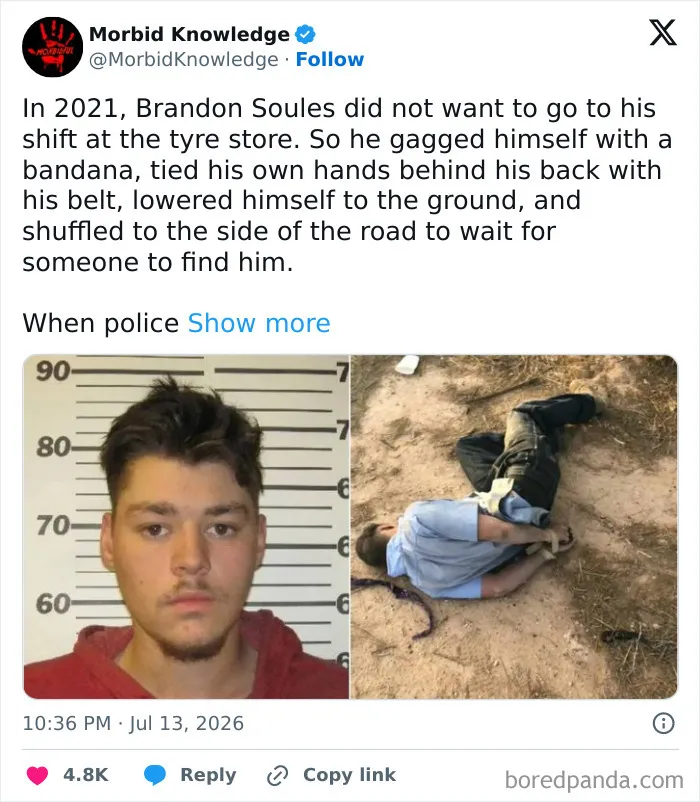
#16
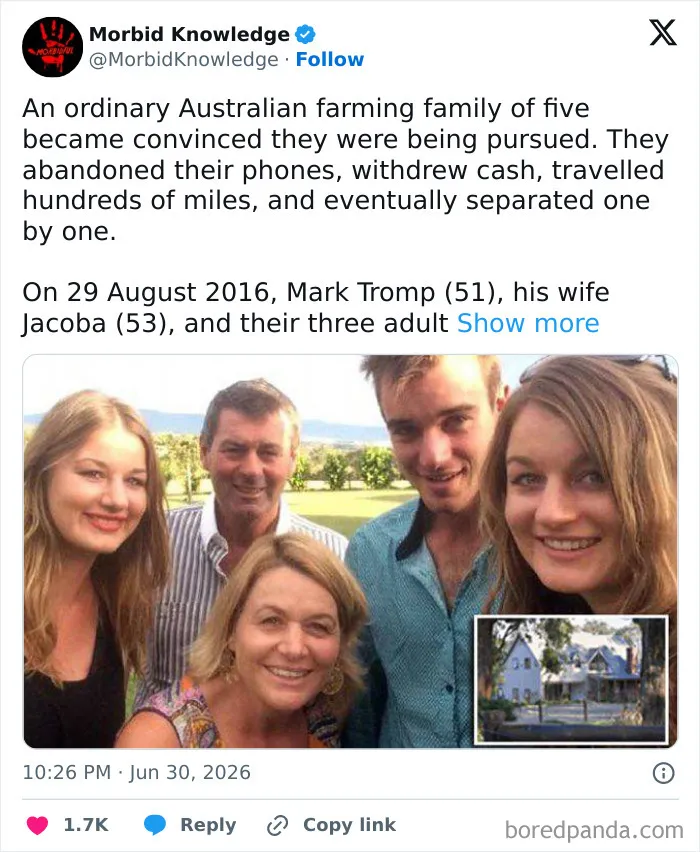
#17
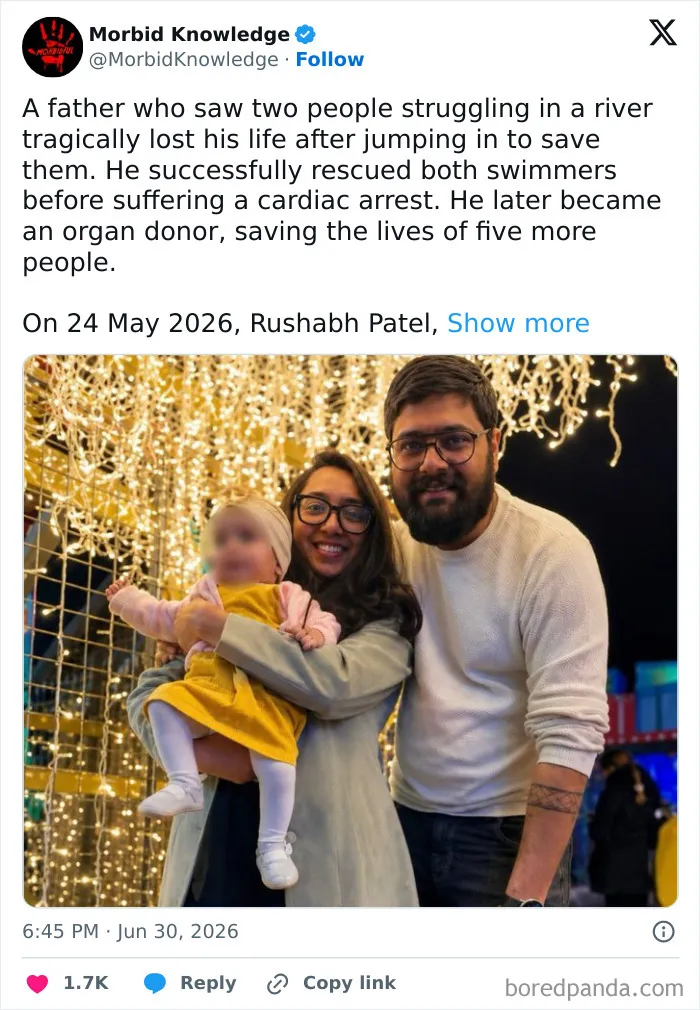
Without hesitation, he jumped in. Their lives were saved, but in the process of rescuing them, Rushabh suffered a cardiac arrest and drowned.
He was airlifted to Milton Keynes University Hospital, where doctors worked tirelessly for days to save him.
Tragically, despite every effort, he passed away on 28 May 2026. His wife Mili and their 18-month-old daughter Vrumi were present that day.
In an interview, Mili described the moment: "I just see his head up in the water and I can't explain that feeling."
She also spoke of their daughter waking at 5am every day to look for her father.
His brother Aman said: "Rushabh's final act on this earth was one of extraordinary courage and sacrifice. He gave his life while saving others. He was a hero in every sense of the word."
In d*ath, Rushabh's generosity continued. Through organ donation, he gave five to six people a new chance at life.
#18
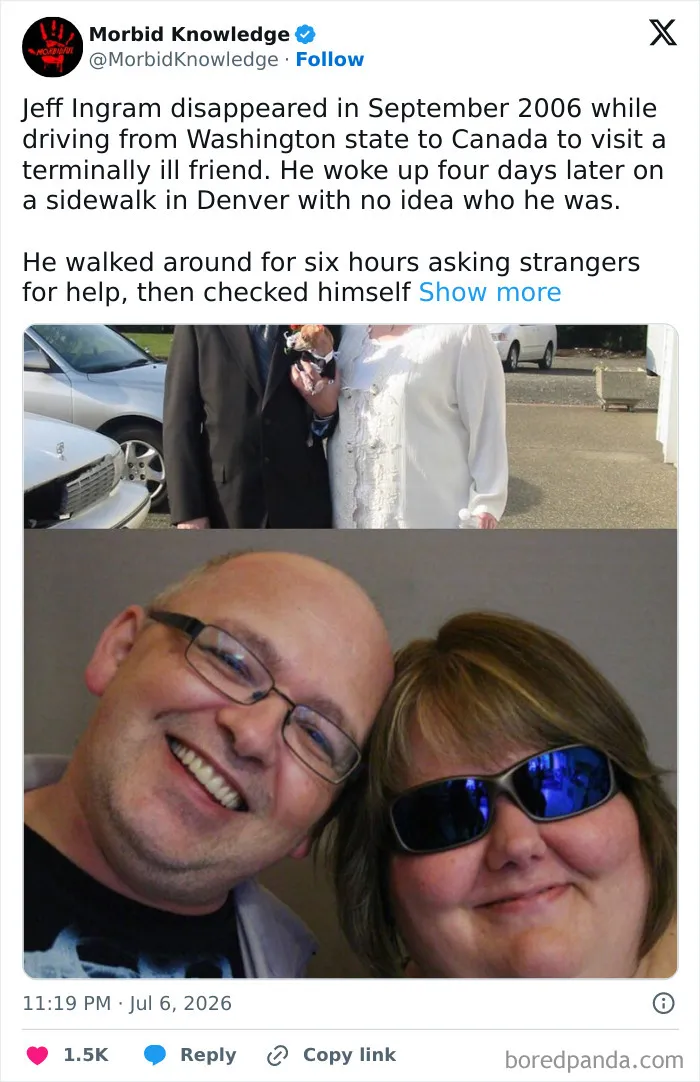
#19
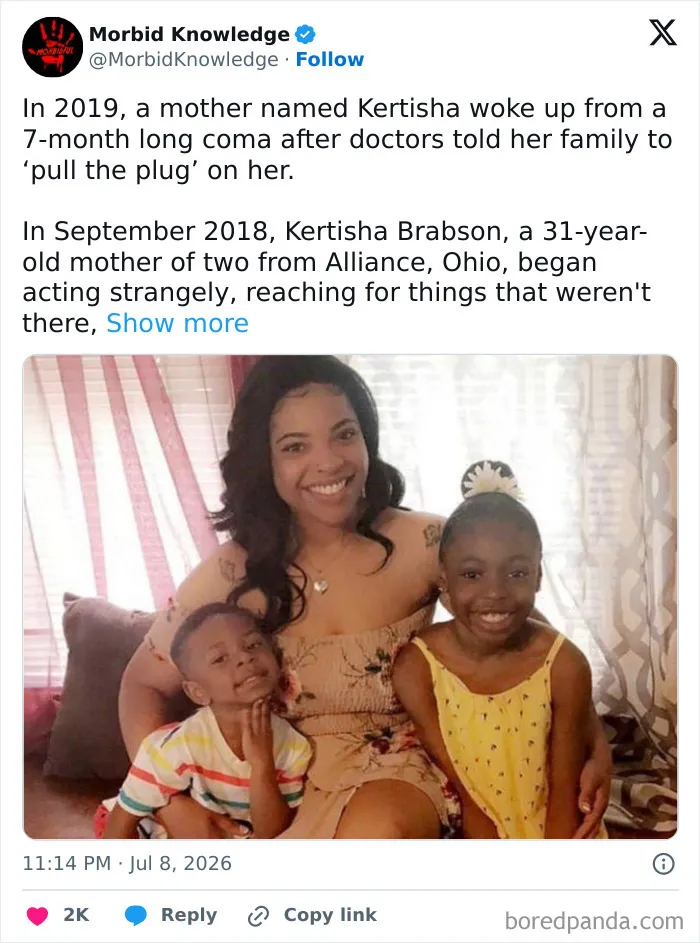
#20
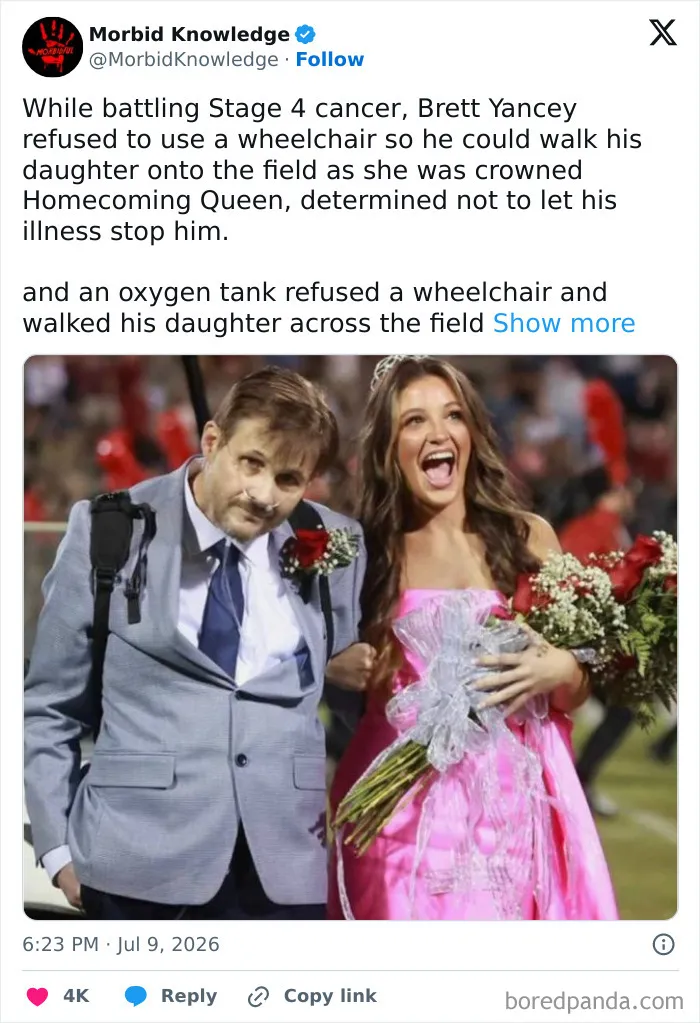
His illness began when he struggled to swallow, leading to a stage 3 diagnosis, after surgery and a brief remission, the cancer returned and progressed to stage 4, spreading to his lungs, brain, carotid artery and nerves.
Before he became ill, he had been the head football coach at Southside High School and had coached all three of his daughters in sports.
In the lead-up to homecoming, Brett experienced paralysis in his left leg and changes in behaviour.
His wife Carrie suggested alternatives, riding in a golf cart, or letting their daughter walk the field alone, but Brett refused.
"I'm going to walk her across that field. I'll walk my baby across that field," he told her.
When the moment came, he did exactly that. Carrie watched from a high vantage point as Brett walked steadily across the field.
Once the pair reached the other candidates, his youngest daughter, 17-year-old Sara Kate, was crowned homecoming queen.