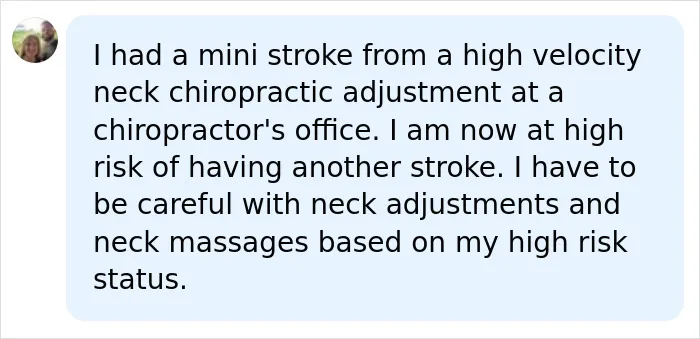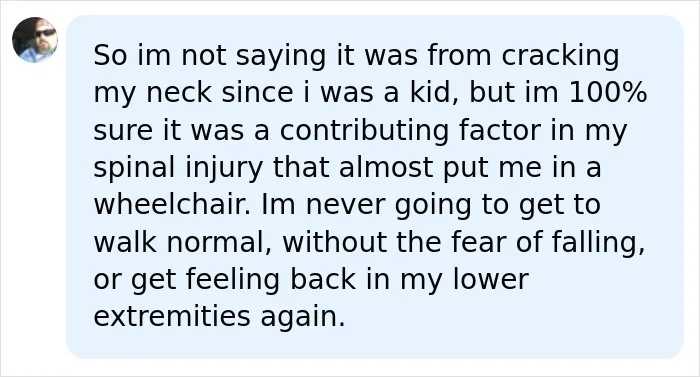


There are few sounds as satisfying as a good neck pop. You turn your head, hear a little crack, and suddenly feel like you’ve reset your entire upper body. For some people, it’s practically a daily ritual. But before you start twisting your neck like you’re trying to get the last bit of toothpaste out of a tube, there’s something worth knowing.
A graphic simulation shared by plastic surgeon Dr. Michael Gartner on YouTube is giving people a rather uncomfortable look at what happens inside the body when someone cracks their neck. The animation begins with a relatively harmless explanation of that familiar popping sound before moving on to a possibility that’s much less pleasant.
A graphic simulation shared by plastic surgeon Dr. Michael Gartner explains why neck joints produce popping sounds when people crack their necks

The animation reveals how forceful neck twisting could damage a blood vessel, potentially causing a blood clot that travels to the brain and triggers a stroke
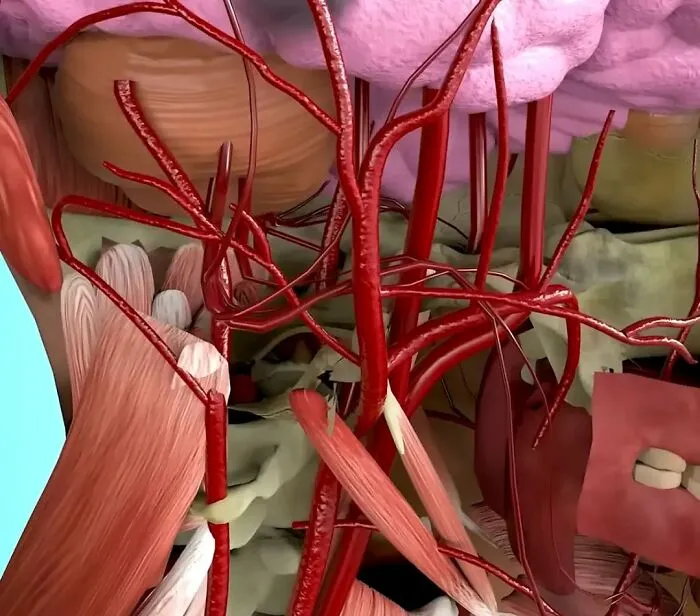
To understand the familiar popping sound, it helps to look at the fluid surrounding the joints. This substance, known as synovial fluid, helps keep joints lubricated and moving smoothly. When you stretch or move a joint, the pressure inside it changes, allowing gas bubbles to form. The process, called cavitation, is what produces that distinctive crack or pop.
The animation explains that cracking your neck forces the joints to move, sometimes causing small gas bubbles in the surrounding fluid to collapse or change rapidly. Gartner pauses the video to agree with the explanation, adding that stretching the joint capsule can cause fluid shifts that contribute to the sound. So, no, your neck isn’t necessarily a collection of tiny twigs waiting to snap. There’s an actual process behind the noise.

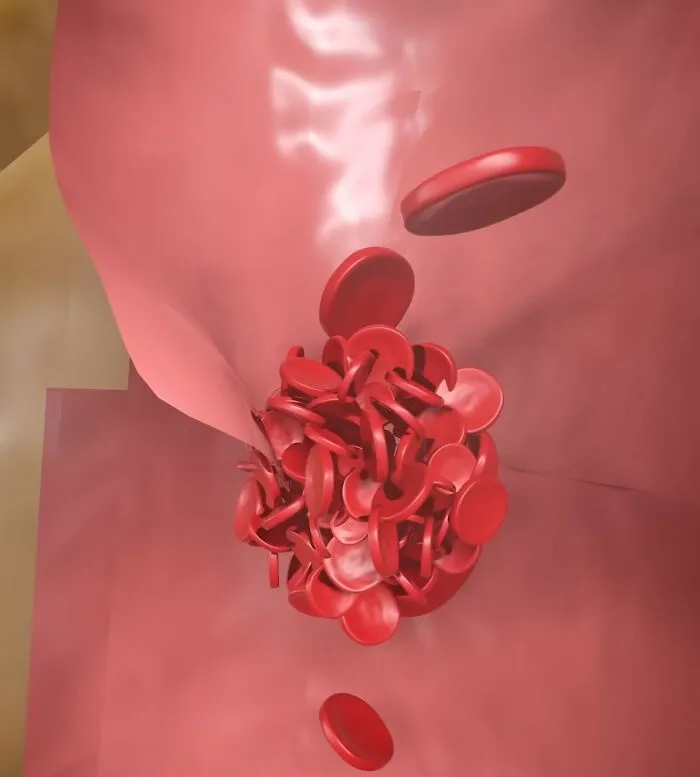
Things get considerably less reassuring when the simulation moves beyond ordinary joint movement. It shows what could happen if someone twists their neck too forcefully, potentially damaging the lining of a blood vessel. That’s where the video swaps satisfying pops for a scenario that is considerably harder to shrug off.
In rare cases, an injury to a blood vessel in the neck can lead to a blood clot forming. If that clot travels toward the brain and blocks blood flow, it can cause a stroke. The animation illustrates this possibility in graphic detail, making the consequences of an overly aggressive neck twist look much more serious than anyone bargained for when they simply wanted to loosen up.
Here’s the video explaining what happens inside the body when you crack your neck and why gentle stretching is a safer alternative

However, the risk needs to be put into perspective. Gartner stresses that strokes associated with neck cracking are “extraordinarily rare.” The video isn't suggesting that every person who cracks their neck is putting themselves on a fast track to the hospital. Rather, it highlights a potential complication that makes forceful twisting an unnecessary gamble.
For anyone who regularly tries to work the stiffness out of their neck, Gartner recommends taking a gentler approach. Slow stretching exercises are a better option than sudden, forceful movements. He also advises people to seek professional guidance when doing anything involving the neck. After all, there are easier ways to feel refreshed than trying to make your spine sound like a bowl of breakfast cereal.
Viewers react to the unsettling animation, with some saying it has given them a new fear and others sharing their opinions on neck cracking

The simulation quickly made its way into viewers’ nightmares, judging by the comments. One person noted that this was a new fear unlocked for them, while another admitted they had never understood why anyone would deliberately crack their neck in the first place. Apparently, not everyone finds the sound satisfying enough to justify the mental image of what might be happening inside.
Other commenters shared their own warnings, including claims that regularly cracking your neck could lead to osteoarthritis later in life. Another person argued that cracking any part of the body without a professional was a bad idea. Those claims shouldn't automatically be treated as medical fact, though. The risks depend on the type of movement involved, and ordinary joint cracking is not the same as forceful neck manipulation.

Of course, the internet wouldn't be the internet without someone deciding that the best response to a medical warning is to declare themselves invincible. One netizen joked that they crack their neck, not just once, but daily, which means that they're basically immortal. It’s a bold theory, if nothing else. Unfortunately, feeling perfectly fine after a habit doesn't prove that every version of it is risk-free.
Now, we would love to hear from you. Did you know about the rare risks associated with forceful neck cracking, or is this completely new information to you? Or do you crack your neck regularly, or has this simulation convinced you to stop? We would love to hear from you!
Some also weren't about to let a little medical scare get between them and their favorite habit, joking that cracking their necks was still worth the risk