





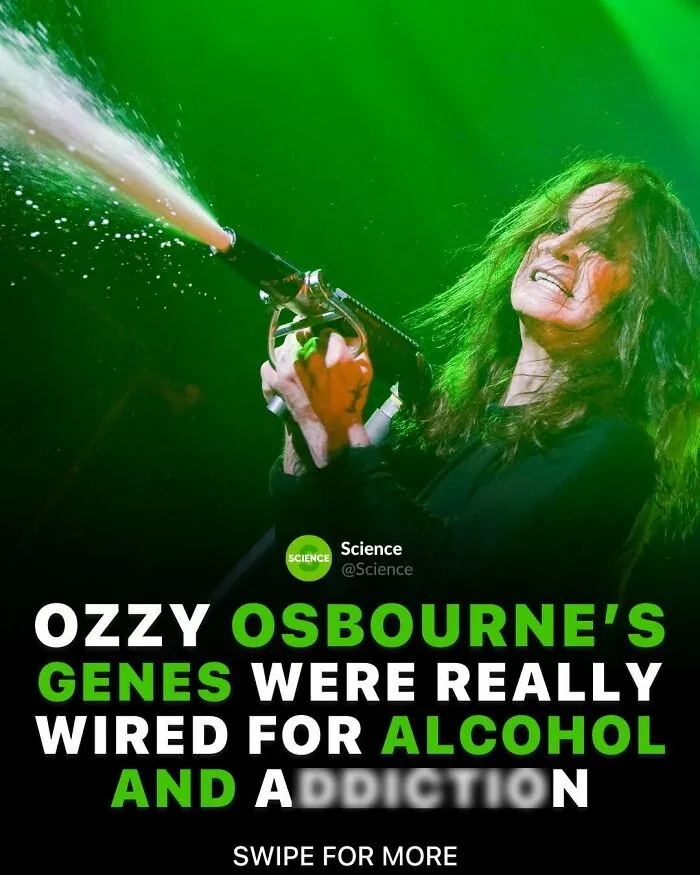
The Prince of Darkness became the King of Genetics—and changed addiction science forever.
In 2010, Ozzy Osbourne made history beyond heavy metal: he became one of the first rock stars to have his entire genome sequenced. After surviving 40 years of legendary excess, scientists at Knome Inc. had one burning question—how was he still alive at the time?
The answer was in his DNA. Researchers discovered that Ozzy carries several hundred thousand genetic variants never seen before in humans, making him what geneticist Nathaniel Pearson called "indeed a genetic mutant". Most shocking was his ADH4 gene mutation—a never-before-seen variant that allows him to metabolize alcohol significantly faster than normal people.
But this genetic superpower came with a dark side. The same mutation made Ozzy six times more likely to develop alcohol addiction than the average person, providing the first concrete evidence of how genetics predispose individuals to substance dependency. His DNA also revealed variants in dopamine processing genes, o****d receptors, and methamphetamine metabolism, essentially a genetic blueprint for addiction.
The research, presented at TEDMED 2010, revolutionized our understanding of addiction science. Scientists discovered that Ozzy's survival wasn't just luck—his COMT gene variants** created a "warrior/worrier" combination affecting his brain chemistry, while CLTCL1 mutations rewired his neural communication systems entirely.
Perhaps most ironic: despite surviving decades of every conceivable substance, researchers found that **caffeine was his genetic kryptonite**[2]—his DNA showed he metabolizes coffee extremely slowly, making him unusually sensitive to its effects.
In 2010, Ozzy Osbourne made history beyond heavy metal: he became one of the first rock stars to have his entire genome sequenced. After surviving 40 years of legendary excess, scientists at Knome Inc. had one burning question—how was he still alive at the time?
The answer was in his DNA. Researchers discovered that Ozzy carries several hundred thousand genetic variants never seen before in humans, making him what geneticist Nathaniel Pearson called "indeed a genetic mutant". Most shocking was his ADH4 gene mutation—a never-before-seen variant that allows him to metabolize alcohol significantly faster than normal people.
But this genetic superpower came with a dark side. The same mutation made Ozzy six times more likely to develop alcohol addiction than the average person, providing the first concrete evidence of how genetics predispose individuals to substance dependency. His DNA also revealed variants in dopamine processing genes, o****d receptors, and methamphetamine metabolism, essentially a genetic blueprint for addiction.
The research, presented at TEDMED 2010, revolutionized our understanding of addiction science. Scientists discovered that Ozzy's survival wasn't just luck—his COMT gene variants** created a "warrior/worrier" combination affecting his brain chemistry, while CLTCL1 mutations rewired his neural communication systems entirely.
Perhaps most ironic: despite surviving decades of every conceivable substance, researchers found that **caffeine was his genetic kryptonite**[2]—his DNA showed he metabolizes coffee extremely slowly, making him unusually sensitive to its effects.