




Dragon mama
Community MemberThis lazy panda forgot to write something about itself.
Dragon mama · upvoted 5 items
about 4 hours ago

Good luck finding enough conservatives with adequate education

It was clearly staged. 🙄
Dragon mama · commented on 3 posts
1 day ago

We're used to being overlooked. It's all good

I wanted a cabbage patch kid one year and my grandma made one for me instead and I still treasure that doll. Lovely gift.
Dragon mama · upvoted 7 items
1 day ago


Dragon mama · upvoted 10 items
2 days ago

I hope it's Cats.

hot take: both look bad
Dragon mama · commented on a post
3 days ago

He is so gross. The way he thinks about her because another man touched her just makes me so angry.
Dragon mama · commented on 5 posts
3 days ago

I turned this fact into a running joke for my kids. Any time something needed a name my answer was always George. EVERY time. And I would insist, over and over, that it be named George. We had a lot of laughs with that. What a nice memory
Dragon mama · upvoted 4 items
4 days ago

"Djelibeybi really was a small self-centred kingdom. Even its plagues were half-hearted. All self-respecting river kingdoms have vast supernatural plagues, but the best the Old Kingdom had been able to achieve in the last hundred years was the Plague of the Frog*. *It was quite a big frog, however, and got into the air ducts and kept everyone awake for weeks." - Terry Pratchett, Pyramids

Dragon mama · commented on a post
4 days ago

Sure would've been nice if they told us why.
Dragon mama · upvoted 4 items
4 days ago
The taxidermist did a reasonably lifelike job on Senator Mitch McConnell.
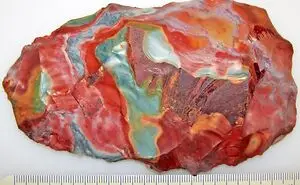
Chert is a sedimentary rock composed almost entirely of silica (silicon dioxide, SiO₂), the same compound that makes quartz, glass, opal, and the beach sand currently stuck between your toes (Stout and Schoenlaub 1945, 13). The difference between chert and all of those other things is its structure. Quartz forms big, visible, Instagrammable crystals. Glass is amorphous, with no crystal structure at all. Chert splits the difference: it is cryptocrystalline, meaning it is composed entirely of crystals, but the crystals are so microscopically small that you cannot see them without magnification (Stout and Schoenlaub 1945, 13). Each one is measured in micrometers. The word "cryptocrystalline" translates literally to "hidden crystals," which sounds like the title of a 2007 Enya album but is actually just a description of grain size. This hidden crystal structure is the entire reason chert matters. When you strike a piece of chert with sufficient force at the correct angle, it breaks in smooth, curving, predictable patterns called conchoidal fractures (from the Latin concha, "shell," because the fracture surfaces look like the inside of a clamshell). Importantly, the fractures are predictable. A skilled knapper (someone who shapes stone by controlled fracturing; you can still do this for fun in competition, btw!) can tell before striking exactly where and how the stone will break. This means they can shape it into anything: a knife edge sharper than surgical steel, a scraper thin enough to shave hide, a projectile point that will punch through a mastodon's ribcage, a drill bit that will bore clean through bone (Stout and Schoenlaub 1945, 7). Chert is, for practical purposes, a programmable stone material. You tell it what shape to be by hitting it correctly, and it becomes that shape, whereas most stone will chip or crack.For roughly twelve thousand years, from the moment the first Paleo-Indian hunter walked into what is now Ohio at the end of the last ice age through the collapse of one of the most sophisticated ceremonial networks in pre-Columbian North America around 400 CE, this rock was the most valuable thing on the North American continent east of the Mississippi. I’m not s******g you. That’s not an exaggeration. It was mined from hundreds of hand-dug pits along a six-square-mile ridgetop (Stout and Schoenlaub 1945, 79). It was shaped into tools so precise they could split a hair down the middle. It was carried by hand, on foot, without wheels, without horses, without roads, to archaeological sites in Louisiana, Florida, New York, Kansas, and everywhere in between, distances of five hundred to a thousand miles, because it was that good and people wanted it that badly (Knepper 2003, 3).