



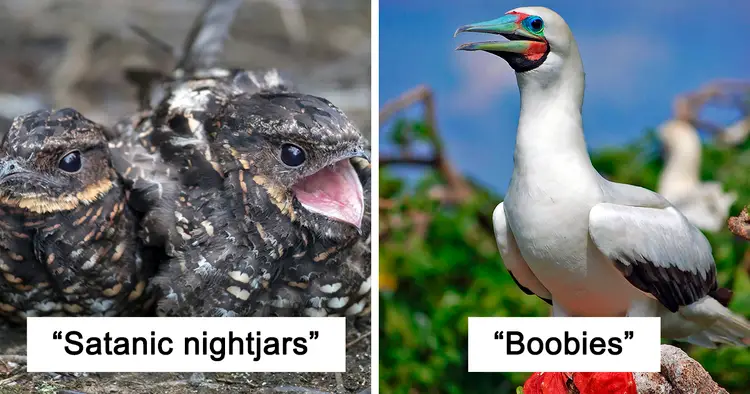


Humor flies, and funny bird names prove this fact to be right! With so much attention given to the more fearsome falcons, hawks, and eagles, we forget the little guys. The Little Bustards and Tiny Sky-Tyrant act like the warm-up gigs. People laugh at and disrespect them for the simple fact that the funny bird's name exists. However, it is not their fault for having such a name!
Scientists and other intelligent people give funny bird names for newly found species. For the most part, the names come up from characteristics or already established terms. Sometimes, it is the barrier of language that results in a wrong translation of the name. So, while the creature might have a fearsome name in Latin when translated to English, the funny bird's name ruins that image.
However, these names don’t come from thin air. Instead, scientists take the time to consider the bird's characteristics before coming up with a name. Learn more about his process down below. However, you can always rush down and check out the funny bird names. Don’t agree with the list? Upvote the birds that you liked. Found the bird you hate? Comment down below!
How Scientists Create Funny Names For Birds?
Animal names are a combination of different characteristics. Birds are no exception. If looking at it scientifically, the names might seem more serious. For example — Eurostopodus diabolicus. Sounds cool and dangerous? Well, if translated to English, then you get Satanic Nightjar. And believe us — it’s not some satanic bird.
Latin plays an important role in the name. The Satanic Nightjar part comes from how English speakers interpret the Latin name. Also, the bird makes a “plip-plop” sound. If you ever heard water drip, you might recognize it. However, the local people instead link the sound to pulling a human eye from the head.
#21 Hoary Puffleg
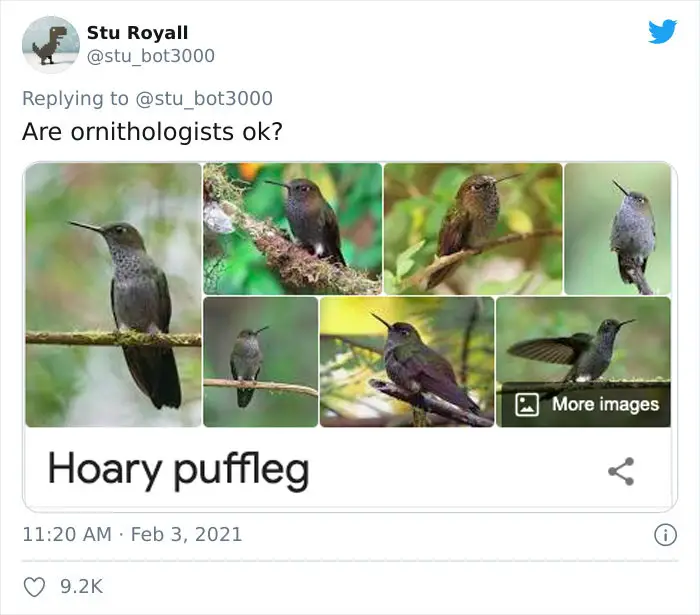
Hoary pufflegs are rare South American hummingbirds. They can be found in areas of the Andes and northwest Ecuador. They prefer evergreen forests at a 1,100-2,500 m altitude. Due to their limited range and declining population, they are considered a threatened species.
Report
32points
#22 Swallow
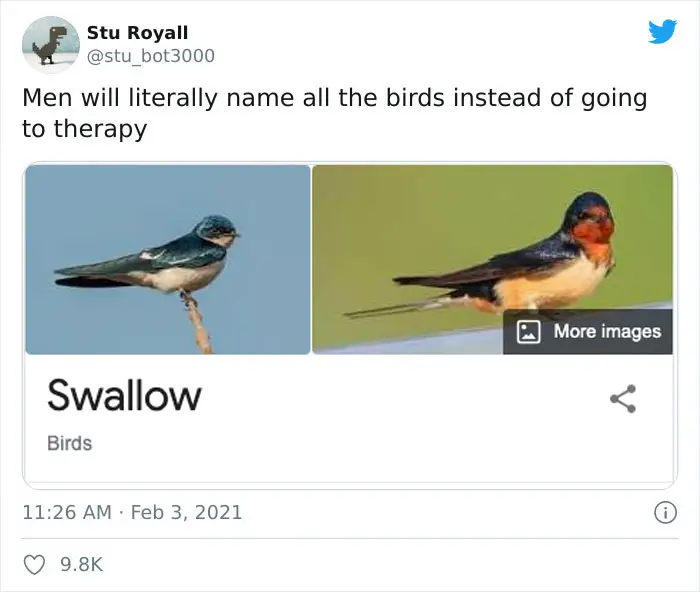
Swallow is a very broad name encapsulating approximately 90 species. These birds are not very big, and often have dark plumage. They are very agile and spend much of their time in the air, catching insects. They can be found worldwide, and more distinct features depend on specific species.
Report
28points
#23 Ruddy Pigeon
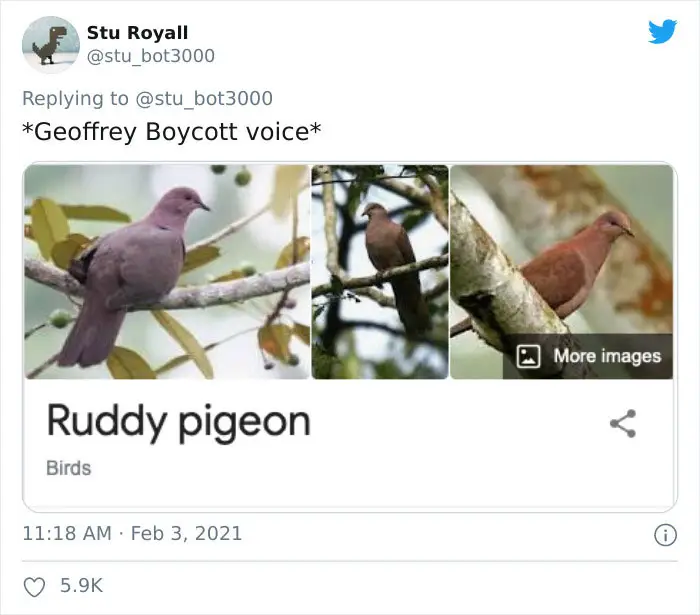
Ruddy pigeons can be found in Costa Rica, Ecuador, and Brazil, and they prefer higher, 1500-meter altitudes. They can be recognized by their unpatterned and mainly wine-purple color of the feathers. The species can often be noticed in pairs, searching for fruits and berries.
Report
28points
#24 Drab Seedeater
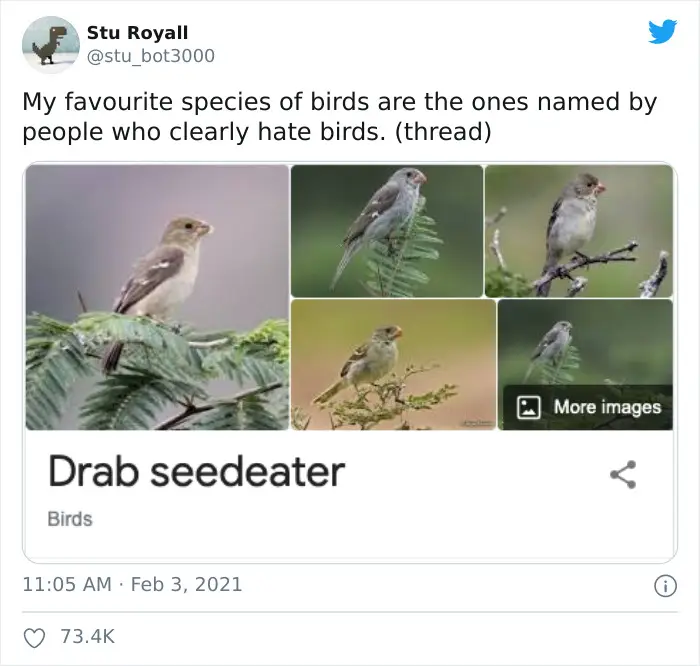
The drab seedeater is found in South America, typically in Ecuador and Peru, and luckily, they are not facing any form of extinction. They like subtropical or tropical shrublands, and the birds themselves don't have any distinct features, hence the name "drab."
Report
27points
#25 Perplexing Scrubwren
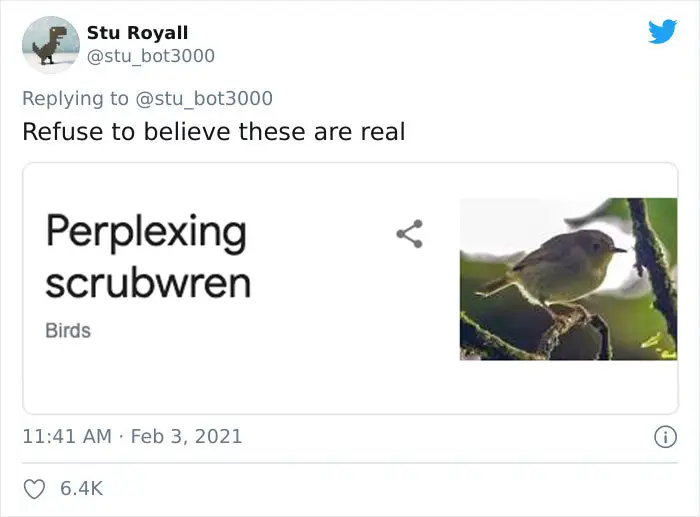
Perplexing scrubwrens live in Indonesia and Papua New Guinea, preferring moist lowland forests. The species' perplexing name arose due to the difficulty it causes while trying to classify it, since living in some areas, this bird interbreeds with larger scrubwren species, and while living in other regions, it doesn't display this behavior.
Report
27points
#26 Monotonous Lark
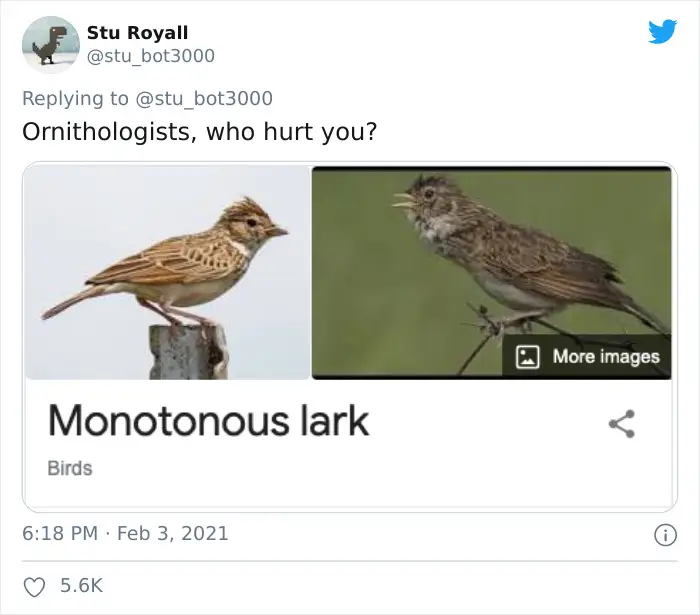
The monotonous lark earned its name due to the males insistently singing a croaking, gurgling, distinctive four-note song every 3-5 seconds for hours, regardless of whether it's day or night. While singing, the bird will puff out, stretch its neck, and raise a small crest.
Report
27points
#27 Noisy Friarbird
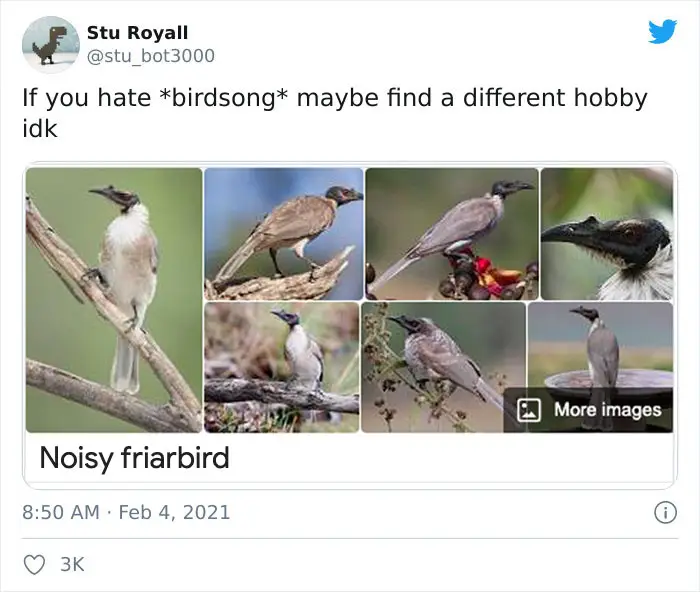
Noisy friarbirds are sometimes referred to as "leatherheads" because of their bare black head. However, despite this species' appearance, they are honeyeaters and you can often spot them in the outer canopy of flowering trees, especially eucalypts.
Report
23points
#28 Noisy Scrub-Bird
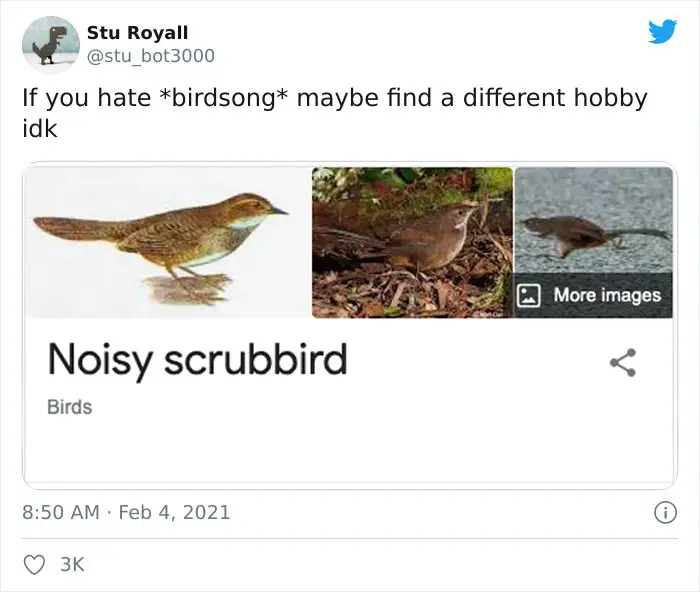
The noisy scrub-bird earned its name for the loud song it performs. Its territorial call starts pleasantly enough, and ends with an ear-splitting finish. It can be found in Western Australia, but its habitat greatly decreased because of the wildfires.
Report
22points