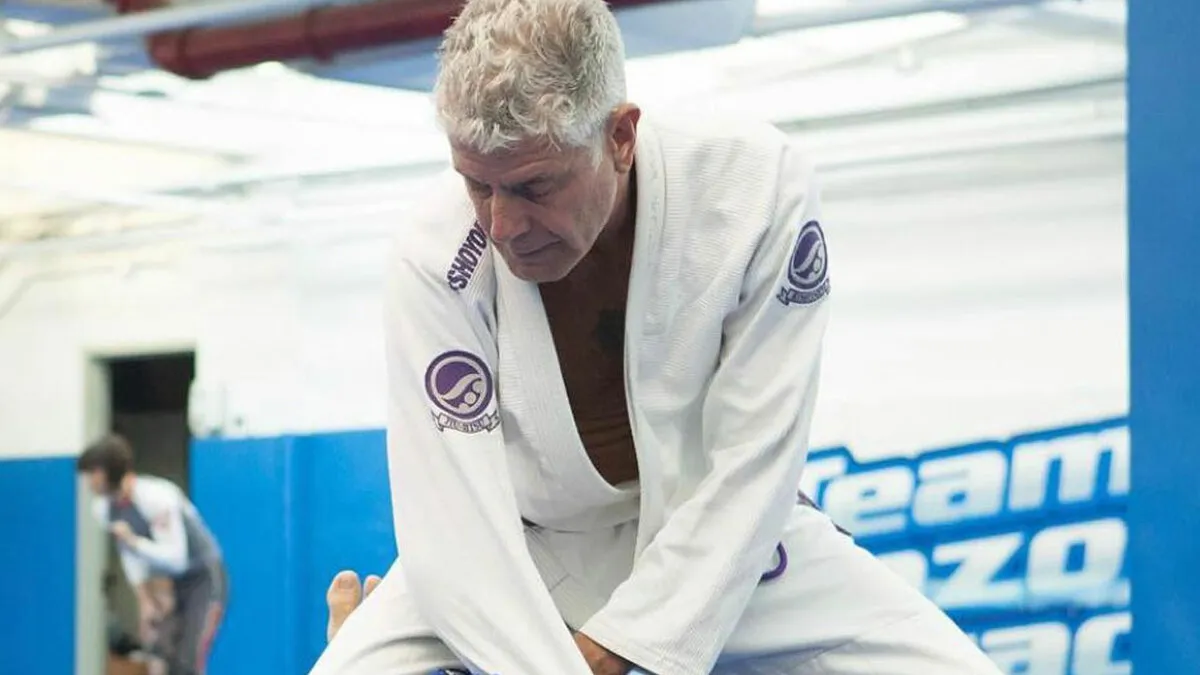
I’m as big of an Anthony Bourdain fan as the next person. To me, he was the cool uncle I never got to meet. I’ve always appreciated his way with words, his candor and irreverence, and his uncanny ability to bring people of all backgrounds together through food. But my biggest hat tip moment for him was starting Brazilian Jiu-Jitsu at the ripe age of 58. That’s first-time granddaddy age for many. Yet, he chose to subject himself to a physically taxing endeavor where the goal is to strangle or break a limb. And at that age, he would, for the most part, be going up against people who are much more youthful and explosive enough to give him rib injuries, sleepless nights of lumbar aches, and stiff necks that last for days. So why would someone who already conquered the realm of food and TV willingly put himself back at the bottom of the totem pole? Well, here’s one thing he said that stuck with me. It was during an interview with Charlie Rose in 2014: “The incremental, tiny satisfactions of being less awful at something every day- it’s like that with Jiu-Jitsu for me. It’s a very steep, very painful learning incline, but I’m hooked. It’s a very satisfying thing. “I just want to suck less tomorrow.” Natalia Pontes senivpetro / Magnific (not the actual photo) If you’re past the age of 30 and feel like you no longer have the desire to pick up a new hobby, you’re not alone. Studies have shown that as we get older, our motivation to learn new things begins to dwindle. Here’s an explanation by Ann Graybiel, an Institute Professor at MIT and member of the McGovern Institute for Brain Research: “As we age, it’s harder to have a get-up-and-go attitude toward things. This get-up-and-go, or engagement, is important for our social well-being and for learning — it’s tough to learn if you aren’t attending and engaged.” Graybiel and her colleagues found that much of it is fear of the unknown. A brand-new endeavor brings uncertainties and difficulties that many people would rather avoid. Adler University professor Dr. Jenna Hepp supports this, stating that fear of the unknown can trigger anxiety and avoidance. It is powerful enough to convince people that not trying at all is better than being bad at something new. simonapilolla / Magnific (not the actual photo) magnific / Magnific (not the actual photo) He chose to keep on keeping on, despite getting crushed day in and day out by younger training partners who were either high school wrestling champs or just yoked kids built from granite. His short-lived Jiu-Jitsu journey resonates with me because I went through a somewhat similar path. I started training at 28. Sure, I was still in my physical prime, but like him, I started out awful. Everyone in my gym was faster, stronger, and more talented. I was the unofficial grappling dummy for people who wanted to try new things or test techniques they learned that evening. Knowing you’re the weakest link never feels good. Ego-crushing is just one of the many words I would use to describe it. But after hearing Bourdain’s Charlie Rose interview and having a coach sit me down and explain the value of incremental progress, I got the eye-opener I needed. Drazen Zigic / Magnific (not the actual photo) wirestock / Magnific (not the actual photo) This is one of the many words of wisdom I got from one of my first coaches in my first few months of training. My morale was in the gutter, and I had stopped showing up consistently. When we feel like we’re terrible at something, seeing the distance between where we currently are and where mastery lies can feel overwhelming, even demoralizing. In my case, I put pressure on myself to make massive improvements in the shortest amount of time possible. I was so zeroed in on getting to the next belt rank that I failed to notice my baby steps toward progress. I think this is another of the many pitfalls we face once we reach adulthood. We tend to get so hyperfocused on major milestones and achievements that we forget the little victories in between. It’s why many strive for perfection while letting the progress go unnoticed. jcomp / Magnific (not the actual photo) Here’s the thing, though: celebrating those small wins actually carries psychological benefits. Educator, speaker, and world-class possibilitizer (this is actually on her profile), Dr. Lindsey Godwin named three: It boosts motivation: As Dr. Godwin points out, noticing you’ve improved 1% more than last time triggers a dopamine release. Seeing that teeny-tiny increase in your progress bar makes you want to keep going. It strengthens resilience: All it takes is shifting your focus from thinking you’ve failed to gaining knowledge. In Jiu-Jitsu, we say, “you win, or you learn.” It fosters connection with others: The strongest bonds form from a shared struggle. That’s why sports teams that endure a tough season and win the coveted championship end up like close-knit families. magnific / Magnific (not the actual photo) senivpetro / Magnific (not the actual photo) I think many of us underestimate the freedom of being below average at something. Immediately, we think about the potential embarrassment and being judged by others. But think about this: once you reach a level of proficiency, you’re pressured to maintain competence. Every misstep, even the slightest ones, can trigger that inner critic that says, “Hey, shouldn’t you be good at this already?” Now, flip that script and think about being bad at something. That bar is wonderfully low. You can freely explore and figure things out for yourself. It allows you to make “ugly” art, play an instrument awkwardly, take photographs that aren’t Instagram-worthy, speak incoherent Italian, dance like nobody is watching, or spend an hour on a Jiu-Jitsu mat getting outclassed by someone half your size. You didn’t get fired from a job. You didn’t hurt anybody. Your worst fear didn’t come true. But you did the thing, and that’s a huge deal. fxquadro / Magnific (not the actual photo) Father Time may be undefeated, but he isn’t as unforgiving as he is made out to be. Believe it or not, there is no time limit on taking up something you'll eventually love and make a big part of your life. It doesn’t have to be as physically demanding as Brazilian Jiu-Jitsu. It can be anything that makes your heart smile and gives you a deep sense of fulfillment. Think about the person who buys a cheap guitar, learns three chords, and starts a garage band with their friends. They’re not trying to be the second coming of The Beatles. Heck, they may not even know what they’re doing. But they enjoy making noise with their friends because it’s fun, complaints from the neighbors notwithstanding. You can also think about the 40-something aunt who joins a salsa class, overcome with shyness and having absolutely no rhythm in her hips. She might step on someone’s foot, turn the wrong direction, and let’s be honest, look a bit ridiculous. Then you find out she came back next Tuesday. She was more than willing to look foolish long enough to have fun. That’s beautifully rebellious of her. flatdogdoodles The thought of spending hard-earned money on a new hobby, only to discover that it isn’t for you, isn’t exactly enticing. But you can always start by lowering the stakes. Find a one-off pottery workshop in your area. Join a free community event for beginner writers and aspiring cooks. Sign up for an introductory calligraphy class before buying a set of specialized dip pens. Shop around and see what suits you best. You might hate it, but that’s useful information to have. You might be terrible at it, but that’s pretty much expected. But you might also discover firsthand the utter joy of being a complete beginner and getting your mind blown from learning something for the first time. Getting hooked would be the cherry on top. Now, you have a reason to come back. flatdogdoodles I’ll circle back to Uncle Tony here. His goal as a Brazilian Jiu-Jitsu practitioner wasn’t really about becoming good. From day one, he accepted the idea that he’d never get his black belt (which he unfortunately didn’t). His mindset had always been along the lines of, “What would happen if I just kept showing up? How far would this take me?” It took me a good while to fully understand it. theonlyogflako I can’t count the moments when I’d drive three hours to and from my gym, only to spend most of the training session flat on my back, staring at the ceiling, getting crushed and tapping out. I’ve questioned myself numerous times, asking, “Why the hell am I even doing this?” But I kept showing up, and things eventually fell into place. I started figuring out how the system works. I eventually learned the rules, then began breaking them to think outside the box. I eventually became creative enough to put my own stamp on it. theonlyogflako All of that comes from piling one tiny improvement after another. From enjoying that small yet highly satisfying distance between where I was yesterday and where I am today. So I will go out on a limb and say, stop trying to be good. Because let me tell you, it’s much more satisfying to know that you’re sucking a little less at something you enjoy doing.