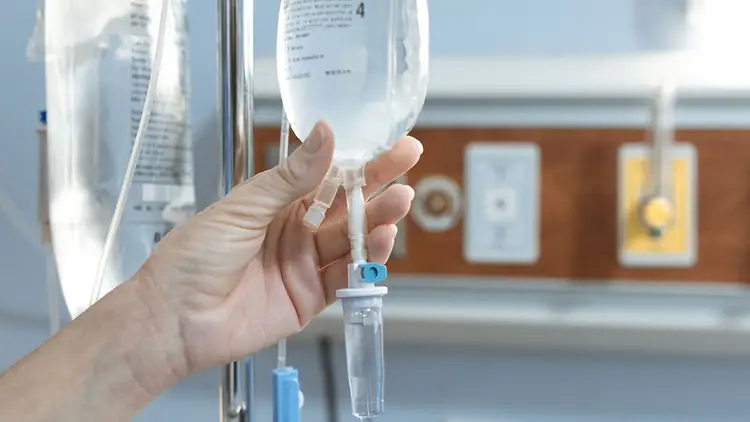
A single IV drip at an American hydration spa costs a median of $179. Add a B12 shot, and it’s another $25 to $75, for a dose the spa buys for under a dollar. For plenty of people, it feels worth it. They walk in exhausted, spend an hour hooked up to a bag of vitamins, and walk out swearing they feel brand new. That feeling has grown into a booming industry worth almost $3 billion a year. But here’s the thing: the people who actually need B12 aren’t necessarily the ones lining up for drips, and many of those who do need it don’t know they’re deficient. Then there’s the marketing. When Yale researchers combed through 255 spa websites, they counted 1,774 health claims. Only two of the sites cited a source. So, yeah, I had questions. I got in touch with two nurses who run mobile IV businesses, a naturopathic doctor whose clinic offers drips, and two board-certified physicians. I also dug into decades of research on B12. Keep reading to find out what's really in the bag, which blood tests to get before you pay, and what happened when B12 was put up against a placebo. RDNE Stock project/Pexels (not the actual photo) IV drips have turned up everywhere from hotel spas and casinos to shopping malls and cruise ships. In cities like Washington and New York, travelers often book them hoping to build up their immunity and energy, according to Andrea Sachs, writing for The Washington Post. In Los Angeles and Miami, she wrote, they're part of the longevity scene, and in party towns, they've become "fire hoses pumping out hangover cures." But drips weren't invented as a pick-me-up. In hospitals, as Sarah Charmley explains for Medical News Today, they're one of the most common procedures there is, used to rehydrate people who are severely dehydrated, deliver medication, replace lost blood, and feed patients who can't eat. Drip bars take the same setup—a bag of sterile fluid hanging above the arm, dripping into a vein through a thin tube—out of the ward and add a menu. Most are built on what's called the Myers' cocktail, a blend of high doses of B vitamins (including B6, B5 and B12), vitamin C, magnesium and calcium. But there's no official recipe. The amounts vary across clinics, and many places add extras like zinc, glutathione or more B12. That's where things get interesting, and more expensive. In October 2025, a team led by Yale's Joseph Ross published a detailed look at the industry in JAMA Internal Medicine. They went through 255 spa websites from across all 50 US states and the District of Columbia and tallied up what was on offer. Nearly two-thirds of the spas (63.5%) sold separate vitamin injections like B12 shots. More than half offered magnesium (57.3%), the antioxidant glutathione (53.7%), or NAD (51%), a molecule cells use to make energy. Around 27% even offered GLP-1 weight-loss drugs. About a quarter of spas also offered ondansetron (26.3%), a prescription anti-nausea drug, and ketorolac (25.5%), a strong anti-inflammatory painkiller. cottonbro studio/Pexels (not the actual photo) When the researchers called 87 spas posing as customers, only 27.6% said a customer would need to see a licensed medical professional before getting hooked up, and about 60% asked about medical history. Meanwhile, 86.2% recommended a specific drip for a headache or a cold. Fewer than a quarter (24.4%) mentioned any risks, and not one of the 255 websites listed an emergency plan. The marketing, on the other hand, was flawless. Every single website made health claims, although only two backed any of them up with a source. Immune support led the pack (312 claims), followed by hydration (265), beauty and skin (211), detox (178), and weight loss (134). Mercedes Denham, a registered nurse with 17 years of experience, runs Swan Hydration, a mobile IV service near Pittsburgh, Pennsylvania. Before a first visit, she told Bored Panda, every client has a short video call with a licensed prescriber who goes over their health history, medications and allergies. "It only takes a few minutes," she said. Her business doesn't routinely test B12 levels before a B12 shot, but she's clear about when to say no. "We turn people away when what they need is beyond what we can safely provide," she said. Her very first booking was a client who needed more medical care than a mobile IV service can offer, so she didn't treat her. Anyone with red-flag symptoms gets sent to urgent care or the ER instead of getting a drip. Leonid Pikman, a registered nurse who spent 18 years in emergency medicine before co-founding Apex Regen Wellness, a mobile IV practice in New Jersey, takes a similar approach. Every client is screened by a nurse first, under protocols set by a physician, and he turns away people a drip isn't right for, like someone with heart or kidney problems who's been told to limit fluids. "I would rather lose a booking than give an IV to the wrong person," he told Bored Panda. But how carefully a clinic screens people seems to be largely up to the clinic itself, since the rules vary from state to state. When the Yale team checked, 32 states had issued some kind of guidance, but none had passed a law aimed specifically at IV spas. And if you're wondering about insurance, not one spa took it. These drips are wellness purchases, not medical care, and they're priced like it. The researchers found that they cost a median of $179 a session, with most falling between $136 and $217. According to Keren Landman, writing for the Guardian, a B12 shot costs a typical US spa less than $1 and sells for $25 to $75. For a real-world comparison, Denham charges $35 for a B12 shot. Her most-requested drip, the Immunity IV Drip, costs $299. Caroline Attwood/Pexels (not the actual photo) So what is B12, and why is it on so many menus? It's a vitamin found naturally in meat, fish, eggs, and dairy, and added to some breakfast cereals and nutritional yeasts. The body needs it to make red blood cells and DNA, and to keep nerves working properly. It also plays a role in turning food into energy, which is where its reputation as an energy booster comes from. Med spas lean into that. On social media, owners and staff describe B12 shots as a pick-me-up for a busy week, and some say people feel a lift within a day or two and recommend a shot every few weeks, the Guardian reported. But the body needs surprisingly little of it. Adults need just 2.4 micrograms a day, a little more during pregnancy and breastfeeding, and a typical diet with animal products supplies about 5 to 15. So most people already get plenty. For them, a B12 shot is a lot. A standard one typically contains 1,000 micrograms, roughly 400 times the daily requirement in one go. That might sound alarming, but B12 itself is generally considered safe, even in large doses. Andrea Dean, a hematologist at Loyola University Medical Center in Chicago, told the Guardian she has never seen anyone overdose on it. The idea that a B12 shot fixes everyday tiredness is way older than drip bars. In a 1970 survey of British family doctors, 68% said they believed it worked, especially for tiredness. So scientists did what scientists do and tested it, several times, against a placebo. One of the first tests came in 1973, when British researchers ran a small pilot study on 28 tired people, giving them two weeks of B12 shots and two weeks of identical-looking placebos. The results were mixed: one group seemed to feel better on B12, the other felt no difference, and later, larger trials didn't back up the benefit. Drips haven't fared much better. In 2009, Yale researchers ran the first placebo-controlled trial of the classic Myers' cocktail, giving 34 adults with fibromyalgia either weekly infusions or a placebo for eight weeks. Most improved, but there was no statistically significant difference between the two groups. The most telling study came out of the Netherlands in 2017. Doctors there noticed that many patients with chronic gut conditions, who often feel exhausted, were being given high-dose B12 by alternative practitioners, even though their levels were normal. In an earlier short course of shots, with no comparison group, 70% of these patients said their fatigue got better. So the team ran a proper trial with 95 of these patients, giving some a high daily dose of B12 in pill form and some a placebo for eight weeks. Fatigue dropped by about the same amount in both groups. Ben Witteman, who led the study, said he'd suspected a placebo response all along, and that the extra B12 added nothing. Nothing since has really changed that picture. A 2023 research review found no high-quality evidence that high-dose vitamin infusions are necessary or useful for people who aren't deficient. So, where does that leave us? If your levels are normal, the controlled studies show no measurable benefit from the vitamin compared with a placebo. Speaking to the Guardian, Dean compares it to filling up a car. If the tank is already full, adding more gas won't make it go any faster. That analogy is close to literal, because most of a shot doesn't stick around. According to the prescribing label for cyanocobalamin, one of the most common injectable forms in the US, a shot into the muscle peaks in the blood within an hour, and 50% to 98% of the dose can show up in urine within 48 hours. The liver holds on to what it can store, and the rest gets flushed. Putting B12 into an IV bag doesn't help either. The same label tells clinicians to avoid the intravenous route, because almost all of it ends up in the urine before the liver can store it. Franco Monsalvo/Pexels (not the actual photo) Los Angeles resident Chris Harmon first tried a Myers' cocktail, prescribed by his doctor, to fight off a virus. He told The Washington Post in 2024 that it gave him more energy, that he felt the benefit immediately, and that he now averages 20 to 30 drips a year. Part of what keeps Harmon and others going back could come down to what the Dutch study hinted at: the placebo effect. And really, think about a drip bar: soft lighting, a comfy chair, a nurse fussing over you, a visible bag of "goodness" with a hefty price tag, and up to an hour set aside to do nothing but rest. Sounds like a recipe for feeling better, whatever's in the bag. "We know that some of this is just all mental," Dean told the Guardian. But that doesn't make feeling better any less real. Even some people who sell the shots agree. Asked about the placebo-controlled trials, Denham told Bored Panda: "Those trials are real, and I don't argue with them—if your levels are normal, a B12 shot is not magic." People who aren't deficient "usually don't get a lasting benefit beyond placebo," she said, and she tells clients so before they book. Pikman is just as blunt. "I won't tell anyone that extra B12 will give them more energy if their levels are already normal, because I'm not aware of good evidence that it does," he said. What a drip does deliver, he added, is fluid, electrolytes and the convenience of a nurse coming to you. Most of his clients come after a long work week, travel, a race or a night out, and simply want to rehydrate without going anywhere. Some drips also contain real medicine. If you've ever felt a "hangover drip" work wonders, the ondansetron or ketorolac in it may be what did the job, not the vitamins. For people who are genuinely low on B12, it's a different story. Fixing a real shortfall can bring energy back, reverse anemia, and stop nerve damage that might otherwise become permanent. RDNE Stock project/Pexels (not the actual photo) So who actually needs it? About 4% of American adults, roughly 1 in 25, have low B12, according to the Guardian. Dean says a shortfall can bring on anemia, memory problems, depression and fatigue. That 1 in 25 is an average, though. Some groups are far more likely to be running on empty, starting with older adults. An estimated 10% to 15% of people over 60 are deficient. Many older adults make less stomach acid, which the body needs to free B12 from food. Diet matters too. B12 comes almost entirely from animal foods unless something is fortified, so vegans are at higher risk. A 2024 review of studies from Western Europe and the US found deficiency in anywhere from 5% to 52% of vegans, depending mostly on how each study defined "low." The lowest numbers came from Norway and Finland, where taking supplements is the norm. In other words, the risk is less about being vegan and more about being vegan without a supplement. Then there are some very common medications. The diabetes drug metformin gets in the way of how the gut absorbs B12. In one primary-care study, 22% of patients with type 2 diabetes were deficient, though those who took a daily multivitamin had much lower odds. Heartburn drugs like omeprazole can also cut the stomach acid the body needs to pull B12 out of food. Finally, anything that disrupts absorption raises the odds. That includes heavy drinking, digestive conditions like celiac or Crohn's disease, weight-loss or other stomach surgery, and pernicious anemia, an autoimmune condition where the stomach stops making a protein needed to absorb B12. People with pernicious anemia usually need B12 shots for life. Spotting a deficiency isn't easy because the symptoms are vague: exhaustion, low mood, memory trouble and, in serious cases, tingling or numbness in the hands and feet. Tiredness is the main reason many people reach for a B12 shot, and it's also the least specific symptom on the list. brgfx/Magnific (not the actual photo) Even Denham, who sells the shots, thinks testing should come first. Most people who ask her for one have never been tested, she said, and plenty of them could be running low without knowing it. "What I tell clients is the shot is inexpensive and very safe—but a simple blood test tells us whether you actually need it, and I'd rather test than guess." B12 isn't part of most routine blood work, so it usually has to be requested. In many US states, you can also order a test online from a commercial lab, though the Guardian warns the results can be tricky to read on your own. Doctors typically start with a complete blood count (CBC), which can show anemia, along with a B12 level. As for the numbers, most US labs report B12 in pg/mL and call anything under 200 or 250 low. But a result that's technically "normal" isn't always the end of the story. Dean treats patients below 400, and UK guidelines treat anything between about 180 and 350 as a gray zone, where deficiency can't be ruled out. If you land in that gray zone, it's worth digging further. Dr. Elissa Gartenberg, a board-certified family physician in Scottsdale, Arizona, pays close attention to patients between about 200 and 300. "A patient can sit in that range and still be deficient in practice, because the blood level does not always show whether the body can actually use the B12," she told Bored Panda. In those cases, she checks methylmalonic acid (MMA) and homocysteine, two substances that build up in the blood when B12 runs short. It's also worth mentioning any recent shots or high-dose supplements before the blood draw, since they can push the reading up and hide an underlying problem. Anyone on metformin or heartburn pills long term should ask whether they need regular testing, even without symptoms. The American Diabetes Association's latest guidelines recommend checking B12 in people who have taken metformin for more than five years. And because constant tiredness has plenty of possible causes, including poor sleep, low thyroid hormone and low iron, the Guardian notes, a thyroid test and a ferritin test (which measures iron stores) are worth adding too. As Dean put it: "It's not just B12." Pikman agrees: "Fatigue has many causes, and a drip won't find them." Even if your B12 does come back low, a drip or shot isn't always the answer. Dr. Zaher Merhi, a board-certified reproductive endocrinologist in New York, told Bored Panda that a Cochrane review found high-dose pills raised blood levels about as well as injections, and they're cheaper and needle-free. Shots make the most sense when deficiency is severe, when the body can't absorb B12 (as with pernicious anemia or after stomach surgery), or when there are nerve symptoms like numbness or tingling. With nerve symptoms, Dean told the Guardian, "we don't play around." Clement Lee, a naturopathic doctor whose Pasadena clinic offers IV vitamin infusions, told Bored Panda that his clinic checks every patient's B12 and medical history before any shot or drip, and turns away people with normal levels and no symptoms. A clinic that skips testing, he said, "is selling a feeling, not medicine." Gartenberg puts it simply: "If nobody has tested you, nobody knows whether you need it." If you're still tempted to book that drip, remember that IVs carry small but real risks, including infection, vein irritation and, in people with heart or kidney problems, fluid overload. Lee also warns about a few red flags: no lab tests, no medical history, package deals pushed before testing, and promises of instant energy that no lab result backs up. Spot any of those, and I'd think twice before offering up a vein or handing over any money.