



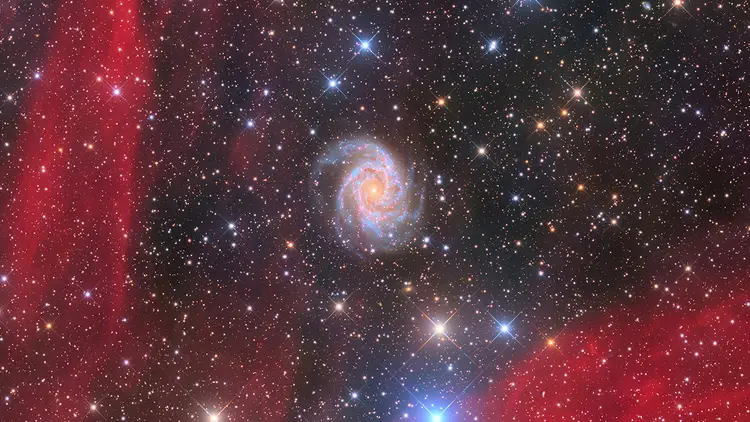


Every year, the ZWO Astronomy Photographer of the Year competition brings together stunning views of the night sky from around the world. Organized by the Royal Observatory Greenwich and supported by ZWO in partnership with BBC Sky at Night Magazine, the competition showcases the incredible talent of both amateur and professional photographers. In 2025, a record-breaking 5,880 entries were submitted from 68 countries, capturing everything from distant galaxies to rare celestial events.
Now in its 17th year, the competition continues to reveal the beauty and mystery of space through breathtaking images. From glowing nebulae and star-studded skies to planetary portraits and lunar close-ups, this year’s shortlist is full of awe-inspiring moments. Here’s a sneak peek at some of the standout photographs ahead of the winners being announced on 11 September.
#21 "Solar System Portrait" By Sophie Paulin
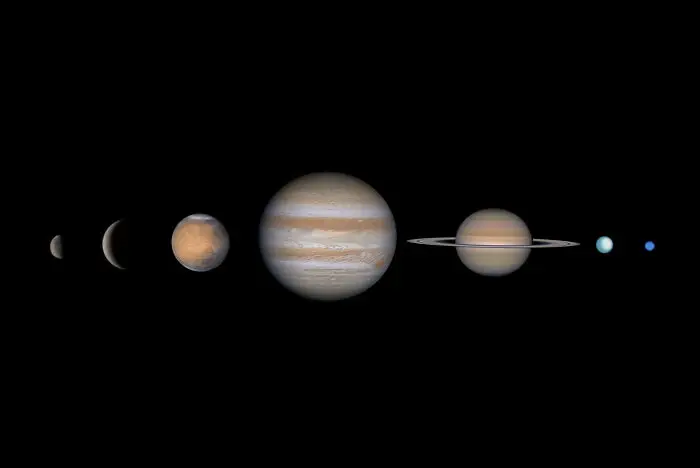
"This image presents all the planets of our Solar System, excluding Earth, showcasing their unique characteristics. Mercury, the closest to the Sun, is a barren, cratered world, while Venus is shrouded in thick clouds. Mars, the Red Planet, has vast deserts and the largest volcano in the Solar System. The gas giants, Jupiter and Saturn, dominate with their immense size and swirling storms, while Saturn’s rings make it especially striking. Uranus and Neptune, the ice giants, are rich in methane, giving them their blue hue."
Taken with a Spacewalk Telescopes Horizon 20" f/3.2 Dobsonian, Tele Vue 5x 1.25" Powermate, Spacewalk Telescopes EQ-Platform ‘Trackie’, Player One Astronomy Uranus-C camera, thousands of <10-millisecond exposures.
Location: Bobingen, Bavaria, Germany, 11 September 2023, 7 September, 29 August and 28 December 2024
Report
5points
#22 "The Arctic Flower" By Vincent Beudez
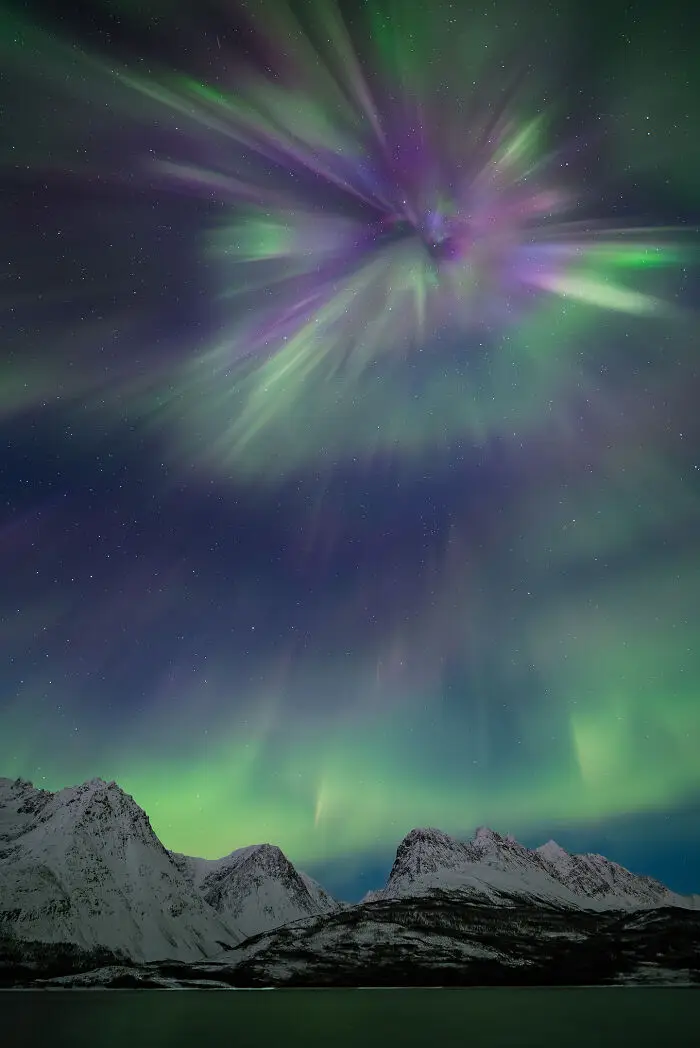
"In April, there is no ‘true’ night in northern Norway. This is why the Northern Lights look much more blue than usual. Vincent Beudez captured the visually pleasing aurora shape above the Norwegian background."
Taken with a Sony Alpha 7S III camera, 14 mm f/1.8, ISO 4,000, 1.3-second exposure.
Location: Sjursnes, Tromsø, Troms, Norway, 4 April 2024
Taken with a Sony Alpha 7S III camera, 14 mm f/1.8, ISO 4,000, 1.3-second exposure.
Location: Sjursnes, Tromsø, Troms, Norway, 4 April 2024
Report
5points
#23 "Encounter Within One Second" By Zhang Yanguang
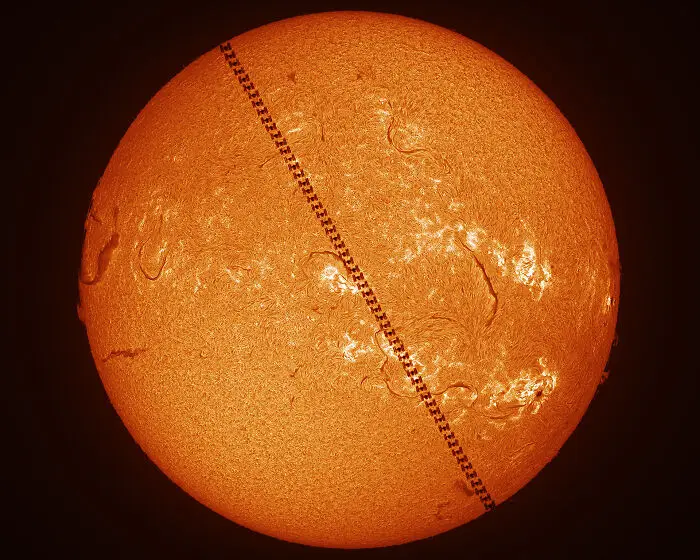
"This image captures the International Space Station (ISS) transiting across the solar disc. The solar background was captured separately with double-stacked etalon[an optical filter that isolates specific wavelengths, used to observe solar details], and reveals high-contrast chromospheric details. The imaging sequences were strategically combined during post-processing to preserve both the spacecraft’s crisp silhouette and the Sun’s intricate surface features. "
Taken with a Takahashi Teegul 60 telescope, Coronado SolarMax 60 double stacked, Vixen polaris mount, Player One Astronomy Neptune-M camera, 500 mm f/8.3, 0.3-millisecond exposure.
Location: Xiamen, Fujian, China, 24 January 2025
Report
4points
#24 "Gateway To The Galaxy" By Yujie Zhang
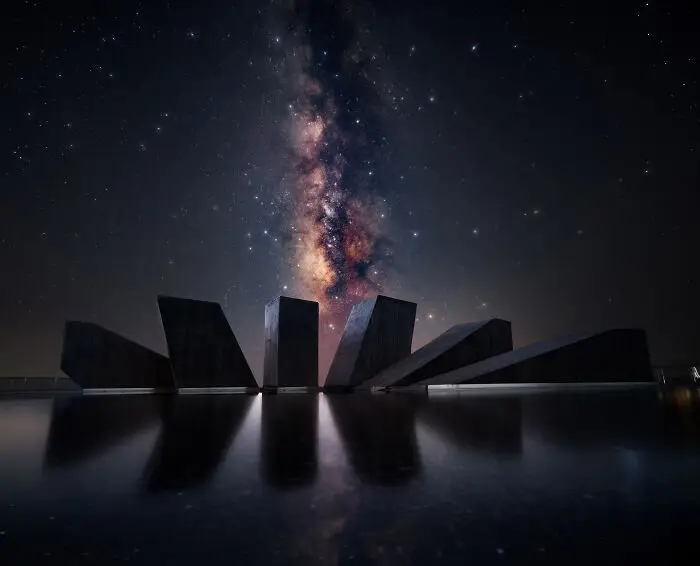
"Under the night sky, several black geometric buildings appear to stand on the water’s surface, resembling gateways to the galaxy. The bright Milky Way stretches across the sky behind them, with stars twinkling. The reflections of the buildings shimmer in the water, blending reality and illusion, as if opening a passage to the mysteries of the Universe, inspiring endless reverie and a longing to explore the vast starry sky."
Taken with a Nikon Z 8 camera, 15 mm f/4, ISO 2,000, multiple 480-second exposures.
Location: Songyang County, China, 10 August 2024
Report
4points
#25 "Neon Sun" By Peter Ward
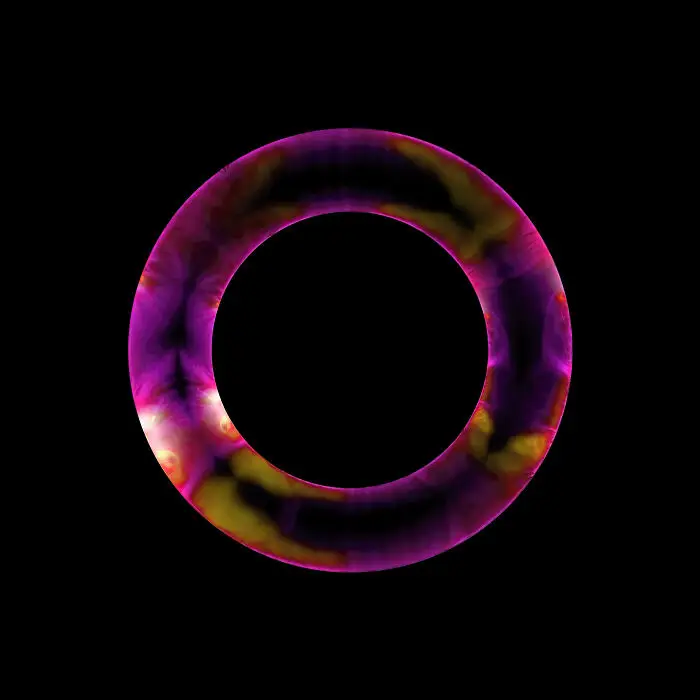
"The data from NASA’s Solar Dynamics Observer (SDO) probe was used here to show the Sun’s inner corona in a way that hints at a process that is similar to that which energises colourful neon lights on Earth.
Images taken by the SDO in the ultraviolet spectrum (at 171, 193 and 304 nm) were re-mapped to a more vibrant palette, with the same coronal data turned ‘inside out’ to surround the Sun, creating the illusion of it being enclosed in a neon tube.
While neon tubes use electrical current to cause the low-pressure gas within them to glow, it is the heat from nuclear fusion that ionises the gas of the Sun’s atmosphere. While this ultraviolet light is undetectable to human eyes, it can easily cause sunburn on unprotected human skin within just few minutes of exposure.
Remapped in Photoshop, the data was then polar inversed to mirror the inner coronal image. Colour saturation was increased by around 30 per cent and given one pass of a noise reduction filter."
Original data from NASA SDO 171, 193, 304 nanometre from 1 June 2024
Data credit: NASA
Report
3points
#26 "Dragon Tree Trails" By Benjamin Barakat
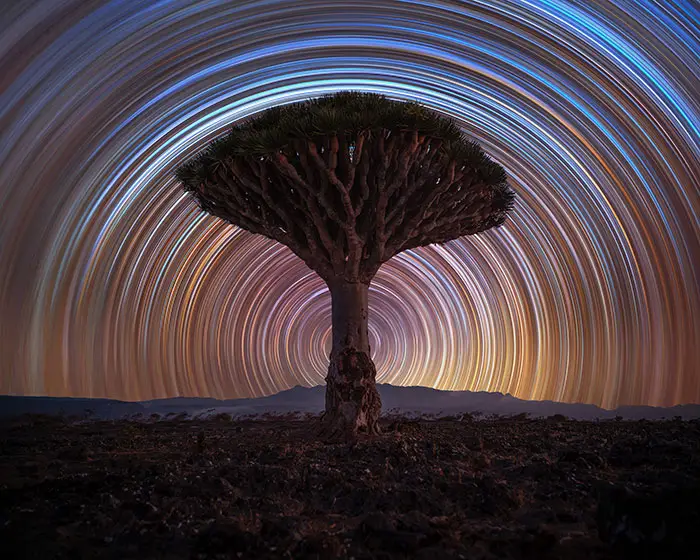
"A solitary dragon tree stands tall in the heart of Socotra’s Dragon Blood Tree forest – an otherworldly landscape unlike anywhere else on Earth. The final image is composed of 300 individual exposures."
Taken with a Sony Alpha 7 IV camera, 24 mm f/2.8, ISO 400, 30-second exposure.
Location: Firmihin Forest, Hidaybu District, Yemen, 13 March 2024
Report
3points
#27 "Blood Moon Rising Behind The City Skyscrapers" By Tianyao Yang
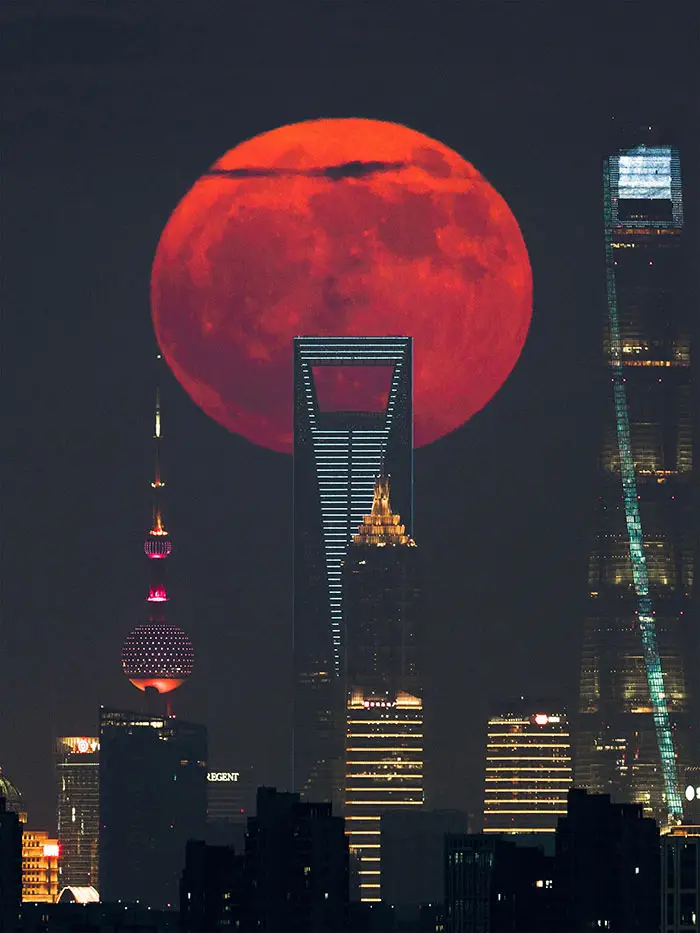
"This photograph captures a red Full Moon rising beside Shanghai’s tallest skyscrapers in Lujiazui. Taken from a distance of 26.5 km (16.5 miles) from the skyscrapers in a single exposure, this image’s alignment took five years of planning. The Full Moon appears perfectly positioned next to the illuminated skyline, creating a striking contrast."
Taken with a Sony ILCE-7RM4 camera, 600 mm f/4, ISO 250, 1/10-second exposure .
Location: Jiading District, Shanghai, China, 21 July 2024
Report
3points
#28 "Total Solar Eclipse" By Louis Egan

"This 22-megapixel panorama shows the different stages of the full solar eclipse, with a high dynamic range (HDR) image of totality in the middle. This reveals both the bright corona and finer details otherwise lost in standard exposures. The final image uses approximately 200 images with varying exposure times to create a HDR totality, before combining everything together."
Taken with a Canon EOS 60D camera, SWSA 2I mount, Sigma 70-300 DG lens, Baader solar filter, 300 mm f/6.3, ISO 100, approximately 1,200 x 1/200-second exposures and 200 x 1/25-second exposures.
Location: Coaticook, Quebec, Canada, 8 April 2024
Report
2points
#29 "Moonrise Over Villebois-Lavalette" By Flavien Beauvais
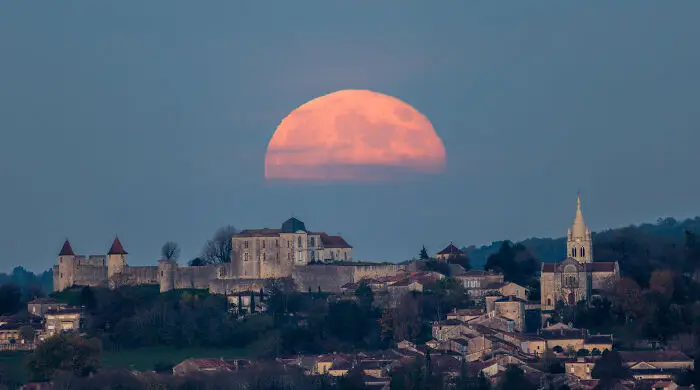
"This unique photograph was taken 6.4 km (4 miles) from the château of Villebois-Lavalette, just north of Bordeaux. The distortions are related to the distance between the imaged Moon and the foreground but also with respect to the atmospheric disturbance, hence the curves on the surface of the Moon."
Taken with a Canon EOS R7 camera, Sigma 150-600 mm lens at 600 mm f/6.3, ISO 2,500, 1/50-second exposure.
Location: La Font Aride, Saint-Amant-de-Montmoreau, France, 16 November 2024
Report
2points
#30 "Progression Of Baily's Beads" By Damien Cannane
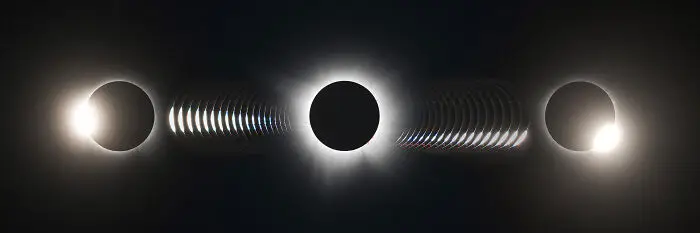
"Baily’s Beads are bright spots around the Moon during a solar eclipse that are caused by sunlight passing through lunar valleys. This composite shows the progression, from left to right, from the first ‘diamond ring’ – a moment when one last bright point of sunlight shines beside the faint corona, resembling a diamond on a ring – fading through Baily's Beads into totality and beyond until a 'diamond ring' occurs again as the Sun starts to reappear. "
Taken with a Sky-Watcher Evolux 62 ED telescope, Celestron NexStar Evolution mount, ZWO ASI2600MC Pro camera, 360 mm f/5.8, Gain 100, Diamond Rings: 200 x 1/ 3-second exposures Baily's Beads: 400 x 1/ 6-second exposures, Totality: stack of 7 x 1/400-second exposure.
Location: Dexter, Missouri, USA, 8 April 2024
Report
2points


