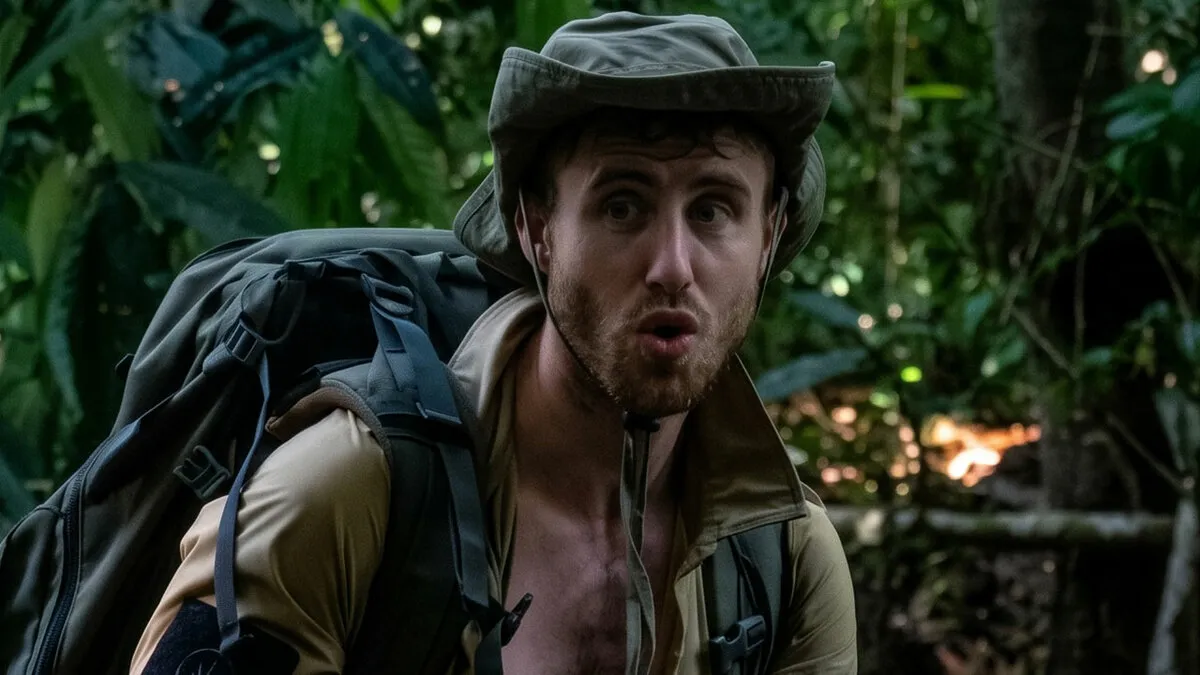
Ash Dykes is a 34-year-old Welsh adventurer who has walked the length of Madagascar, traversed Mongolia alone, and hiked the entirety of the Great Wall of China. He has been followed by wolves for two days in Tibet, paddled crocodile-infested rivers in Madagascar, and encountered bears in the mountains of China. He is not, by any reasonable measure, a man who makes reckless decisions. He is also, in the first weekend of October, dropping an inflatable kayak into the Sangha River in the Central African Republic and paddling 700 kilometres through one of the last truly wild places left on earth, through territory shared by forest elephants, hippos, gorillas, and a parasite that causes permanent blindness. Project Six is Dykes's most ambitious undertaking yet, six extreme expeditions completed back to back with barely two weeks between each. The Sangha River descent is Mission One, and it has already divided opinion before he has even put the paddle in the water. Reddit has already said he is booking himself a one-way ticket. Others have called it the future of exploration. Dykes calls it the “most interactive expedition in modern exploration history.” Bored Panda spoke exclusively to a search and rescue professional operating in remote environments, and to the founder of DRCTOURISM to ask the questions that the comment section has been asking rather less politely. What does survival actually look like when something goes wrong 400 kilometres from the nearest doctor in a rainforest the size of Western Europe? And is an expedition like this opening one of the world's most misunderstood countries to the world, or using it as a backdrop? JosepMGracia Project Six is a series of six extreme expeditions completed consecutively, each one dropping Dykes into a different environment with barely two to three weeks between them to rest, recover, and prepare. Jungle. Desert. Tundra. The specifics of each mission after the first have not been revealed. They get unlocked when the previous one ends, which means Dykes does not just have to survive the Congo. He has to survive it in good enough condition to turn around and do something equally extreme in a completely different climate weeks later. Mission One takes him from Cameroon, overland through the Central African Republic, and then onto the Sangha River at Nola. From there, the plan is to paddle approximately 20 miles per day, carrying ration packs, pitching tents on the riverbank each night, and completing the 700-kilometre descent to Mossaka in the Republic of Congo within a month. ash_dykes They will be burning an estimated 7,000 calories per day. But apart from his food rations, he says a speaker is the strangest item in his kit. He has Starlink for live streaming, a Galaxy Beacon for emergency positioning, and a Garmin InReach as his personal distress signal. A social media manager will be posting two to three times daily from back home, while they also attempt a live stream once a day. "I want to make this one of the most interactive projects as far as modern exploration goes," Dykes has said on a recent podcast. He says he will also be spending time with communities along the river before and during the descent, working with local partners and supporting a grassroots NGO documenting what the river, the wildlife, and the people along it are facing. The choice of inflatable kayaks might seem insane, but the Sangha has rapids and obstructions that would stop a rigid hull completely. The inflatables can be deflated, portaged around whatever the river throws at them, and reinflated on the other side. The whole thing seems to be well thought out. But you can plan untill you are blue in the face; Mother Nature still might have other plans. Guinness World Records Before we get to the survival mathematics, do you even know what the Congo Basin actually is? Laure Zoya, founder and CEO of DRCTOURISM, spoke exclusively to Bored Panda about how people need to reframe their thinking. "The biggest misconception is that the Congo is only a place of conflict and danger. Those challenges are real in certain regions and should never be minimised, but the Democratic Republic of Congo is an enormous and extremely diverse country." The DRC is the second largest country in Africa by land area and, by most global comparisons, the second most biodiverse country on earth after Brazil. It has nine national parks, more than 400 mammal species, more than 1,000 bird species, and species found nowhere else, including the bonobo, the okapi, the eastern lowland gorilla, and the mountain gorilla. The Congo River itself is the deepest river on Earth, with sections reaching approximately 220 metres, and carries the second-largest volume of water of any river in the world after the Amazon. MODIS Land Rapid Response Team, NASA GSFC Not everyone on the internet was convinced Ash is truly putting his life on the line, though. One Reddit commenter wrote that “[they] started researching and he's actually going down the Sangha River. That river is touristy and not as scary as I had originally been thinking." This is partly true. The Sangha, relative to some of the Congo Basin's more remote waterways, is not entirely unmapped territory. But “touristy” isn’t exactly the right word, and Dykes is not oblivious about what awaits the expedition. Malaria. Dengue fever. Parasites, which he says are a near certainty. Then there is river blindness, a disease he had not heard of before beginning his preparation, caused by a parasitic worm spread by blackfly bites along fast-moving water, producing severe skin conditions and, in advanced cases, permanent blindness. Chris Stenger (not the actual photo) "There's no way I'm not coming back with a parasite," he has said to People Magazine. But he seems like a man who has made his peace with the smaller threats because the larger ones require his full attention. The larger ones include hippos, which kill more people in Africa each year than any other large animal, and forest elephants, which have established corridors through the jungle that the team cannot pitch their tent across. "They'll trample you," Dykes notes. He has encountered bears and wolves and crocodile-infested waterways before. He has not encountered a combination of hazards in this kind of geography, but his bags are packed anyway. Guinness World Records Dykes has a Garmin InReach, a Galaxy Beacon, and Starlink. He has, in other words, the full complement of modern satellite technology that gives expedition creators and their followers a comfortable sense that if something goes wrong, help will come. Bored Panda spoke to a Search and Rescue operator who operates in remote environments and requested anonymity given the sensitive nature of their work. He filled us in on what good a Garmin will do you once trouble comes knocking. "That is a very good system to have," he said, "but as we all know, technology can fail, sometimes very badly." The Garmin InReach sends coordinates through a 24-monitor system, which then contacts either local or international rescue teams depending on location. In theory, this is reassuring. In practice, the source explains, the coordinates represent where the device was when the signal was sent, not necessarily where the person is by the time anyone reaches the area. Dehydration sets in fast in equatorial heat. Disorientation follows. A person who sent their coordinates from a point on the river may have drifted, wandered, or been moved by the current before any rescue team is mobilised, let alone arrives. Toza Productions (not the actual photo) "By the time a rescue team or medical team is mobilised to come and search for you, it is gonna be some time," the source said. "I can't put an exact time on that. It's gonna depend on the local resources available, or if international help is required, how long that response takes." He also notes that the political complexity of operating across multiple jurisdictions- the Central African Republic, the Republic of Congo, and potentially the DRC- adds layers of bureaucratic and logistical delay that no satellite device can shortcut. And then there is the forest itself. "The trees make it quite difficult to search for a person. It is very, very dense." A helicopter can identify a GPS coordinate. It cannot necessarily see through a rainforest canopy to the person below it. A ground team can be mobilised. It cannot necessarily reach a location several days' travel from the nearest accessible point. "It is also known for searches to be suspended after a week or two for a person who has gone missing," the source said. "How long will they fund that search? At what point do they determine they cannot find the person?" The source adds one final variable that tends not to feature in expedition content: the crocodiles. In 2010, world-class kayaker Hendri Coetzee was taken from his rigid plastic boat by a crocodile estimated at fifteen feet and two tonnes, on a quiet stretch of the Lukuga River in the Congo, while paddling four to five feet from two experienced teammates. Dykes is paddling an inflatable. "I reckon they would go for something just drifting down the river like a free lunch," the source said candidly. When asked what his honest, unfiltered reaction about this expedition was, he simply said: “Insanity.” Noted. Brett A (not the actual photo) When a western creator takes extreme, calculated risks in a remote environment for an audience of followers and a subscription model charging approximately $8 a month for exclusive content, they are not only risking their own life. They are, in the event that something goes wrong, counting on local, under-resourced rescue teams, rangers, and ground fixers to risk their lives to find them. "They will go to the most extreme to find these people," the source said. "They will put their lives on the line to go and search for a victim." This applies regardless of how the victim came to need rescuing. A rescue operator does not distinguish between someone who fell into difficulty accidentally and someone who chose a route that made difficulty statistically likely. They go. "But I also think a line has to be drawn somewhere. You are putting teams of thirty, forty people, depending on the operation, in danger for one guy. For views on TikTok." Rawpixel (not the actual photo) The Reddit reaction sits at both ends of this spectrum. "This is a suicide mission if ever there was one. Reckless stupidity that has nothing to do with human endurance," wrote one commenter. "I won't feel any sympathy if something happens to him. These guys are driven by the urge to satisfy their thrill-seeking egos," wrote another. These responses are understandable and also, in some respects, beside the point. The more useful question is not about sympathy. It is about the structure of accountability around expeditions like this, and whether the communities on the ground have any meaningful say in the risk calculations being made above them. ArtHouse Studio (not the actual photo) Zoya's perspective on what responsible exploration can do for the DRC reframes the entire debate about whether expeditions like this are appropriate at all. "Responsible explorers can make an enormous contribution because they bring international attention to ecosystems and communities that rarely receive global coverage. Someone documenting an expedition through the Congo Basin can introduce millions of people to forests, rivers, wildlife and communities they may never have encountered before. That visibility can encourage tourism, conservation funding, scientific interest and economic opportunities for local communities." "We are pleased to see the work of Ash Dykes bringing attention to challenging and underrepresented destinations,” she adds. “We hope to join Ash Dykes in promoting responsible exploration of the DRC and to support future expeditions through local knowledge, logistics, community connections and responsible tourism planning." Her conditions for what makes exploration responsible are equally explicit. "The story should also recognise the Congolese guides, boat crews, fixers, communities and experts who make these journeys possible. Content can become harmful when poverty is turned into entertainment, communities are filmed without dignity or consent, sensitive wildlife locations are exposed, or danger is exaggerated simply to create more dramatic content." The DRC's tourism potential is extraordinary and almost entirely unrealised by the international market. The country that supplies the cobalt in the battery of the device you are reading this on is largely unknown to the people using that device. Its forests, its river systems, its wildlife, its 450 distinct tribal cultures: none of these have had anything approaching the global exposure they warrant. An expedition that reaches millions of followers and is documented daily across multiple platforms is, if it is done responsibly, the kind of attention that conservation funding and community economic development can be built on. If it is done irresponsibly, it is a very expensive selfie with a very dangerous backdrop. Camilo Ospina (not the actual photo) Ash Dykes has done things that most people would describe as impossible and returned to describe them. He has the experience, the preparation, the local partnerships, and the technology to give this expedition a serious chance of being exactly what he says it is: a landmark moment in interactive exploration that brings meaningful attention to one of the world's most overlooked natural environments. He is also paddling an inflatable kayak through a river system where a fifteen-foot crocodile took a world-class kayaker from a hard-shell boat, in a forest that covers close to two million square kilometres, several days from the nearest medical facility, in a region where search operations are resource-limited, politically complicated, and known to be suspended when they run long enough without result. Both of these things are true simultaneously, which is what makes the expedition deeply compelling rather than simply reckless or simply brave. The line between those two things has never been drawn in advance. It gets drawn by what happens. Dykes drops in at the beginning of October, and his protein bars and kayaks are packed. We will be watching.