



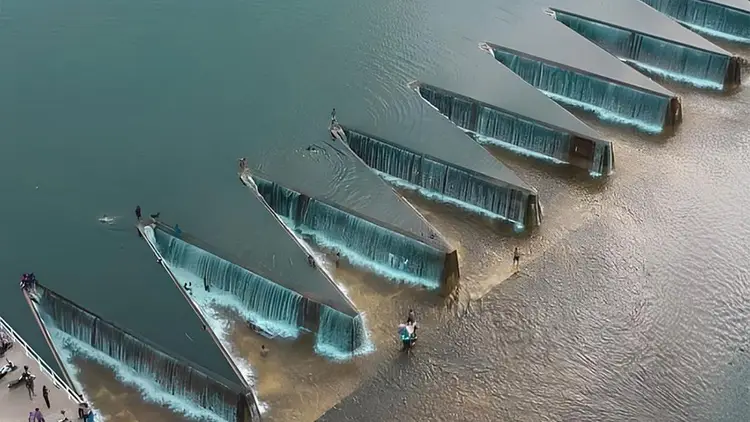


With new technology, smarter tools, and a lot of patient digging, historians and archaeologists are uncovering marvels from every corner of the world.
One day it’s an enormous thigh bone from a titanosaur. Another day, Roman mosaics reappear from the waters of the Euphrates, still stunning after 2,000 years.
The world is full of wonders whether it’s ancient, modern, natural, or man-made, and so is this list curated from the Facebook group ‘Art, History & Archeology from around the world.’
Created in 2020, the group has grown to over 125.3K members.
#61
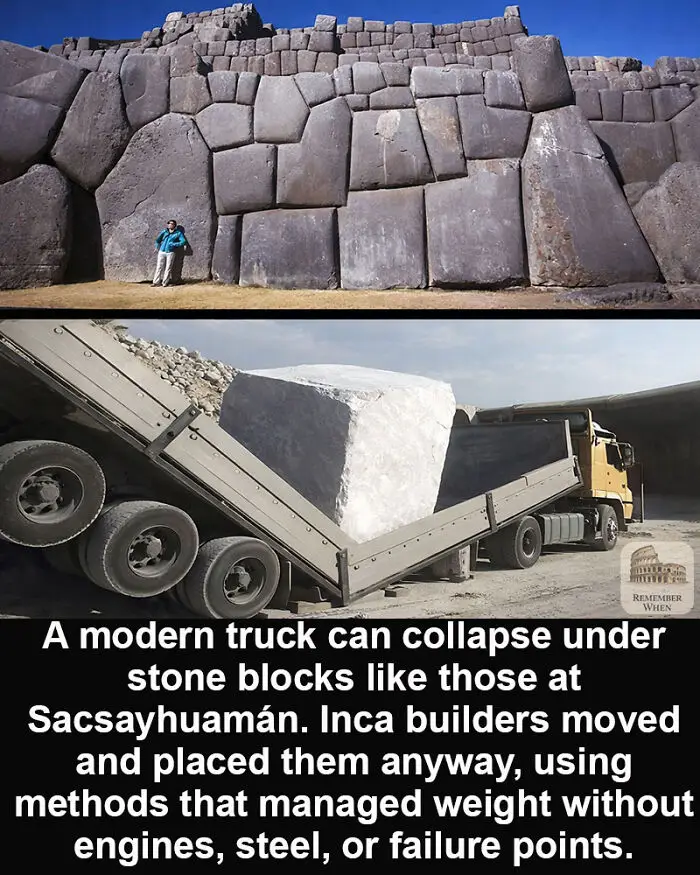
The contradiction is mechanical, not mythical. At Sacsayhuamán, above Cusco in Peru, Inca builders in the 15th century handled limestone blocks weighing tens, sometimes over a hundred tons. The image of a modern vehicle breaking under a comparable load reframes the discussion.
These stones were not dragged casually. They were shaped, moved uphill, rotated, and seated with precision that tolerates no adjustment after placement. Modern engineering relies on steel frames, hydraulics, and reinforced axles to manage such mass. None of these existed here.
Archaeology points to ramps, rollers, ropes, levers, and coordinated labor. These are valid principles, yet the exact execution remains undocumented. No surviving tools match the demands implied by the finished structure.
What stands at Sacsayhuamán is evidence of applied technology, not brute force alone. The stones behave as proof of systems that worked reliably at extreme limits. The methods succeeded so completely that only the results remain, leaving the engineering logic intact but partially invisible.
And there is one more uncomfortable detail: some evidence suggests the massive megalithic foundations at Sacsayhuamán may predate the Inca, who appear to have built more rudimentary structures atop earlier walls, a difference in technique still visible today. But that's another discussion for another day.
Report
13points
#62
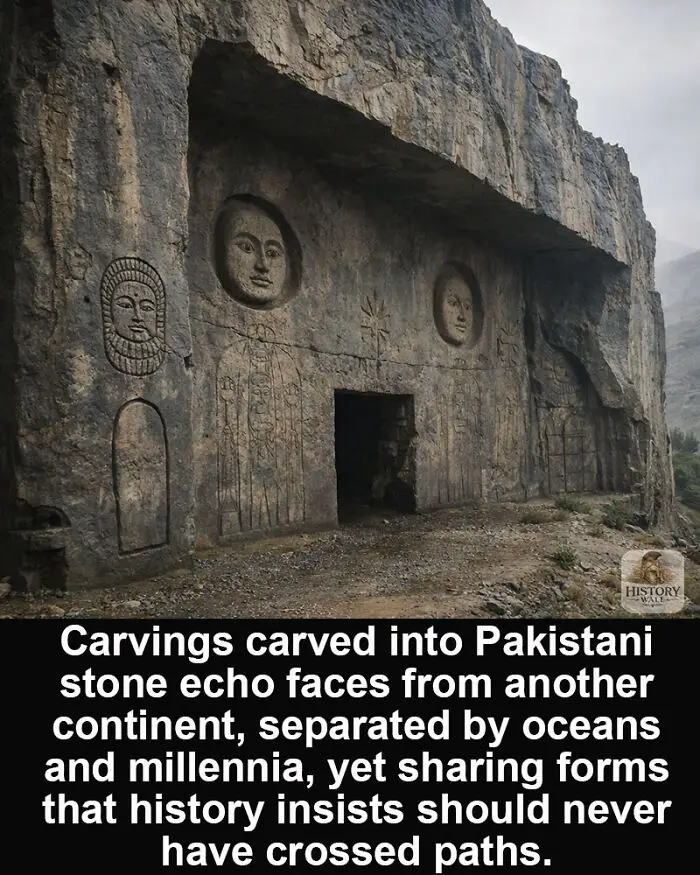
These carvings, found in Pakistan and cut directly into exposed rock, challenge an assumption that ancient cultures developed in isolation. The faces, with heavy features, stylized eyes, and deliberate symmetry, resemble artistic conventions commonly associated with the Olmec civilization of Mesoamerica, active roughly between 1500 and 400 BCE.
Mainstream archaeology places the Olmecs firmly in the Americas, with no verified evidence of transoceanic contact with South Asia. In Pakistan, the carvings are typically interpreted within local religious or cultural traditions, shaped by regional beliefs rather than foreign influence. Yet the visual overlap remains difficult to dismiss at a glance.
No inscriptions link these works, no tools trace a shared origin, and no texts describe contact. The similarity exists only in stone and form, recorded but unexplained. Whether coincidence, parallel development, or something not yet understood, the resemblance lingers without asking permission from established timelines.
Report
13points
#63
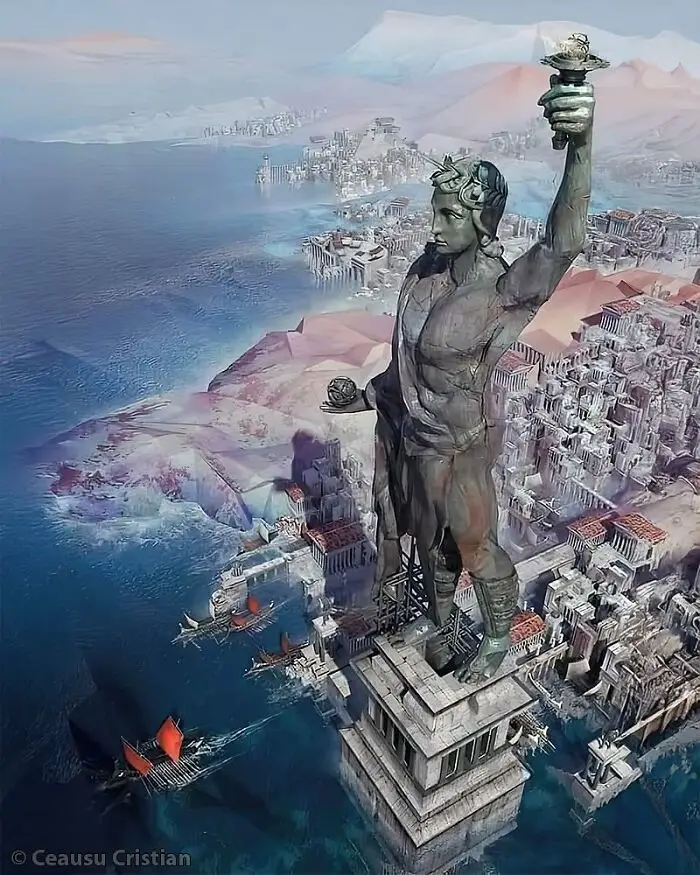
Imagine a statue that once soared 157 feet into the sky, a colossal tribute to the sun god Helios, casting its shadow over Rhodes. Erected between 292 and 280 BCE by the skilled sculptor Chares, the Colossus of Rhodes celebrated the island's triumph over Cyprus. Crafted from iron and brass and filled with stone, this marvel stood proudly at Mandraki Harbor for 54 remarkable years. However, tragedy struck in 226 BCE when a powerful earthquake shattered its grandeur, leaving only mystery in its wake. Today, the Colossus continues to captivate our imagination through artistic representations of its former glory.
Report
12points
#64

After the attack on Pearl Harbor, the USS West Virginia sank to the harbor floor, torn open by torpedoes and bombs. While many sailors died instantly, some survived the initial chaos, sealed inside dark compartments deep within the ship.
Months later, during salvage operations, workers discovered one such space. Inside were the remains of three sailors. On the steel wall beside them, a crude calendar had been scratched by hand.
Sixteen days were marked, one by one. These men had lived far longer than anyone realized, enduring darkness, rising water, limited air, and the slow certainty that help was not coming.
They did not persih in combat or explosion. They met their demise waiting. The calendar they left behind transformed their deaths from statistics into a human story of endurance, hope, and silence. It stands today as a reminder that the cost of war is not always loud. Sometimes, it is measured quietly, line by line, on cold steel.
Report
12points
#65
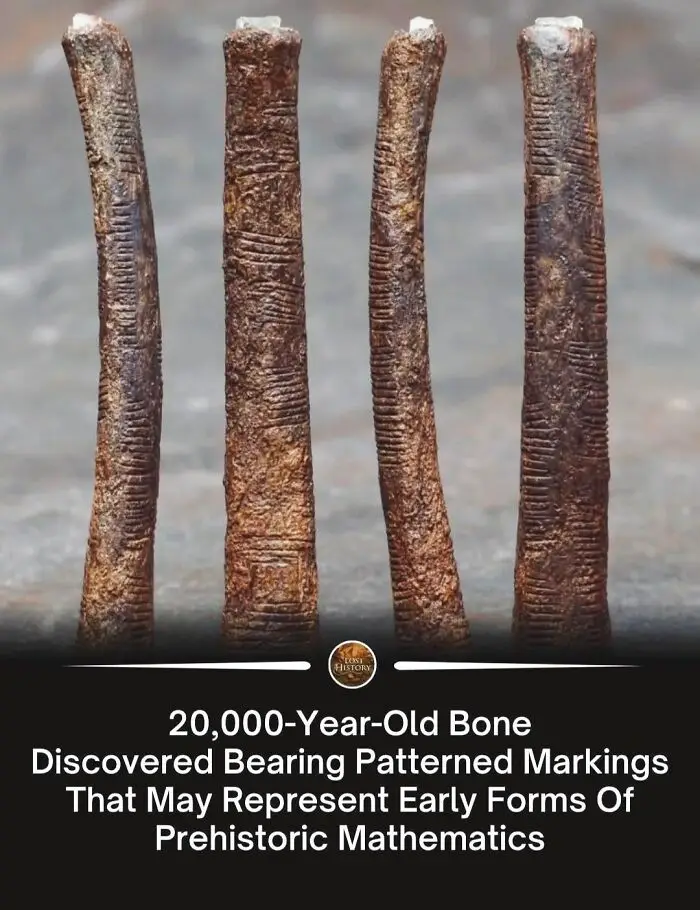
20,000-year-old bone has been discovered bearing patterned markings that some researchers believe represent early prehistoric mathematics. The artifact offers a tantalizing glimpse into the cognitive and symbolic abilities of Ice Age humans.
Archaeologists studying the bone note the repeated lines, scratches, and geometric arrangements etched into its surface. These patterns appear deliberate rather than random, suggesting intentional recording or counting. Some scholars propose that the marks could represent lunar cycles, tallying, or other primitive mathematical concepts, hinting at abstract thought far earlier than previously assumed.
The bone was likely a tool, a teaching object, or even a ritual item. Its markings demonstrate that early humans engaged not only in survival but also in observation, calculation, and symbolic expression. Each line invites curiosity: who created it, for what purpose, and how sophisticated was their understanding of numbers or patterns?
Beyond mathematics, the artifact evokes mystery. It connects us with individuals who lived tens of thousands of years ago, whose lives, knowledge, and intellectual curiosity have been frozen in time. The bone bridges millennia, showing that even in a harsh Ice Age world, humans sought to understand, organize, and interpret their environment in systematic ways.
This 20,000-year-old bone reminds us that history often hides in small details. Patterned markings preserved for millennia reveal early ingenuity, abstract thinking, and the enduring human drive to explore the mysteries of numbers, time, and life itself.
Report
12points
#66
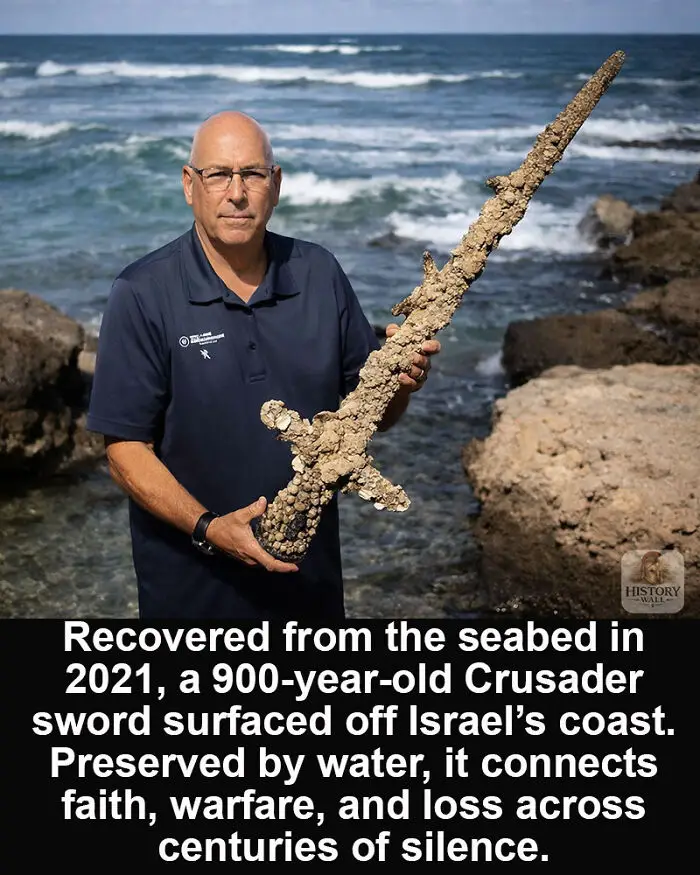
In October 2021, the sea returned a contradiction. Violence emerged from stillness. Off Israel’s northern coast, a 900-year-old iron sword surfaced from the seabed, preserved where waves had erased memory but not metal. Nearly four feet long, the weapon dates to around 1100 AD, the era of the Crusades, when faith and conquest traveled together toward the Holy Land.
The sword is believed to have belonged to a Crusader knight, likely lost during a coastal journey or skirmish. Its survival owes nothing to intention. Buried beneath sand and saltwater, the iron avoided complete corrosion, locked away from air and human hands. What remained was not a relic displayed for glory, but an object abandoned by circumstance.
This find does not recount a single battle or name a fallen owner. It offers something less complete and more unsettling, a direct link to movement, risk, and belief carried across dangerous seas. The blade endured. The story around it remains fragmented.
Report
11points
#67
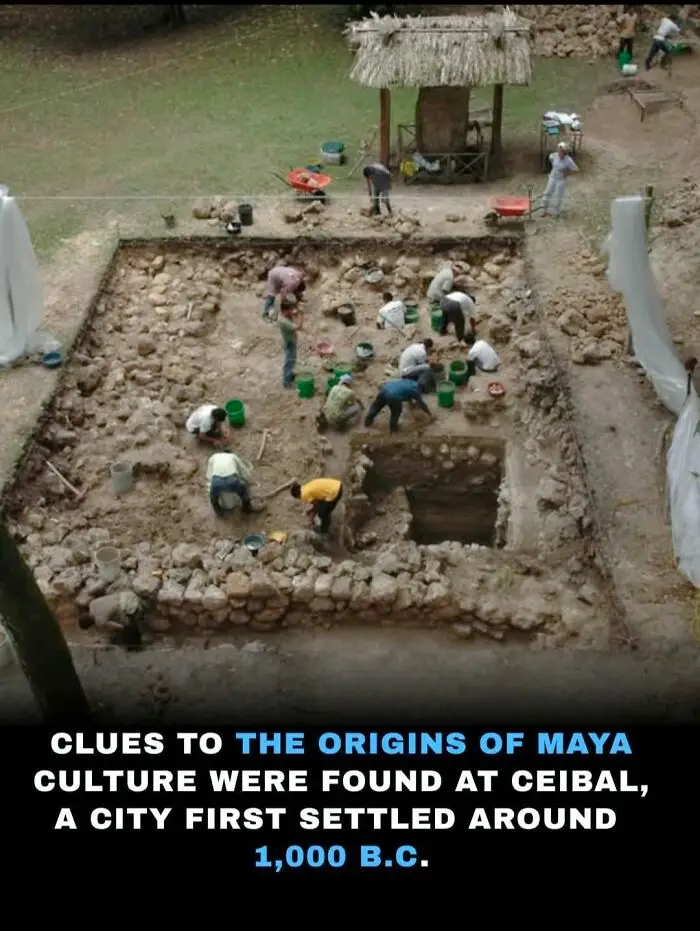
Archaeologists have uncovered important evidence about the origins of Maya culture at the ancient city of Ceibal, located in what is now Guatemala.
The site was first occupied around 1,000 B.C., making it one of the earliest places where researchers can trace the beginnings of Maya civilization. Excavations show that Ceibal played a key role during a formative period, when early communities were developing new religious practices, political organization, and monumental architecture.
The discoveries suggest that many ideas later associated with classic Maya culture—such as ceremonial centers, ritual gatherings, and shared artistic traditions—were already taking shape here.
Rather than emerging suddenly, Maya civilization appears to have grown gradually from these early experiments in social and religious life. Ceibal offers a rare window into that critical moment when scattered communities began transforming into one of the most influential cultures of ancient Mesoamerica.
Report
11points
#68
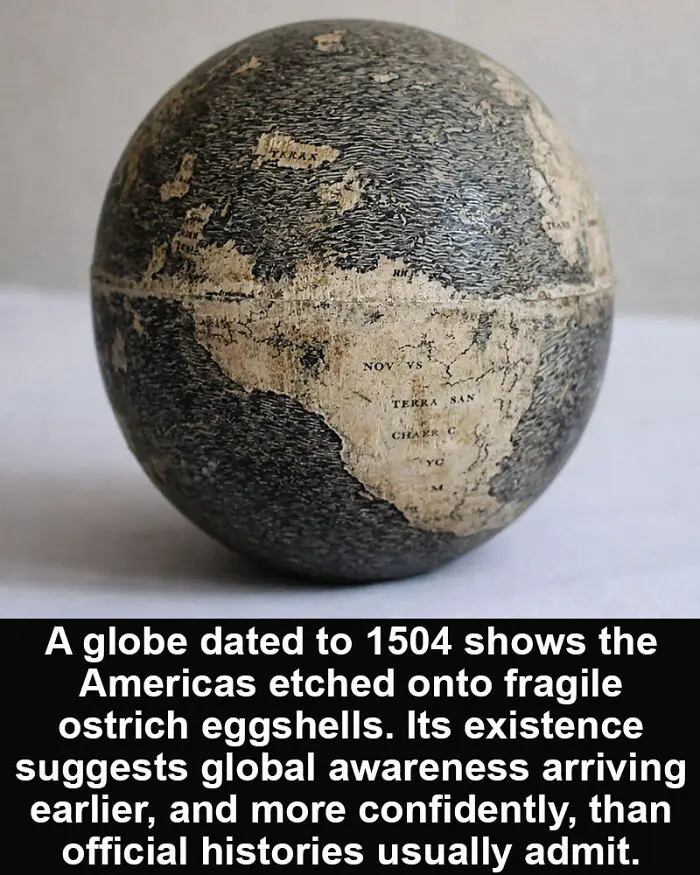
This object sits uncomfortably early in the story of world mapping. Dated to 1504, the so-called ostrich egg globe is widely regarded as the oldest known spherical depiction of the Americas, created only years after European contact.
The globe is constructed from two joined ostrich egg shells, their fragile surface carefully engraved with coastlines, names, and oceans. South America appears clearly labeled, not as rumor or suggestion, but as a defined landmass. That confidence is the tension. Cartographic certainty seems to arrive faster than exploration narratives imply.
Some scholars have proposed a connection to Leonardo da Vinci, based on stylistic and technical similarities, though no definitive attribution exists. What is certain is the skill required to engrave such detail onto an eggshell without destroying it.
The artifact reflects a moment when geographic knowledge, ambition, and secrecy overlapped. It records a world still being claimed, mapped, and interpreted, faster than its story could fully be told.
Report
8points
#69
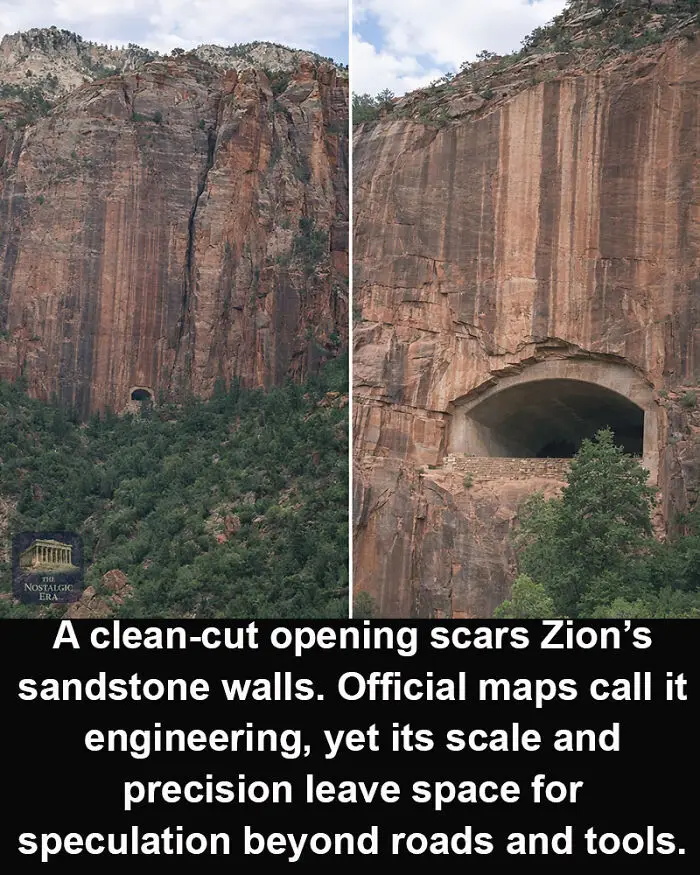
At Zion National Park, towering sandstone cliffs dominate the horizon, shaped over millions of years by erosion and uplift. Yet embedded within these walls are tunnels that interrupt the geological narrative.
The most famous, the Zion–Mount Carmel Tunnel, was carved in the early 20th century to connect remote canyon routes. Its smooth curvature, uniform ceiling, and strategic placement stand in sharp contrast to the surrounding fractured rock. From a distance, the openings appear almost intentional in a way nature rarely produces.
Engineering explains how the tunnels were made and when. It does not fully explain why their presence feels so anomalous within such an ancient landscape. Some observers have suggested alternative possibilities, including hidden or secondary uses never documented. There is no evidence to support such claims, yet the visual tension remains. In a place defined by deep time, even modern interventions can feel strangely out of context.
Report
2points
