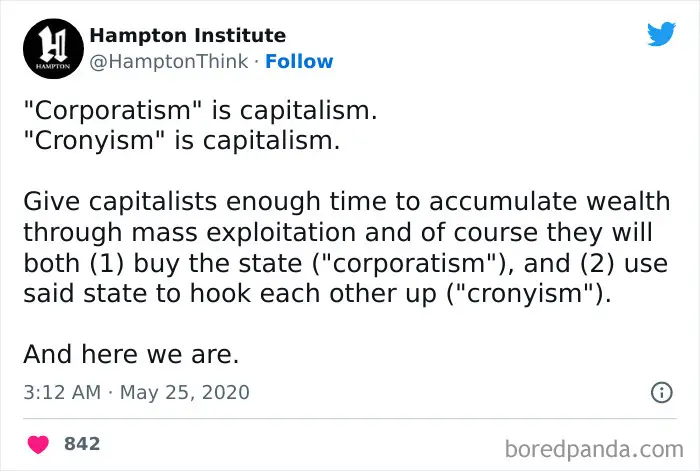



In practice, this is the dominant form of capitalism worldwide, due to the powerful incentives both faced by governments to extract resources by taxing, regulating, and fostering rent-seeking activity, and capitalist businesses trying to increase profits by obtaining subsidies, limiting competition, and erecting barriers to entry. In effect, these forces represent a kind of supply and demand for government intervention in the economy, which arises from the design of the system.



Critics argue that capitalism leads to a significant loss of political, democratic and economic power for the majority of the population because it creates large concentrations of money and property in the hands of a relatively small minority (the elite or the power elite), leading, according to them, to very large and increasing wealth and income inequalities between the two groups.
And while 57% of the American public continues to view capitalism favorably, that is 8 percentage points lower than in 2019 (65%), a 2022 national survey by the Pew Research Center revealed.
However, its main "competitor" isn't doing too well either. Just 36% of U.S. adults say they find socialism to be somewhat (30%) or very (6%) positive, down from 42% who viewed it positively in May 2019. (Six in ten today say they view socialism negatively, including one-third who view it very negatively.)