





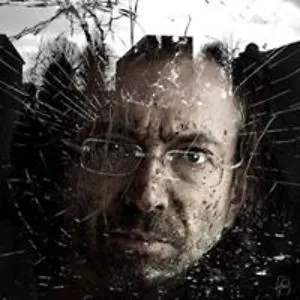

Between 2012 and 2020, I photographed several hundred places of worship across Europe. Over time, these places became enveloped in silence. The only thing heard there now is an occasional gust of wind whistling through broken stained glass or the rhythmic drip of water leaking through the dilapidated roof above a nave.
Nevertheless, these muted places still draw an occasional visitor. Once upon a time, prayers could be heard recited in Latin in a German church; and in a French Catholic college, the voices of children once resounded to the sound of the bells. But who can imagine what sounds might be concealed behind the walls of a crypt in the heart of the Italian mountains, or within a tomb in a former convent in Portugal?
Why visit and photograph abandoned or forgotten places? Why have I concentrated my attention on places abandoned by humankind and traveled thousands of kilometers each year to bring back photographs of them? Must a passion necessarily be explained to be shared? Because sharing is indeed what this is all about: sharing the emotions I had when I discovered places of worship that exist in harmony with the ruins of time.
My book Abandoned Churches: Unclaimed Places of Worship is an unparalleled testimony to these places.
This post may include affiliate links.
#21 It Will All Work Out / 12th And 16th-Century Castle Chapel, France, Grand-Est Region
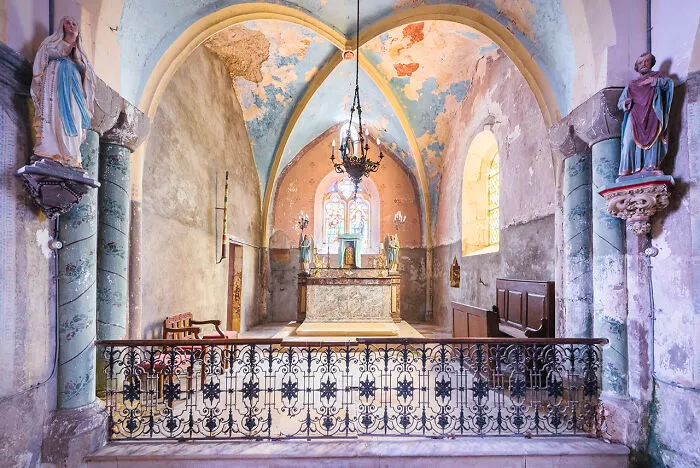
"Always in the axis, double arch with golden features, taut double arch with frescoed remains... on each side, a statue, therefore... two guardians of the image: one... a virgin, the other... a very colourful saint... the columns outlined with barely visible, fleeting, moving strips... a vault medallion presides... with a central... even self-centred position, “in visibilio” again. A hanging chandelier seems to answer for its ironwork at the edge of the altar, which is far away, at the very bottom of its history. A pew, on the right, in prayer... maybe... in discussion... at best, in waiting... is also in a dialogue with its alter ego... longer and so much in front. Two orderly angels carry shabby candelabras... a stained glass window... on the right, or a garden, it depends, powers a soft light: the one that will arouse a mystic-like ecstasy for a moment. Diametrically, a sculpted and hanging handle answers for its superb, its place... its shape and its semblance of coloured shadow. To him. In the background, another intact, openwork stained glass window watches over and surprises this tabernacle... a golden door... A long step nonchalantly sprawls out in front. All the candles are electric and try to make us believe in a system that would have, one day, modernised the space... where sockets and switches act as delicately obsolete supports. The inhabited marble altar." —Nicolas Hamm
8points
#22 In Your Villainous Memory / 13th, 15th, And 18th-Century Church, Belgique, Hainaut
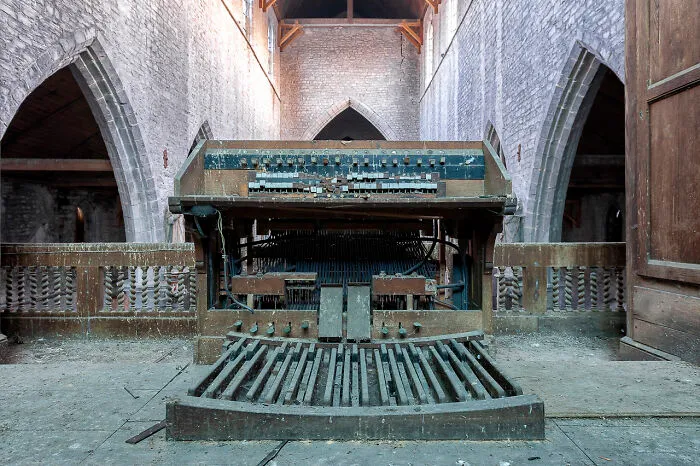
"I’ve seen this image many times before. I was much younger, I was in a church and there was this man in a dress who was raising his arms to the sky as he sang. I was much younger, overcome by pain and anger. I closed my eyes and I saw this image, not this exact image but a similar one. And every time I opened my eyes, I saw this man in front of me again. Every time I closed them again, I was brought back to the second image. For a second, I thought that by concentrating, I would succeed in making everything explode, in devastating everything, in reducing to dust this unbearable reality, like at the end of Brian de Palma’s Carrie or at the end of Antonioni’s Zabriskie Point, a magnificent and liberating destruction." — Michel Cloup
7points
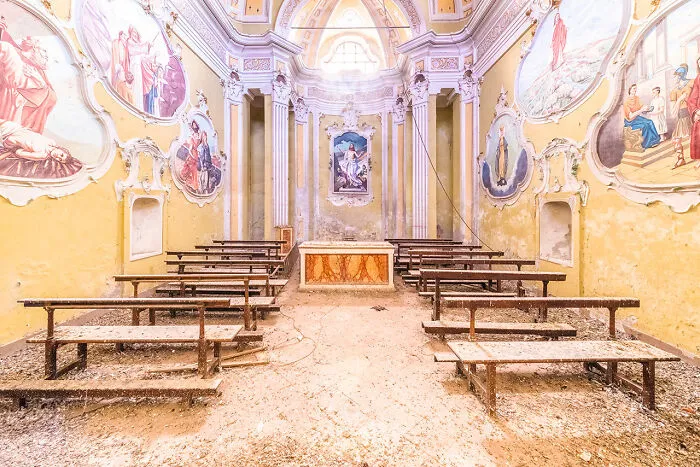
#23 In Contrast / 18th And 19th-Century Chapel, Italy, Lombardy Region
7points
#24 State Of Mind / Early 18th And 19th-Century Chapel, Italy, Veneto Region
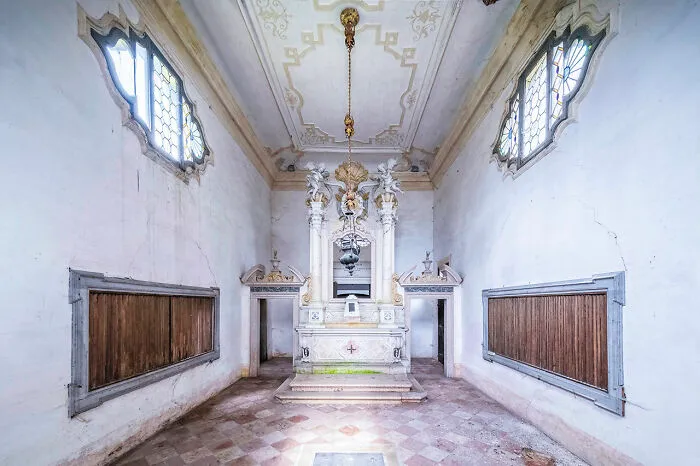
"The traveller awakens at the heart of a white parallelepiped that seems to extend infinitely. The traveller? No one knows where he comes from? No one knows when he comes from?
For him, the only point of reference in this escapade is the checkerboard floor covered with alternating squares of white tiles, worn by time, and reflection-free natural bistre tiles.
The light seems to emanate from the centre; more precisely, at the foot of a black stele embedded in the floor. Engraved with inscriptions that the traveller cannot read, this deep black stele seems to push the light towards the ceiling.
A lamp hanging from a long golden cable falls from the high ceiling! This cable is like a line that prolongs these friezes in angles and golden arabesques, remnants of random and cabalistic paths towards the unattainable. Beyond, an altar erected for forgotten gods dominates the heart of infinity, of this checkerboard. Made of immaculate marble, it creates, like an Yggdrasil, a bridge between earth and sky. The mirror in the middle reveals the back of the traveller. It is a focal point, supported by the perspective of low windows, long rectangles that were sealed in the old days — what abysses, what monsters hide behind these bars in order to be forgotten?
Only the pupils of the high windows act as exits, inaccessible but open to the light and towards an unknowable elsewhere!" — Samuel Nowakowski
For him, the only point of reference in this escapade is the checkerboard floor covered with alternating squares of white tiles, worn by time, and reflection-free natural bistre tiles.
The light seems to emanate from the centre; more precisely, at the foot of a black stele embedded in the floor. Engraved with inscriptions that the traveller cannot read, this deep black stele seems to push the light towards the ceiling.
A lamp hanging from a long golden cable falls from the high ceiling! This cable is like a line that prolongs these friezes in angles and golden arabesques, remnants of random and cabalistic paths towards the unattainable. Beyond, an altar erected for forgotten gods dominates the heart of infinity, of this checkerboard. Made of immaculate marble, it creates, like an Yggdrasil, a bridge between earth and sky. The mirror in the middle reveals the back of the traveller. It is a focal point, supported by the perspective of low windows, long rectangles that were sealed in the old days — what abysses, what monsters hide behind these bars in order to be forgotten?
Only the pupils of the high windows act as exits, inaccessible but open to the light and towards an unknowable elsewhere!" — Samuel Nowakowski
7points
#25 Stars In The Eyes / 19th-Century Church, France, Occitanie Region
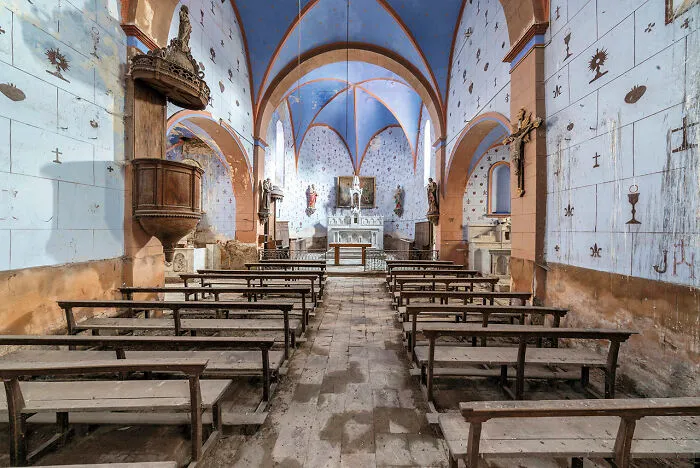
"We climbed through the forest in single file, sometimes at night with torches. And up there on the moor, she would appear. Small and stocky, encircled by large, flat, mossy stones . . . turned towards the sea. After the damp porch, a drunkenness of light, a ship’s hull overturned above our heads to protect us from ill fate. When the regular Masses ceased, candles continued to be burned there: for a school exam, a driver’s license, a medical
exam, a love wish, for anything and everything. I think it lasted until the great storm of ‘77, when so many boats did not return. We felt betrayed. Yes, that’s right, it was after ‘77 that the village really deserted the chapel." — Sylvie Robic
exam, a love wish, for anything and everything. I think it lasted until the great storm of ‘77, when so many boats did not return. We felt betrayed. Yes, that’s right, it was after ‘77 that the village really deserted the chapel." — Sylvie Robic
6points
#26 Close To Privileges / 14th, 16th, And 19th-Century Castle Chapel, France, Nouvelle-Aquitaine Region
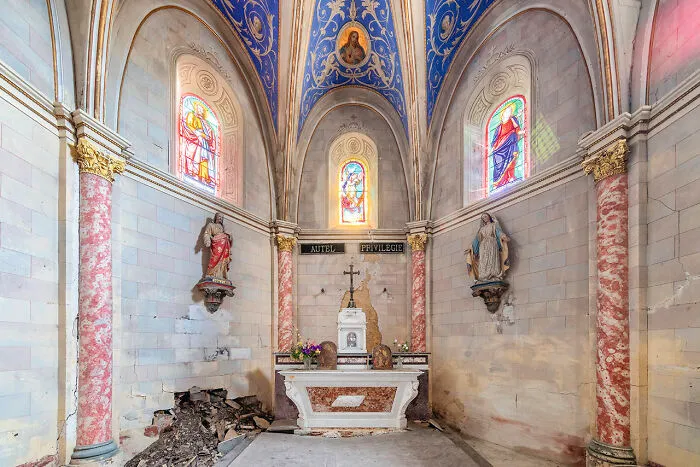
"One of those chapels that was so often built next to some convent. A simple architecture whose high windows were the only source of light. The whiteness of the walls did the rest. The apse, of Gothic inspiration, is only the extension of an austere nave, lifted only by committed pillars. The Corinthian-style capitals, along with the ornaments of the vaults, are the only elements bringing a spark of gold. A blue vault recalls the sky. The statues are limited to the essential: the Virgin and Saint Joseph in the apse, and a large crucifix. There are some images on the side walls. Was it the Way of the Cross or the representation of some saint? There is a side door pierced into the south wall, another one opposite leads to a room that is probably also abandoned.
How many of them, men or women, came to pray in this chapel, addressed a prayer to the Virgin Mary, or made a plea to St. Joseph? The songs to the glory of Jesus and his disciples and the murmur of prayers could be heard in calmness and devotion. To those who entered the place, everything seemed so luminous, so simple and so grandiose at the same time that they found peace and comfort here. Tears could also probably have been heard, and many a teardrop brought a blessing of pain to the ground.
Today, some immobile chairs still attend silent services, and the servants no longer ring the bells or bring the mass wine. The only witnesses to these sleepy services are now nothing more than splinters of stucco, plaster, and paint that no one looks at anymore. Yet the neatly arranged chairs suggest that from time to time, very rarely, there may be a service attended by old ladies and people nostalgic for a bygone era.
If one day our footsteps lead us to such places, let us not think that they are dead. They are asleep.
Let us come here with curiosity, with eyes wide open and a sympathetic ear, and with a bit of luck we may just hear the breath of angels." — Christian Montesinos
How many of them, men or women, came to pray in this chapel, addressed a prayer to the Virgin Mary, or made a plea to St. Joseph? The songs to the glory of Jesus and his disciples and the murmur of prayers could be heard in calmness and devotion. To those who entered the place, everything seemed so luminous, so simple and so grandiose at the same time that they found peace and comfort here. Tears could also probably have been heard, and many a teardrop brought a blessing of pain to the ground.
Today, some immobile chairs still attend silent services, and the servants no longer ring the bells or bring the mass wine. The only witnesses to these sleepy services are now nothing more than splinters of stucco, plaster, and paint that no one looks at anymore. Yet the neatly arranged chairs suggest that from time to time, very rarely, there may be a service attended by old ladies and people nostalgic for a bygone era.
If one day our footsteps lead us to such places, let us not think that they are dead. They are asleep.
Let us come here with curiosity, with eyes wide open and a sympathetic ear, and with a bit of luck we may just hear the breath of angels." — Christian Montesinos
6points
#27 Combining The Useless With The Unpleasant / 19th-Century Chapel, Belgium, Namur Province
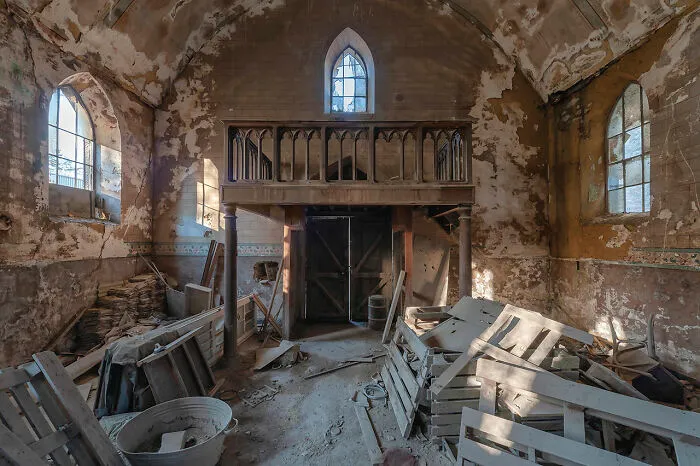
The small chapel was the only surviving building in this area, near a huge working quarry; the kind of quarry that leaves a thick cloud of white dust for several kilometres around. As I approached the location indicated on my GPS, I saw the landscape change and gradually lose its colours. Everything was white around me when I parked in a gravelled carpark destroyed by construction machines. Dodging the countless puddles of whitish water, I came closer to the building. I pushed open the door thinking I had found a place of refuge to breathe again. But it was the same inside. The dust had been meticulous, covering indiscriminately with a thick layer of white dirt everything that was there. How could they? There were piles of wooden pallets, piles of broken boards, basins with holes in them, buckets of dirty water, tools thrown on the floor. A makeshift table had probably been used by workers to break bread and have a drink. Another table a little further away displayed a number of screws, bolts, and nails of various sizes. The small sacred building had been used as a workshop, a shed, a canteen... and a toilet. The panes of the pointed windows were all broken, allowing rays of light and sparkling particles to easily pass through. To the right of the choir, an attempt at a repair had been made with a tarp, planks of wood, and corrugated iron. It was a lost cause. This was not one of those forgotten buildings in which time had patiently served its purpose, gnawing at the walls, piercing the ceilings, causing the paint to crumble... Someone had added a layer! As I turned around, right above the door through which I had arrived I saw a wooden balcony that did not look ready to give way just yet. However, the stairs had given way. Using a ladder that I found there, I decided to climb up to assess the magnitude of the disaster: the Apocalypse was not expected the following day.
6points
#28 The Punishment / 20th-Century Crypt, Italy, Liguria Region
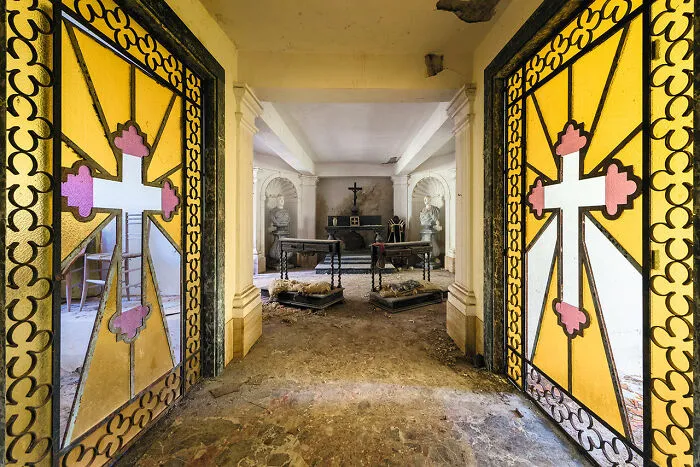
"A gashing wound ruptures the light grey background, against which is an altar for the faithful. With its left part demolished, the altar, standing atop a base, appears fatally wounded. Ironically, just like the cross of a viewfinder on a camera or a gun, a small square surrounded by a gilded frame surrounds an equal-armed cross. Higher, a crucifix compliments the scene.
Two noble busts, proudly sitting on their pedestal, frame the altar on a background of scallop shells: a space with no miracle or mystery.
And as if at any moment a priest could emerge from nowhere, a dark vestment with gold trimmings waits on a headless mannequin to the right of the altar.
A few steps behind, two high chests of drawers are arranged symmetrically to form a wide angle. Each one has two drawers. The drawers of the chest to the right are open, while those of their counterpart on the left appear closed. Their contents must have included altar bread, pure white cloth, phials of wine, tongs, and bowls.
The chests of drawers rest on tall, slender, twisted legs. But, as if the occupants had officiated in an already dilapidated place, heavy bags — did they contain grain, sand or gravel? — were placed on the base to ensure an overall stability. The base itself forms a platform on which the legs of these chests of drawers rest.
Towards the exit, two large white orthodox crosses accompany us and form a corridor. Each cross is made of the yellow material of two large stained glass windows, where two equal sections in the form of a ray of light have been broken and profusely reveal the profane world. On the floor to the right, a yellow frieze is still there, while its counterpart on the left stained glass window has lost both its glass and its colour." — Jean-Pierre Marchand
Two noble busts, proudly sitting on their pedestal, frame the altar on a background of scallop shells: a space with no miracle or mystery.
And as if at any moment a priest could emerge from nowhere, a dark vestment with gold trimmings waits on a headless mannequin to the right of the altar.
A few steps behind, two high chests of drawers are arranged symmetrically to form a wide angle. Each one has two drawers. The drawers of the chest to the right are open, while those of their counterpart on the left appear closed. Their contents must have included altar bread, pure white cloth, phials of wine, tongs, and bowls.
The chests of drawers rest on tall, slender, twisted legs. But, as if the occupants had officiated in an already dilapidated place, heavy bags — did they contain grain, sand or gravel? — were placed on the base to ensure an overall stability. The base itself forms a platform on which the legs of these chests of drawers rest.
Towards the exit, two large white orthodox crosses accompany us and form a corridor. Each cross is made of the yellow material of two large stained glass windows, where two equal sections in the form of a ray of light have been broken and profusely reveal the profane world. On the floor to the right, a yellow frieze is still there, while its counterpart on the left stained glass window has lost both its glass and its colour." — Jean-Pierre Marchand
6points
#29 Heading Towards Oblivion And General Forgetfulness / 14th-Century Convent And Crypt, Portugal, Lisbon Region
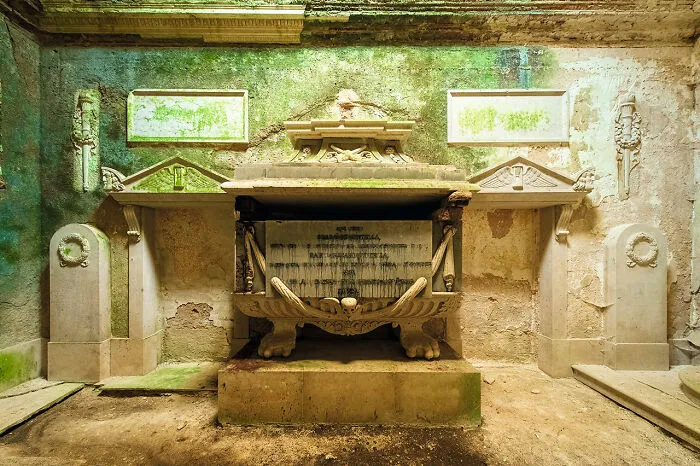
"I’ve already seen this image in a dream; not this one precisely, but a similar one.
I had a Go-Pro camera in my hand. I was making a kind of documentary series for my YouTube channel, in what seemed to be a distant future. I was showing children and teenagers places they didn’t know, places that were the remains of a past civilisation, of a bygone era: fast-food restaurants, huge factories, slaughterhouses, television studios, shopping malls, places of worship. Everything was damaged, partly destroyed, and abandoned. This one had suffered from the rising waters. Then I filmed their reactions and talked with them. That day, none of these young people believed me when I told them about the different religions, the rites related to them, and the crimes committed in their names. They were afraid, and asked to leave as soon as possible." — Michel Cloup
6points
#30 I Need You / 13th-Century Chapel, Italy, Piedmont Region
5points
#31 Candle Songs / 12th, 16th, And 19th-Century Castle Chapel, France, Nouvelle-Aquitaine Region
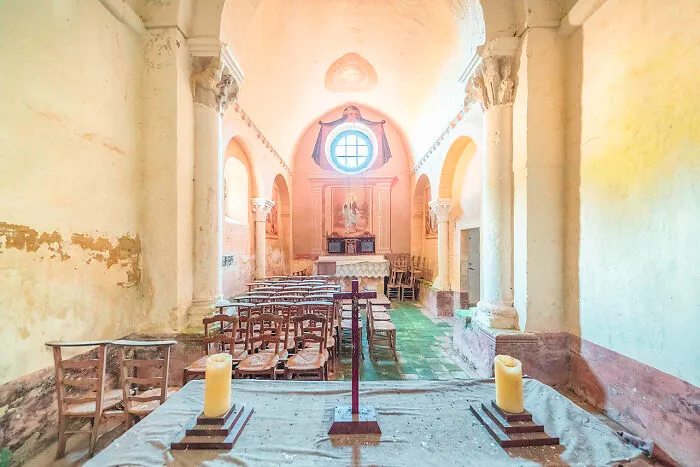
"Now this is a beautifully high ceiling under a semicircular vault. The decoration is minimal, as if it were whitewashed, faded by the passing of time. The floor is also worn out. The immobile stone is riddled with woodworm. The fault lies with the fact that no one has walked here for so long. In the foreground, well-aligned chairs gaze patiently at the central stage. A pulpit waits in a corner for a reading or a reader. The stage on which the altar stands is delimitated by a barrier, left slightly ajar. The altar looks stern. Its jagged legs give it an unfriendly appearance. On the wall, a lonely, tilted frame tries its best to decorate what can be decorated. It appears as a survivor, given the large nails left orphaned and protruding here and there from the walls. They look like the nails of the Passion of this suffering church... Columns flank the walls and bear an arch that acts as a support for the vault. The relief gives rhythm to the volume. Behind the altar is another row of chairs. Are these the places of honour of VIP clergymen? They could very well have come from behind, through these arches hidden on the sides. Over here, the decoration appears to have survived: tabernacle, fancy credenza, embroidered doilies... A large frame features a saint clinging on to a long stem. Perhaps a twig or a palm leaf... Is it Elizabeth or Barnabas? It brings to mind early Christians who ended up nibbled by lions or beheaded by an uncertain ruler. The chairs in the back — facing the altar — also face the chairs in the foreground; an arrangement that undoubtedly triggered strange exchanges of glances during the ceremonies... Eyes meet, tribunes observe each other. Did the monks behind the priest spy on the heavy eyelids of the believers? The opposite might be possible... but in this mischievous face-off, everyone knows who will have the last word... He looks at you from that oculus up there, open on a trompe l’œil curtain. The one who sees everything: He is the great referee of the game." — Louvre-Ravioli aka François Bénard
5points
#32 For How Long? / 17th And 19th-Century Monastery, Italy, Ombria Region
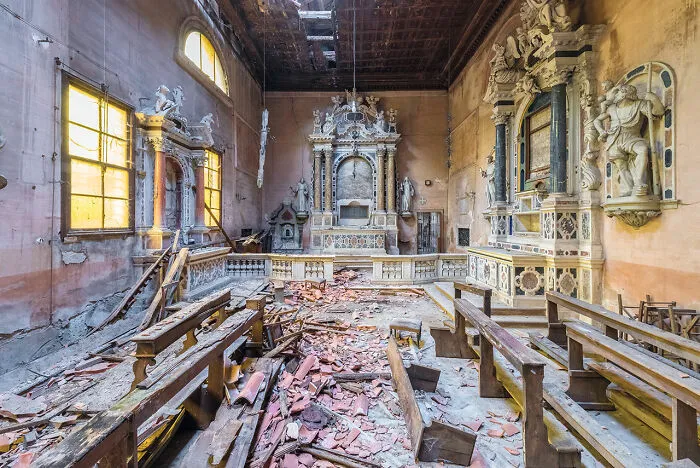
"At the crack of dawn, the birds stopped singing; by the village entrance the dog started barking at the sky, and the fox came out of its burrow. The rustle of the foliage stirred the air, though this was not caused by the wind. A line of ants broke ranks. Nothing seemed in its place anymore. Until the great silence that filled the surroundings with fear and peace. The lizard found nowhere to hide. The earth began to shake gently, regularly, in one direction, diagonally, then up and down more firmly, more heartily. It spoke an age-old audible and indistinct language. When its signs quickly became visible and understandable, despite the fact that nobody knew who was speaking, save for the successive waves, she was listened to, though nobody knew where she would disperse. A huge net of lines running along the ground began to creep up the walls of buildings like a secret sap seeping under a second skin, spinning faster than a spider, digging wider channels as the tremors became more frequent. Every palace, every church suddenly spoke its own, incredible language that had never been heard before, and which showed what they were made of. All of them, in their bones, vibrated with a distinctive
flesh. The mighty Saint Christopher, carrying on his shoulders the Saviour, remained trapped in a niche in the wall. From the very top, the soft light of day pierced through the collapsed roof. The broken tiles cracked underfoot and the beams mingled with the pews. Next to a light bulb hanging from the top of the church, a piece of wood was hanging vertically, taunting gravity. Had the ritual of verticality been broken?
flesh. The mighty Saint Christopher, carrying on his shoulders the Saviour, remained trapped in a niche in the wall. From the very top, the soft light of day pierced through the collapsed roof. The broken tiles cracked underfoot and the beams mingled with the pews. Next to a light bulb hanging from the top of the church, a piece of wood was hanging vertically, taunting gravity. Had the ritual of verticality been broken?
The stick of Saint Christopher, much higher than his shoulders, carries him to other lands. A traveller, a migrant, a displaced person, always tries to make a crossing. He who carries the world, waits to put his stick in the ground to see it blossom again. 'Go, go, I will find you!'" — Frédérique Villemur
4points
#33 Two Doors, Only One Exit / Early 20th-Century Crematorium, Germany, Saxony-Anhalt Region
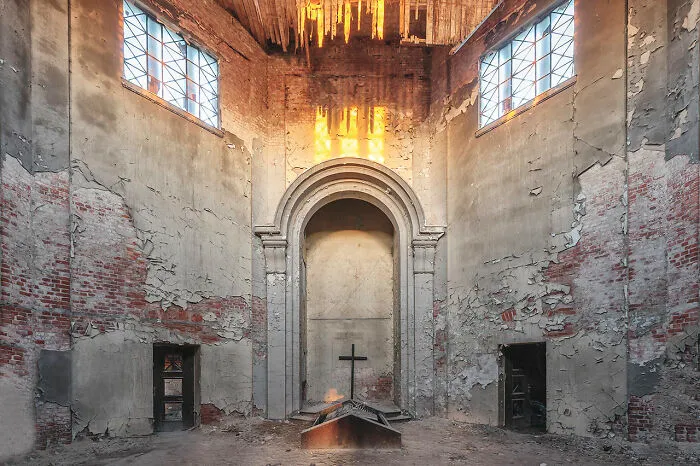
"How long did it take the traveller to reach this tomb? Which countries did he pass through? What dangers did he face? How many borders were crossed?
After this long journey, to this point that does not appear on any map of mankind, he crossed the threshold and bowed before this modest tomb.
This tomb, without gold or embellishment, is built like a dwelling made to resist eternity. Its triangular façade, which emerges just above the ground, is covered with age-old dust. Topped by a simple cross, as if traced in Indian ink on the light background of the wall that blocks the horizon, the tomb is topped by an arch, a
monumental vault, a semicircular arch that has withstood the test of time.
Like the sign of a forgotten god, a trinity of orange light descends in parallel strips from a hidden sky, through a ceiling torn apart by the destructive action of telluric jolts that would have wanted to return this tomb to dust.
The leper walls that enclose it on either side still bear the scars of these assaults of time; blemishes reveal their red-brick organs. He has to look so high up to see the rectangular windows that bring brightness without light.
To what labyrinths, to what beyond, to what other dimensions do these two small doors on either side of the tomb lead? What will the traveller’s choice be? Which door will he pass through?" — Samuel Nowakowski
After this long journey, to this point that does not appear on any map of mankind, he crossed the threshold and bowed before this modest tomb.
This tomb, without gold or embellishment, is built like a dwelling made to resist eternity. Its triangular façade, which emerges just above the ground, is covered with age-old dust. Topped by a simple cross, as if traced in Indian ink on the light background of the wall that blocks the horizon, the tomb is topped by an arch, a
monumental vault, a semicircular arch that has withstood the test of time.
Like the sign of a forgotten god, a trinity of orange light descends in parallel strips from a hidden sky, through a ceiling torn apart by the destructive action of telluric jolts that would have wanted to return this tomb to dust.
The leper walls that enclose it on either side still bear the scars of these assaults of time; blemishes reveal their red-brick organs. He has to look so high up to see the rectangular windows that bring brightness without light.
To what labyrinths, to what beyond, to what other dimensions do these two small doors on either side of the tomb lead? What will the traveller’s choice be? Which door will he pass through?" — Samuel Nowakowski
4points
#34 He Came This Way / 9th, 15th, 16th, And 19th-Century Church, Italy, Trentino-Alto-Adige Region
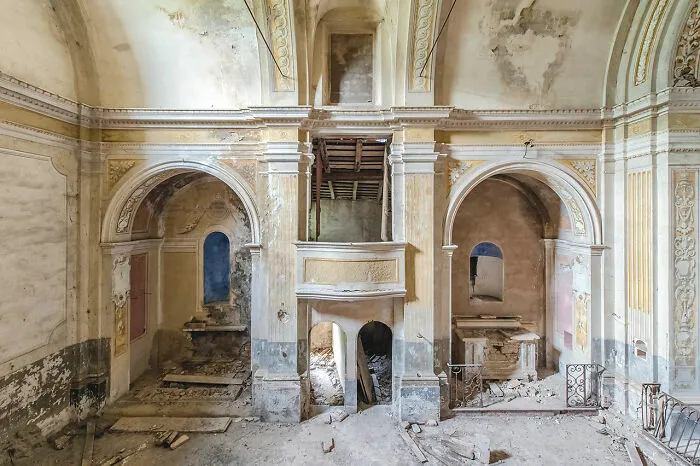
"We are under the crossing where the transept separates the nave from the choir yet also connects them. Our gaze faces directly towards a trompe l’œil apse, towards that region of space where the sun majestically rises every day to illuminate the world. The monument is like the world: blue-grey in its earthly parts, golden yellow, ochre and bright blue in its celestial parts. Here and there, debris litters the ground, yet no crevice or hole can be seen. It could be the remains of an altar that has been destroyed, or a collapsed part of the roof. It is this pile of debris that a ray of light from the left illuminates in a theatrical way. What appears to have broken off and fallen to pieces is in fact the superimposition of the Christian narrative of the Saviour on the pagan worship of the Sun God, who, when he is at the height of his power, makes this narrative sprout for the salvation of humankind. Breaks in this twinship occur in silence, between an old god that appears and disappears, and a new god, invisible and omnipresent. In the foreground, a twisted and partly divided wrought iron fence seems to represent the violence of such a break.
I remember the words of Heraclitus: 'The most beautiful order in the world is a random gathering of things.' Sharp-bladed paradox. Did he mean to say that it is in this way, deprived of the help of any human representation, any beautiful speech or sumptuous edifice, that we get a glimpse of the hidden order of the universe?" — Jean-Pierre Marchand
I remember the words of Heraclitus: 'The most beautiful order in the world is a random gathering of things.' Sharp-bladed paradox. Did he mean to say that it is in this way, deprived of the help of any human representation, any beautiful speech or sumptuous edifice, that we get a glimpse of the hidden order of the universe?" — Jean-Pierre Marchand
3points
#35 The Loneliness Of The Sleeper / 21st-Century Crypt, Germany, Thuringia Region
3points
