



Our planet is full of incredible places, fascinating wildlife, and natural wonders that are easy to take for granted when we see them every day. Luckily, many photographers dedicate their time to exploring the world and capturing some of its most extraordinary moments. Sometimes, their pictures show us things we might never witness ourselves.
The Nature Photographer of the Year (NPOTY) competition celebrates this talent, bringing together photographers from around the world and showcasing their remarkable work. Breathtaking landscapes, unusual animal encounters, and tiny details of nature are the competition's main highlights, offering plenty of reasons to appreciate the world around us.
The winners of the 2026 edition of the People’s Choice Award by NPOTY have now been announced, along with a selection of outstanding images from this year's finalists. We've selected the most impressive shots to share with you, and there's plenty to admire, whether you're a wildlife enthusiast, a photography lover, or simply someone who enjoys seeing our planet from a different perspective.
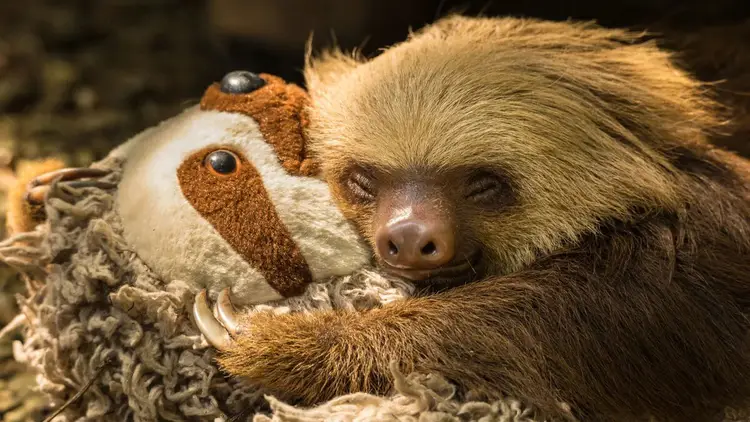
#1 Highly Commended People’s Choice Award 2026: Sweet Dreams By Rona Neri
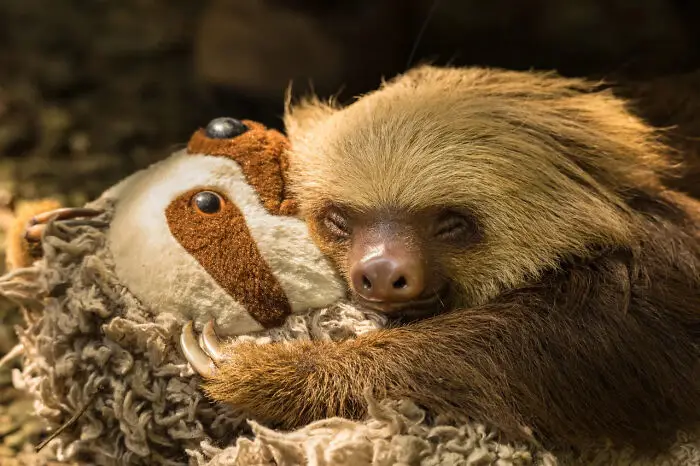
This image was captured on a photo tour in Costa Rica organised by Suzi Eszterhas. Our small cohort of photographers spent several days with Dr. Rebecca Cliffe of the Sloth Conservation Foundation (SloCo) in Costa Rica, learning about sloths and how the foundation studies and protects them, while looking for both two- and three-fingered sloths in the rain forest. Locals know about SloCo’s important work and often notify the team when they see sloths.
On this day, SloCo received a call from a community member about a young sloth low in a tree near a local restaurant. When we went to the location, we saw this juvenile two-fingered sloth named Tender, already known to Dr. Cliffe as the son of a female named Tiki.
SloCo is conducting a first-ever “sloth census” attempting to learn the true conservation status of sloths. Sloths are notoriously difficult to track due to their exceptional ability to camouflage and because of their lack of scent, near silence, slow movement and adaptable body temperature. They are also vulnerable to habitat loss, climate change and rapid urban development. SloCo has innovated a variety of methods to locate sloths including trained scat-detection dogs, drones and GPS-enabled collars.
Tender was a perfect candidate for a collar. The SloCo team carefully sedated Tender and as he fell asleep, gently removed him from the tree and put him onto a large sloth stuffed toy named "Jim". This let Tender naturally cling to something comforting and familiar, minimising his stress during the procedure.
Dr. Cliffe and her team carried him to a quiet space behind the restaurant where she took measurements, hair samples, weighed him and then fitted him for his new collar. Before the data collection began, I was able to lie low on the ground to capture this image of Tender peacefully sleeping on Jim in the dappled light of the rainforest.
The whole process took only a few minutes while our small group of photographers watched from a respectful distance, in awe of both the beauty of this young sloth and the care and efficiency with which the SloCo team gathered information to help learn about and preserve the future of sloths.
As he began to wake, Dr. Cliffe carried Tender back to his original tree, and we watched him climb back to his safe space with his new collar.
5points
#2 After The Fires By Ana Norman Bermudez
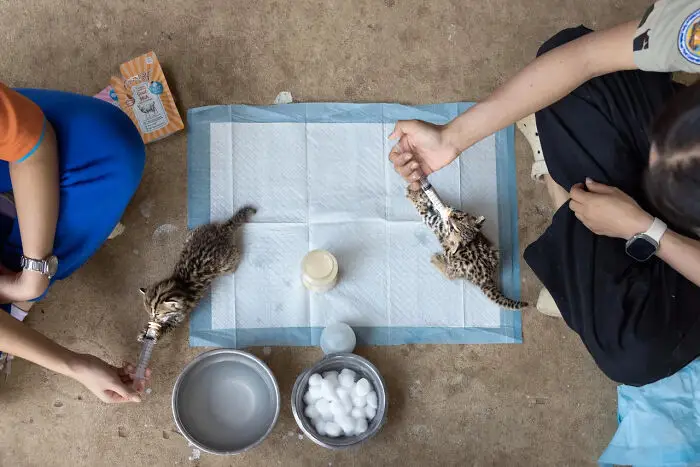
This was taken as part of a story about the impact of agricultural fires on leopard cats in northeastern Thailand. There were over 50 cubs at the centre, and these tiny siblings were the latest rescues. Their fur and whiskers were burned and they needed to be fed formula milk every few hours. They kept trying to wriggle out of the keepers' hands to play and wrestle with each other.
I've since returned to the centre to see the same cats, now around 6 months old, being "soft released" into a behavioural rehabilitation pen. They will be released into the wild within the next couple of months, once they have mastered their climbing and hunting skills.
4points
#3 Gay Pride By Ana Retamero Olmos
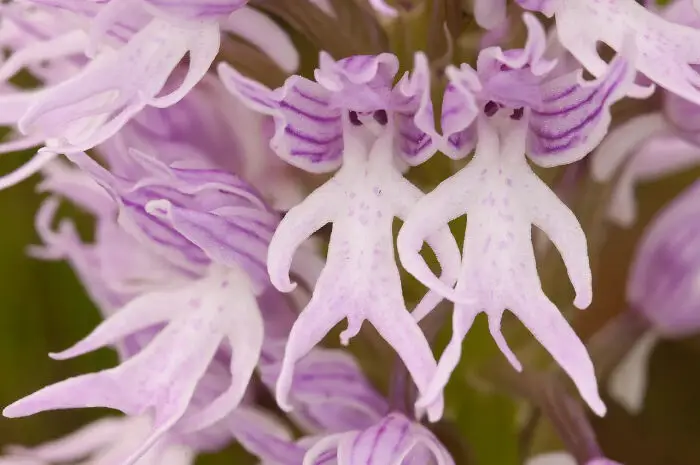
Who says botany is boring? While photographing the intricate inflorescence of the orchid (Orchis italica), I decided to look closer and focus on the macro details. I was utterly captivated by how much these flowers resemble a naked human figure. After hours of patient work searching for the perfect angles and compositions, I couldn't help but smile when I discovered these two specific flowers. Side by side, they seemed to be strolling arm in arm with pride, perfectly mirroring the joyful spirit and unity of a Gay Pride parade. It was taken in Jerez de la Frontera (Cádiz), Spain.
4points
#4 Unexpected Trophy By Antonio Sánchez Chamorro
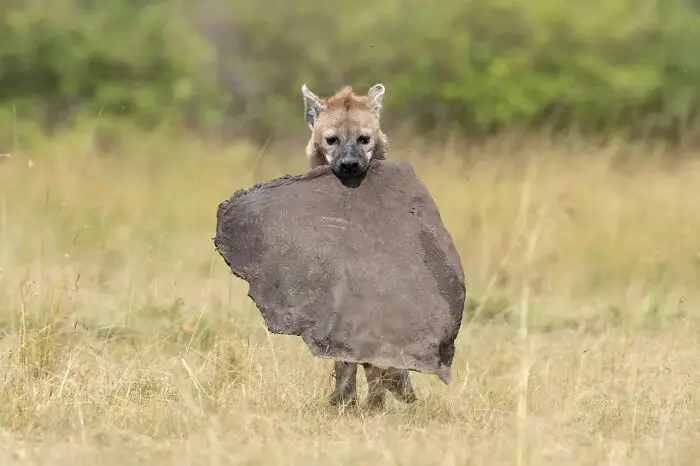
We were on a photographic safari in the Masai Mara National Reserve, Kenya, when we came across an elephant that had died of natural causes. We immediately alerted the park rangers, who came to remove its tusks and prevent them from becoming a target for poachers. I had the opportunity to witness this important conservation work first-hand. Once the tusks had been removed, it was important to leave the carcass where it was, allowing nature to take its course and providing food for lions, hyenas and other scavengers.
We returned to the site the following day, and, as expected, the carcass had become the centre of activity. Several lions were feeding on it, while hyenas waited for an opportunity to approach. Whenever the lions moved into the shade to rest, the hyenas quickly took advantage of the moment and returned to feed. On one of these occasions, a hyena grabbed one of the elephant’s ears and immediately ran off with it. I was ready with my camera and managed to capture the moment as it disappeared with its unexpected prize.
The image tells a small story about the circle of life on the African savannah: even in death, the elephant continued to sustain other species, while the behaviour of the hyena revealed the opportunistic nature of one of the Mara’s most resourceful predators.
4points
#6 Uncomfortable Friendship By Georgina Steytler
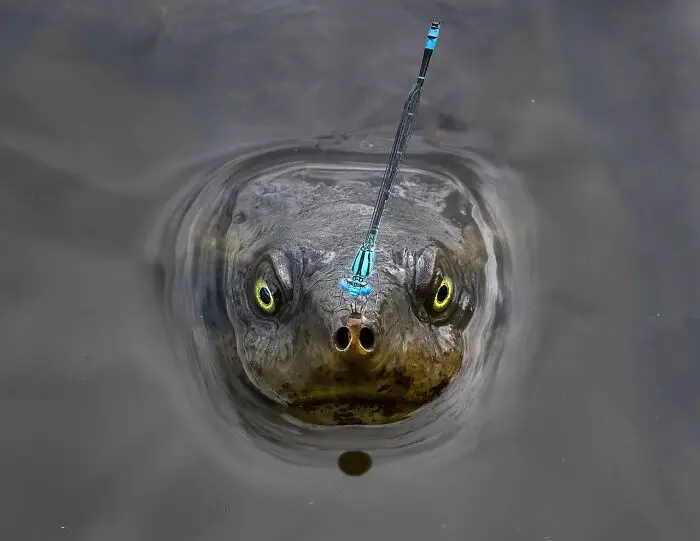
I was at a wetland on the boardwalk when I looked down and a turtle was looking up at me. I love how grumpy they look. I saw a damselfly in the area landing on nearby water lilies and when it landed on the turtle's nose I could not believe it! The grumpy turtle looked less than pleased! I love how nature interacts, and the oddest of animals happily coexist. If you open your eyes, stay patient and stop and enjoy nature, it rewards you with moments like this.
4points
#7 Runner-Up People’s Choice Award 2026: Bad Place By Tom Haugaard Svensson
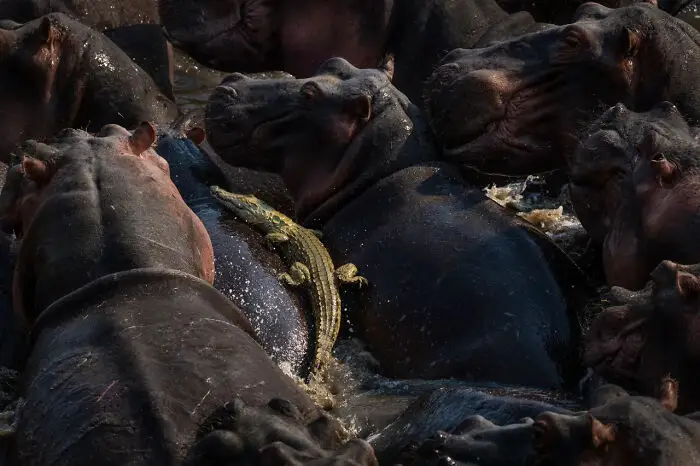
This was taken in magical South Luangwa, Nsefu, where there are very many hippos, and it is always so interesting to see what happens when you are there. That day I was so lucky to see a small croc that ended up in the wrong place, among all the hippos, which is very dangerous for it. But this time he was lucky and was only thrown aside by the male hippo.
3points
#8 Rainbow Tripodfish By Gabriel Jensen
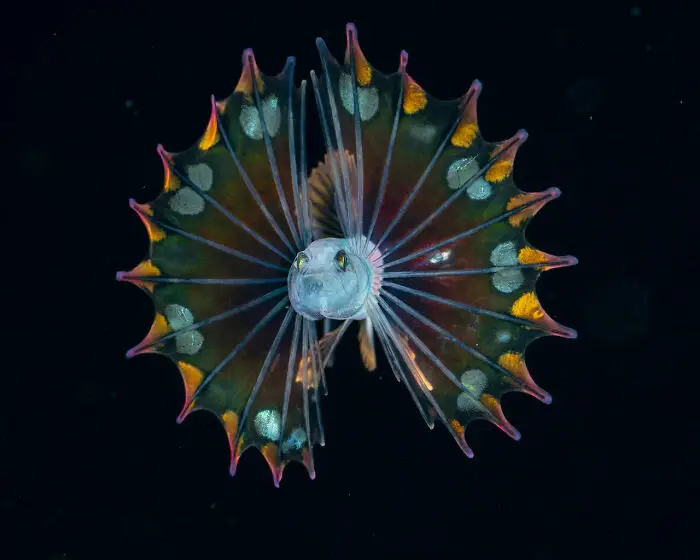
Blackwater diving is one of the closest experiences I have had to exploring another planet. At night, we take a boat into the Gulf Stream, jump into water more than 700 feet deep, and drift in darkness as the diel vertical migration, the largest migration on Earth, brings countless animals towards the surface. It gives us the extraordinary chance to meet visitors from the ocean’s midnight zone face-to-face.
This tiny rainbow tripodfish, Bathypterois sp., was one of them. At this larval stage it bears almost no resemblance to the deep-sea fish it will become. Its enormous, brightly patterned pectoral fins spread around its body as it hangs nearly face-up in the water, a posture thought to help it mimic gelatinous plankton and discourage predators. Eventually, it will descend to the deep seafloor, where tripodfishes perch above the sediment on extraordinarily elongated fin rays.
Making the photograph required nearly as much concentration as finding the fish. With no reef, bottom or horizon for reference, both of us were drifting through three-dimensional space in the Gulf Stream. Because the fish was swimming inverted, I had to match its orientation and photograph it while nearly upside down myself, maintaining precise buoyancy, focus, working distance and lighting for a macro image while suspended over more than 700 feet of open water.
For a few moments, though, all of that disappeared. Through my LCD there was simply this tiny, impossibly ornate fish suspended in the black. That is what keeps drawing me back to blackwater diving: entering the largest migration on Earth and briefly meeting animals whose hidden lives normally unfold far beyond our view.
3points
#9 Into The Hole By Imre Potyó
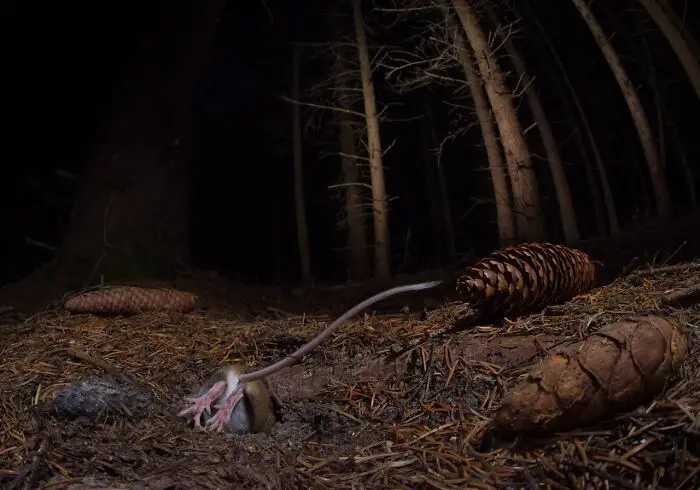
My favourite time for photography is the evening, when species that hide during the day start to move and the atmosphere becomes special. Here, a yellow-necked mouse disappears into the entrance of its underground home at night, but its tail and tiny paws are still visible for a moment in a pine forest in the Börzsöny Hills (Hungary). These quick little mammals come alive at dusk, setting off on their nightly foraging routes.
Over several weeks, I kept returning to this pine forest and managed to capture a few lucky moments: fast movements, acorns being carried, travel through snow, leaps between branches. Among them, this was perhaps the most interesting. I used a carefully placed camera trigger, flashes and a fisheye lens, which allowed me to show the scene together with the animal’s habitat.
3points
#10 Love Is In The Air By Sophie Mijnhout
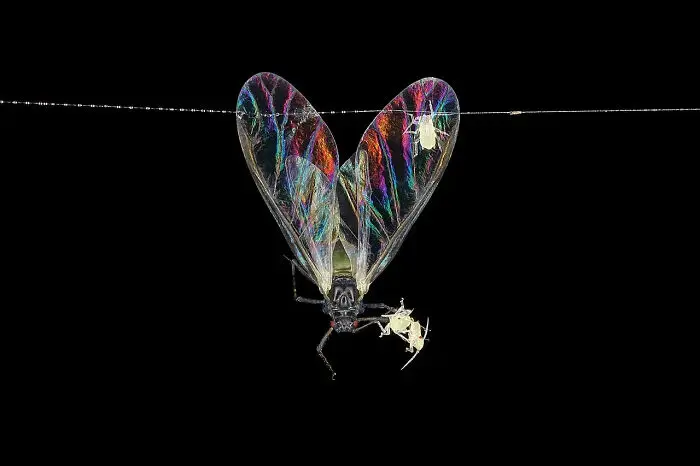
In the morning, I noticed an aphid dangling from a single strand of spider silk, like a piece of laundry on a clothesline. It was too windy to take a good photograph. By late afternoon, the wind had calmed, so I went back for another look. The aphid was still there and still alive, but now tiny white “specks” were clinging to her body.
At first, I was disappointed. But when I looked closer through my macro lens, I saw that the specks were moving, and realised that they were baby aphids. Aphids give birth to live young. It dawned on me that, while suspended in midair, this mother had given birth. The newborns, like their mother, had nowhere to go. A microdrama that few people will ever witness.
3points
#11 The Approach By Cliff Spooner
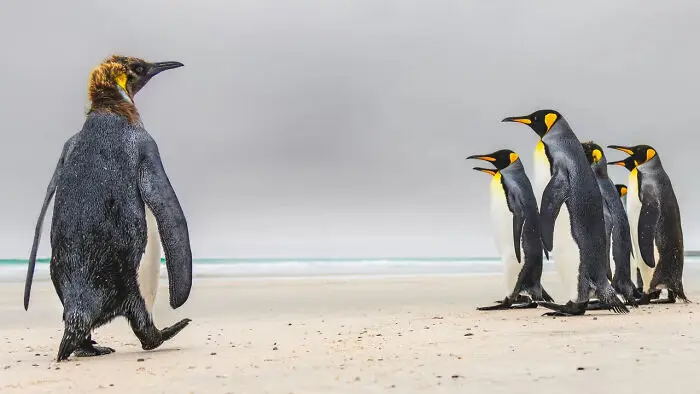
A King Penguin in the final weeks of its catastrophic moult approaches the colony at Volunteer Point on the Falkland Islands mainland, ragged, grounded, and unable to feed at sea, but heading back to where it belongs.
I spent three days at the beach, frequently lying on the sand among the colony in December 2025, part of a longer trip through the archipelago. King penguins are among the penguin species most tolerant of human presence. Lying at ground level, I felt less like an observer and more like part of their world. On this particular afternoon a sea lion had been patrolling the shoreline, and the birds were wary. The moulting penguin, unable to escape into the sea as the others could, was making its way back to the safety of the group. Some of the adults had already clocked it.
The flat grey sky and white sand strip everything back. It's just the bird, the colony, and the potential threat out of frame.
3points
#12 Wings Against The Turning World By Stefan Cruysberghs
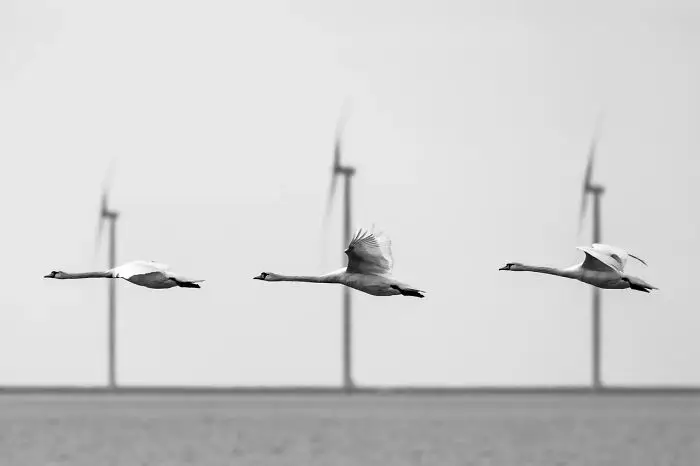
From the De Ral hide in Piaam, we were looking out over the IJsselmeer when three mute swans suddenly came flying in. I fired off a series of shots, assuming the wind turbines in the background would clutter the frame. Looking back at them later, though, I noticed the symmetry and realised it had become a striking image with a story of its own. They are two very different symbols of movement and energy, sharing the same flat horizon. The soft, overcast light flattened all colour out of the scene, so converting the image to black and white felt like the natural choice.
3points
#13 Kangaroo Court By Raoul Slater
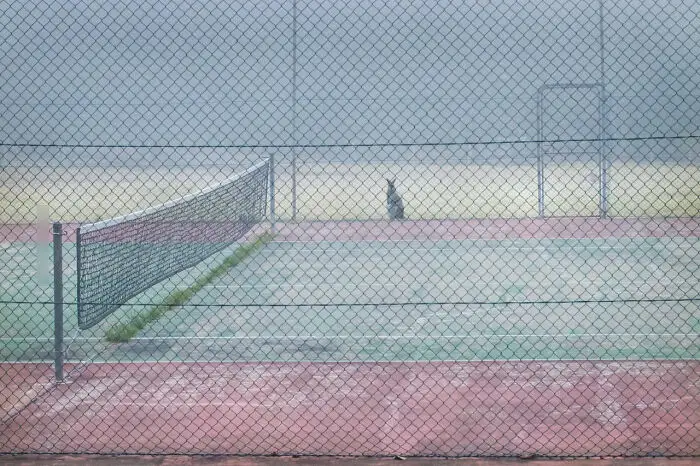
A misty morning on the Bunya Mountains. I spotted the wallaby waiting its turn to play tennis. They are very used to people, so I had no worries about it hopping away. I worked my way closer, screwing the composition tighter with each shot until every element balanced. This is the last of the series and is my best ever wildlife composition; you could bounce a truck off this and it would hold solid.
3points
#14 Highly Commended People’s Choice Award 2026: Frog Caught In The Sunbeams By Luc Rooman
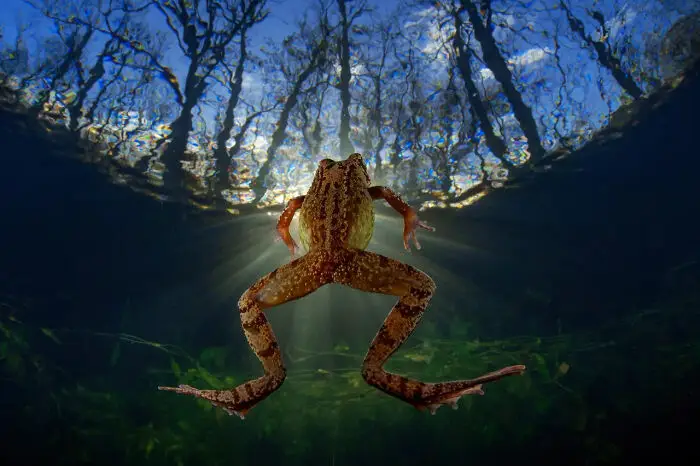
The photograph was taken at Put van Ekeren near Antwerp, where I was looking for pike to photograph. Suddenly, out of the corner of my eye, I saw a frog swimming past. Fortunately, it paused briefly, allowing me to position myself as quickly as possible and capture the frog in the sunbeams. Probably a once-in-a-lifetime photograph.
2points
#15 Bound By The Edge By Nicolas Cao
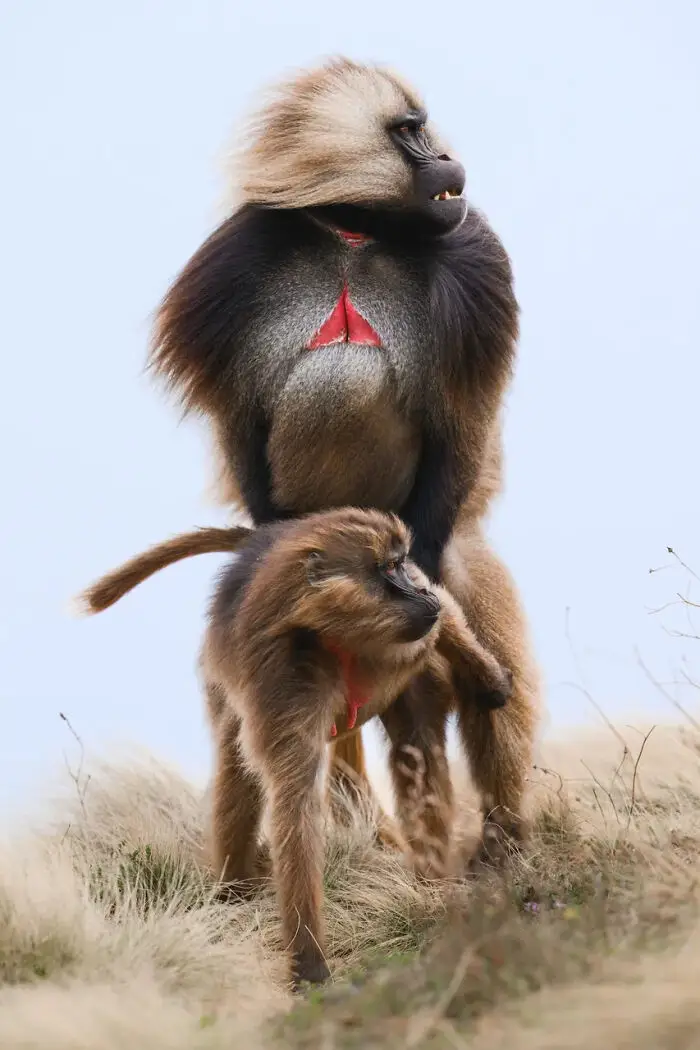
I made my first journey to Ethiopia’s Simien Mountains in May 2025, drawn by one of the world’s most remarkable primates: the gelada. I had learned that years of regional conflict had significantly disrupted tourism in the area, affecting not only the communities that depend on visitors but also the conservation efforts that help protect these extraordinary animals. I wanted to photograph the geladas in their natural habitat and, through my images, share their story with a wider community and bring greater attention to their fragile world.
High in the mountains, where sheer cliffs fall away into vast valleys, and the wind sweeps relentlessly across the Ethiopian highlands, I encountered this pair of geladas at the edge of a cliff. For a fleeting moment, their lives came together against the immense landscape. The male stood above the female as they faced directly into the powerful mountain wind, their thick coats swept back by the gusts. Exposed at the cliff’s edge yet seemingly undisturbed by the elements, they appeared inseparable from the wild and unforgiving environment around them.
What I witnessed was an intimate moment, but also something much larger: a small chapter in the continuing story of a species that has lived among these mountains for thousands of years. Gelada society is built around relationships, and every bond plays a part in the survival and future of the troop.
Watching this pair on the roof of Africa, I was reminded that conservation is ultimately about protecting more than individual animals. It is about preserving the possibility for these moments to continue: for bonds to form, new generations to be born, and geladas to remain part of this extraordinary landscape for generations to come.
2points
#16 Dots By Uwe Zimmermann
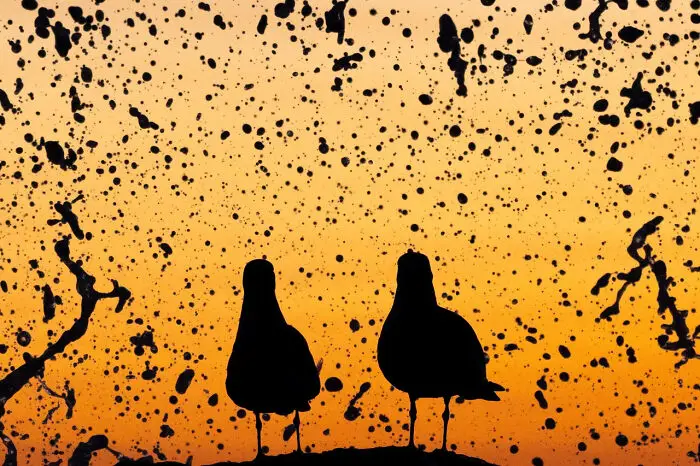
I was walking along a beach near Vancouver, Canada, when I noticed two gulls, most likely Glaucous-winged Gull (Larus glaucescens), sitting on a rock close to the edge of the water. The waves of the rising tide were crashing into the rock and the water was splashing high into the air. The sun had already set but the horizon was still dipped in red and orange colour. I noticed the striking contrast of the white water appearing black in front of the glowing sunset and set my camera to a fast shutter speed to freeze the blobs, splats and dots so beautifully framing the pair of gulls.
2points
#17 Overall Winner People’s Choice Award 2026: Runners By Andrés Basilio Sagarna
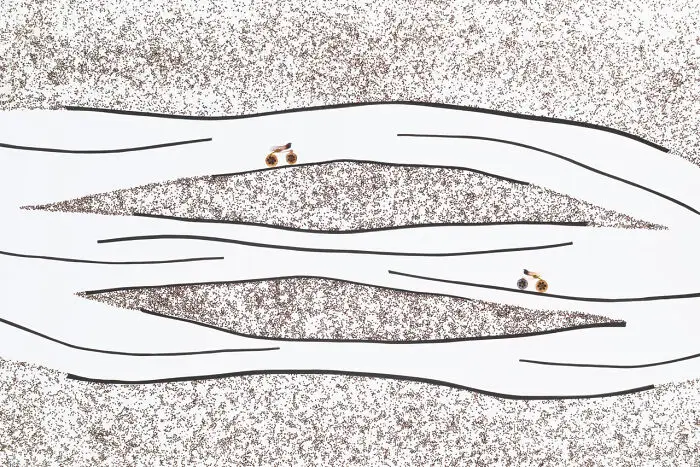
I like to explore the boundaries between species, to capture in images the metamorphosis between the animal and plant worlds, to be captivated by the vertigo of the impossible or the unthinkable. In this image, made in Álava, Spain, I have allowed myself to try once again to take that leap. I have glimpsed a place where, in spring, the fields are covered in beautiful flowers, some very special and playful, from the genera Muscari, Papaver, Formica, and Asplenium.
2points
#18 The Giant’s Foot By Juan Jesus Gonzalez Ahumada
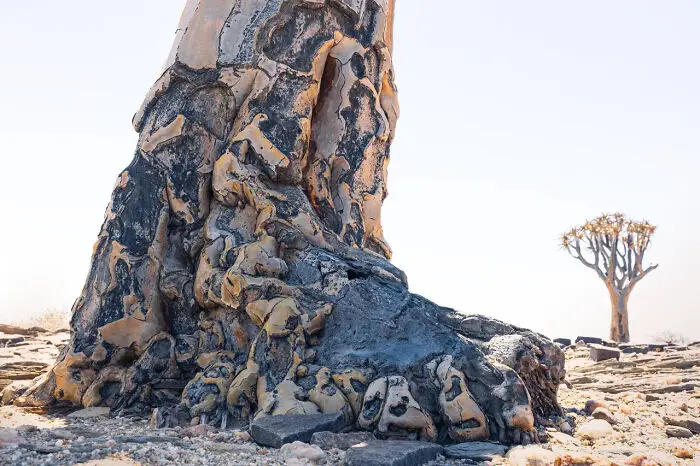
The image was taken in the Namib Desert. A few specimens of Aloidendron dichotomum survived, scattered across the landscape. It's incredible that life thrives in such extreme and demanding climatic conditions.
One of the specimens had a curious shape at the base of its stem; it looked like a bare foot. Taking a low angle, with the camera at ground level, I managed to include another of its kind in the frame. From this perspective, it gave the impression of an enormous giant's foot, threatening to crush everything in its path. Metaphorically, it was as if the desert itself were taking shape and, with its extreme climate, wanted to annihilate any trace of life.
2points
#19 Star Wars By Jade Hoksbergen
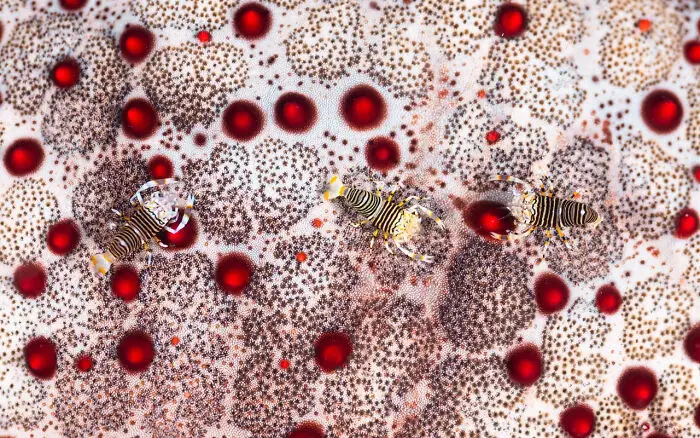
While snorkelling in the Maldives, I noticed a cushion seastar. What I saw upon closer inspection completely blew my mind. As plain as day, on the aboral surface of the sea star, a family of bumblebee shrimps (Gnathophyllum americanum) went about their usual feeding business! After ten years of hoping to find one, I found a family of them in the least expected of places.
I knew they were hard to find, cryptic and each measuring a mere 8mm; but after consulting with the Maldives Marine Research Institute (MMRI), it turns out this discovery was exciting beyond just a personal level as this could represent the first photographic evidence of Gnathophyllum americanum from Maldivian waters.
This photograph is a wonderful reminder that the ocean still holds endless surprises. Sometimes, all it takes is slowing down, looking a little closer, and being curious about what might otherwise go unnoticed.
2points
#20 Hungry Mouths By Rachel Piper
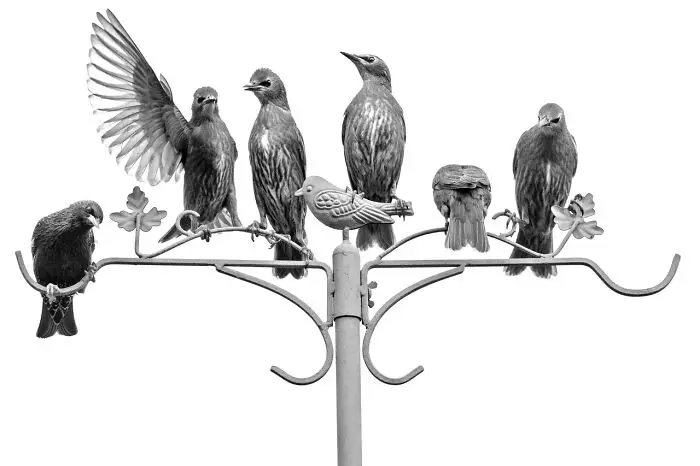
At the end of May 2024, a flock of starlings gathered in my garden. The young birds waited nearby while the adults collected food from the bird table. I spent many hours watching and photographing them at different times of day from the comfort of my garden pod, capturing the changing light. They remained unperturbed by my presence, and so I was able to be a part of their world for a day.
2points

