




Nature’s Best Photography (NBP) has revealed the 2025 Winning Images, celebrating the creativity, patience, and passion of photographers from around the world. This year, more than 20,000 breathtaking submissions poured in from dedicated nature and wildlife photographers across 62 countries.
After months of careful review by an esteemed panel of judges, editors, and advisors, nearly 500 images advanced to the semi-final round. From there, a detailed evaluation of high-resolution files and the inspiring stories behind each photo led to the selection of the Top 100 finalists.
Scroll down to explore some of the most powerful and captivating photographs that made it to this year’s finals.
#41 Highly Honored, Animal Antics: Brotherly Hug By Daniel Valverde Fernández Of Madrid, Spain
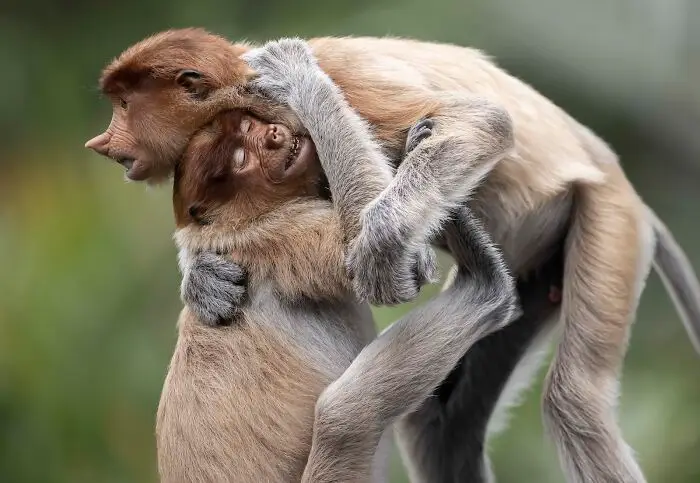
“This image was captured in the middle of the Malaysian jungle in the state of Sabah, located in northern Borneo.
Sabah is the only place on Earth where proboscis monkeys are found in the wild. This photo shows two monkeys embracing after a minor argument. It captures how this species can display such human-like behaviors and expressions, including a reconciliation hug and a surprising look of tranquility and joy. This moment is a striking reminder of how humans can learn from animals and why it is crucial to protect them and prevent their extinction.”
Report
16points
#42 Winner, Wildlife: Male Jaguars By Hira Punjabi Of Thane, India

“This image of two jaguars in a single frame was one of the most challenging I’ve ever captured. I spent six full days boating through the Pantanal on safari, tracking these males. After several failed hunting attempts, they finally paused to rest—giving me a rare opportunity to compose them together in one shot.”
Report
15points
#43 Highly Honored, Polar Passion: Harp Seal By Roberta Olenick Of Vancouver, Bc, Canada

“Whiskers thickly coated in ice, a female harp seal emerges from a breathing hole in the sea ice, just one among the thousands of mothers here to nurse their whitecoat pups in the Gulf of St. Lawrence.
Harp seals need vast, stable expanses of thick pack ice to successfully raise their young. The year I was there, the ice was so solid and extensive that it took me two tries to reach the main breeding colony. My first attempt was on a multi-day voyage aboard a steel-hulled vessel repurposed from seal hunting to eco-tourism. We never managed to break through the ice to the primary nursery, but fortunately, we discovered a smaller, accessible group that offered wonderful opportunities for photographing the seals. To experience the grand extent of the main colony, I had to try again, this time by helicopter.
“The ice that year may have impeded boat travel, but it was just great for the seals themselves. Sadly, such favorable ice conditions are becoming increasingly rare. With climate change, the North Atlantic pack ice is declining and becoming more unpredictable. In low-ice years, far too many seal pups drown or get crushed in broken ice, with pup mortality sometimes exceeding 90% in the Gulf of St. Lawrence.”
Report
15points
#44 Highly Honored, Polar Passion: Young Polar Bear And Walrus By Florian Ledoux Of Kvaløya, Norway

“This young female polar bear was absolutely fearless. On that night, like many others, she decided to chase walruses resting on the broken fast ice. For several days, her routine was nearly the same. She would wake up in the late afternoon and slowly move across the solid fast ice, going from seal hole to seal hole. But with little patience for traditional seal hunting, she would soon make her way to the ice’s edge, clearly enjoying herself as she chased the walruses—a mix of play and curiosity. After a while, she would have had enough and head off to the hills and mountains, where she would take down a reindeer, eat, sleep, and repeat.”
Report
15points
#45 Highly Honored, Outdoor Adventure: Spy Hopping Humpback Whale By Torie Hilley Of Ventura, California, USA

“It was slow going at first for whale photography in Monterey Bay. But toward the end of our session, we were joined by two “friendly” humpbacks. They casually swam around us and the neighboring boat, occasionally sticking their flukes out nearby. At one point, one of the whales lifted its head to check out the neighboring boat. It amazes me how these gentle giants sometimes choose to hang out with us in boats.”
Report
15points
#46 Winner, Conservation Story: The Great Turtle Rescue By Sandesh Kadur Of Bangalore, Karnataka, India
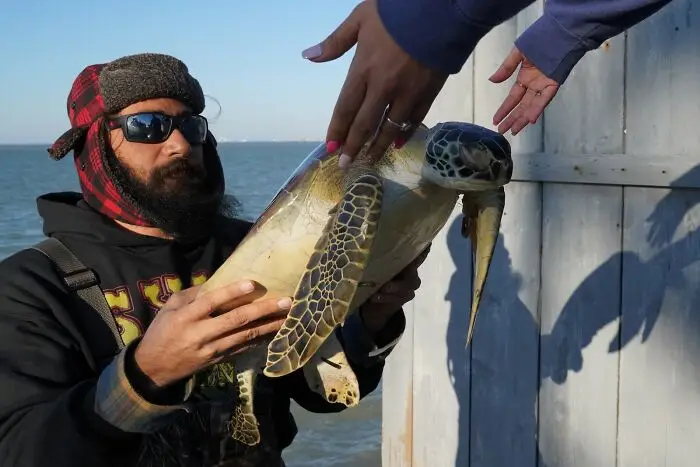
“February 2021 brought an incredible cold weather event, a rare Arctic cold front that froze pipes, destroyed the power grid, and plunged South Padre Island into disaster. But something else happened that brought residents out of their homes—the sight of thousands of cold-stunned, suffering, and freezing green sea turtles along Laguna Madre Bay.
The cold-blooded reptiles were unable to regulate their body temperature and metabolism to stay active. With water temperatures dipping below 50°F, turtles struggled to stay afloat to breathe. Thought to be the largest cold-stunning event of green sea turtles in recorded history, over 5,000 incapacitated turtles started washing up on the beach, found floating on the water, paralyzed by the cold.
Green sea turtles are predominantly herbivorous as they mature, preferring seagrass meadows to any other habitat and usually staying close to the shallows of the bay. As the cold front swept in, the upper waters of the bay froze, killing thousands of turtles and other aquatic life that could not escape to deeper, warmer waters—a colossal loss of marine biodiversity.
It was then that South Padre residents braved the freezing temperatures to start rescuing turtles of every size, from hatchlings to adults. They collected the animals by carload and brought them to rescue and rehabilitation centers on the island. Soon, thousands of motionless turtles were resting on tarps, slowly being warmed and revived.
It is rare to witness a community coming together to protect a wild species, especially while dealing with their own struggles during a severe cold wave that affected their entire town. Power, water, and gas supplies were all impacted, yet they united to rescue over 5,000 green sea turtles and support a four-decade-long conservation program aimed at protecting the species.
Without this incredible effort, the island’s entire turtle population could have been decimated—a massive loss to decades of conservation work. Stories like this deserve to be told to a global audience, perhaps inspiring many to join hands in protecting their local wildlife.”
Report
15points
#47 Highly Honored, Birds: Prairie Chicken Jump-Off By Peter Hudson Of Port Matilda, Pennsylvania, USA

“A ‘jump-off’ between two Greater Prairie Chickens illustrates their remarkable aerial combat, where one bird launches into the air attempting to strike its opponent, triggering a reciprocal jump attack by its adversary — so they are often in the air at the same time.
I have a lifelong passion for grouse species, and I enjoy nothing more than sitting in a small hide on a remote hillside, watching and photographing these fascinating birds. Most grouse species exhibit lekking behavior, where males compete in communal arenas to attract the attention of females.
Early biologists interpreted this as simple male-to-male competition, much like a medieval tournament where the winner claims the female as a prize. However, it is now becoming apparent that it is not the male winning the female, but rather the female selecting the male, that drives these displays. Females evaluate males using a range of behavioral and physical traits.
Interestingly, males consistently engage with the same territorial neighbor, forming predictable rival pairs that surprisingly tolerate each other well when females are absent. Different species use similar calls and behavioral displays, but these vary with body size — so these smaller grouse jump much higher.
This complex social dynamic is utterly fascinating.”
Report
15points
#48 Highly Honored, Art In Nature: Backlit Owlfly By Thibault Andrieux Of Mougins, Alpes-Maritimes, France

“This was one of my first encounters with the common owlfly (the French common name for this species). This individual is much more colorful than the sulfurous owlfly I’m more used to seeing, so I wanted to create an image that would highlight the vibrant wings and their delicate veins. Luckily, it was ideally perched, allowing me to do just that. To capture this image, I placed a flash behind the ascalaphe to create backlighting and carefully adjusted the flash power and shooting settings to completely darken the vegetation in the background.”
Report
15points
#49 Highly Honored, Ocean Views: Green Turtle By] Henley Spiers, Devon, England, UK

Report
14points
#50 Highly Honored, Birds: Drongos In Flames By Baiju Patil Of Aurangabad, India

“Just before the onset of winter, sugarcane fields are harvested, leaving dry leaves scattered across the land. Beneath these fallen leaves, countless insects thrive, hidden away for weeks. When farmers finally set fire to the leftover stubble to clear the fields, the intense heat forces the insects out in a desperate bid to escape.
From a distance, drongos spot the thick plumes of smoke curling into the sky. Instinctively, they gather near the burning fields, knowing a feast awaits. The moment the insects burst into the open, the drongos launch into action — diving, twisting, and darting with breathtaking speed to snatch their prey from midair.
Unlike most birds that shy away from fire, drongos embrace the chaos. They plunge straight into the dense smoke and swirling embers, maneuvering with astonishing precision through the shimmering heat. Often hunting in small groups, they display remarkable coordination, weaving in and out of the fiery haze with effortless grace.
Their sleek, glossy black feathers gleam against the orange glow of the flames, creating a striking contrast that turns this hunt into a visual spectacle. This image freezes one such moment in time — a drongo suspended in mid-flight, wings outstretched, eyes locked on its prey. It stands as a vivid testament to nature’s resilience, adaptability, and the bold survival tactics of one of the most fearless birds in the wild.”
Report
13points


