




The Ocean Art Underwater Photo Contest has once again showcased the world’s finest underwater photography! Now in its 13th edition, the competition received thousands of submissions from over 90 countries, featuring mesmerizing macro shots of marine birth and breathtaking wide-angle reefscapes and cenotes.
With 14 categories, including stunning portraits, dramatic black-and-white imagery, and unrestricted digital underwater art, the contest not only celebrates creativity but also highlights the importance of ocean conservation. Thanks to generous sponsors, over $60,000 in prizes were awarded, making this incredible event possible.
Scroll down to explore the award-winning images and discover some fascinating facts.
#21 Honorable Mention Macro: Synchronicity By Suliman Alatiqi

Grooved razorfish (Centriscus scutatus) live in sandy substrates and tend to stay in large groups. Unlike most fish, they are unique in swimming and positioning themselves vertically with their tails up and snouts down, which helps them blend in with sea urchins, sea grass or whip coral. They move together as a group in synchronized movements, angling themselves almost identically to each other as seen in the photo, which likely makes it more difficult for predators to isolate individual fish.
15points
#22 5th Place Wide Angle: Close Contact By Julian Gunther
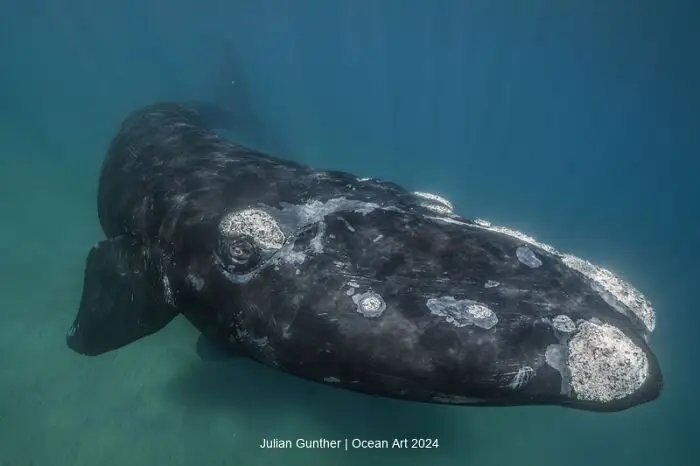
This photo was taken under a professional photography permit issued by the Argentine government and under direct supervision of Argentine authorities. This was shot using ambient light, as strobes can disturb the animals and often will blow up suspended particulate anyway. For this particular shot, I was free-diving in about 30ft (9m) of water, looking for whales to photograph, when this adult took a keen interest in me. It spent well over 30 minutes with me, doing a few close passes, but mostly swimming around me and doing underwater acrobatics such as going inverted or swimming around me while at a 90-degree angle to the seafloor. I wasn't sure if it was doing it for fun or to amuse/impress me (I'm probably anthropomorphizing, but I like to think that's what I might have been doing).
15points
#23 1st Place Wide Angle: Light By Hwanhee Kim
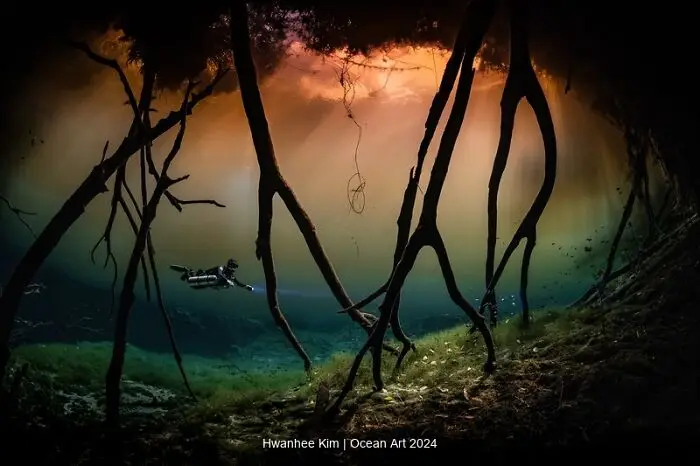
LIGHT is nature's greatest gift. The week before I captured this shot, heavy rains fell in Cancun. Sediment and nutrients from the nearby CARWASH were washed into the cenote, creating stunning colors due to the difference in concentration. Rain is typically a challenge for underwater photography, but in this instance, it produced vibrant hues rarely seen underwater. Sunlight, with its strong vitality, pierced through the reddish waters, revealing a magical moment. The light served as a connection between the land and the underwater world, as well as between nature and humans. I felt privileged to witness this beauty and fortunate to have been able to document it.
14points
#24 1st Place Cold Water: Curious Cormorant By James Emery

During a dive in Monterey, I was photographing the Metridium fields when I noticed a cormorant swimming down towards us. To my surprise, it began pecking at my wife's head, but she was completely unfazed. I quickly swam over to get a few shots, and then the cormorant's attention shifted to the reflection in my camera's dome port. It stayed with us for about 20 minutes, swimming up for air before returning to check us out again. It was a unique and playful moment that gave me a glimpse into the curiosity of the cormorant, and I was lucky enough to capture it.
13points
#25 4th Place Wide Angle: Spinner Dolphins In Sataya By Mehmet A. Gungen

Sataya Reef (also known as Dolphin Reef) is located in the Marsa Alam region of the Southern Red Sea, Egypt. The most distinctive feature of this location is the presence of permanently residing pods of spinner dolphins. I visited the area on a liveaboard tailored for underwater photographers. We spent around 1.5 hours snorkeling in the water with dolphins. During this time, snorkelers from a couple of day-trip boats were also in the water. Our group stopped the activity as soon as the dolphins began showing sleeping behavior, in contrast to the playful behavior we had witnessed earlier. I visualized the image I wanted to capture as one of the pod or individual dolphins swimming toward me, rather than chasing them for side or tail shots. This presented a challenge: I needed to align the early morning sun in the right direction, as I was shooting with natural light. Another important consideration was keeping other snorkelers out of the frame as much as possible. Given the amount of swimming required, I kept my camera rig as compact as possible and brought freediving fins specifically for the dolphin snorkeling, even though this was primarily a scuba diving trip. To minimize motion blur, I shot most images at 1/320s. As the available light increased with the rising sun, I gradually lowered my starting ISO from 800 to 400. One advantage of using my water-contact Nikonos RS 13mm lens was its ability to shoot at relatively wider apertures, in addition to its compact size. For post-processing, I used Adobe Lightroom Classic. Most adjustments were global, such as white balance, contrast, and exposure adjustments for shadows and highlights. I also used Lightroom's auto subject selection tool to enhance the contrast of the dolphins, helping them stand out more.
13points
#26 2nd Place Underwater Conservation: Turtle Conservation By Tom Vierus
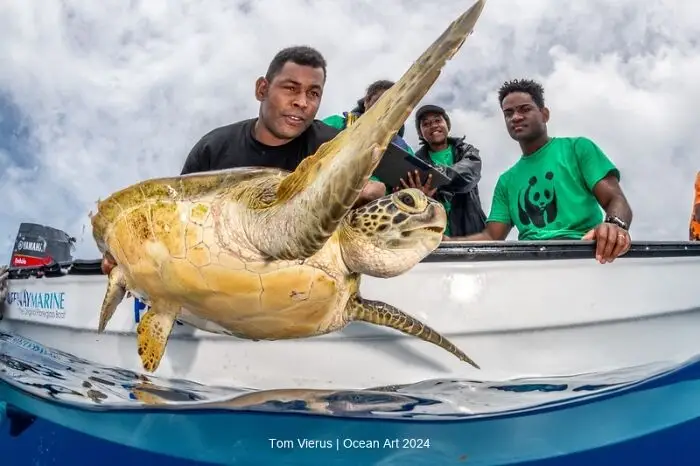
As part of a photographic assignment to document the turtle conservation program implemented by WWF Pacific in Fiji, I joined WWF staff & turtle monitor volunteers at three locations in the country. Besides monitoring and recording data from known nesting beaches, the teams also monitored adult turtle populations in the waters surrounding the islands. During one such scouting trip through the waters near Dravuni Island in Fiji's southern part, one of the villagers spotted a green turtle from the boat at about 20m depth. He was a skilled freediver and carefully slid into the water. I joined him shortly after and followed him down with my housing, freediving as far as I could with my skills and the housing with attachments. It was impressive to witness: He dove down, approached the turtle, caught it with his hands, and brought it to the boat, where he passed it to the team for a number of measurements. This is the moment you see in this photo. Time is of the essence, and everything has to go as fast as possible, so I knew I didn't have a lot of chances to capture this moment. I tried to get as close as possible while framing an over/under shot, minding the wave action, making sure the settings were on point and everything was in focus. After a few minutes, the turtle was released back into the water unharmed and swam off. The data will help to formulate robust conservation plans for the turtles in the waters of Fiji, an urgent necessity given that the International Union for Conservation of Nature (IUCN) classifies green turtles as 'Endangered.'
12points
#27 1st Place Blackwater: Hunting By Kyungshin Kim

I captured this shot during a blackwater dive in Anilao last November. At first, I noticed two squids stuck together and assumed they were mating. However, upon closer inspection, I realized they were not mating, one squid was eating the other, a smaller squid. Squids are known to engage in cannibalism, but it's rare to witness small squids eating each other during a blackwater dive. I carefully followed and observed them, managing to capture a few photos. After about 10 minutes, the color of the smaller squid, which was being consumed, began to fade. Finally, it released a spurt of black ink. Shortly after, the squid that had finished eating slowly disappeared into the distance, while the squid that became its prey sank into the dark depths of the sea.
12points
#28 2nd Place Wide Angle: Blue Sun Rising By Julian Gunther

This photo was taken in the very late afternoon, just as the sun was setting offshore Cabo San Lucas, Mexico. My friends at Latitude Encounters and I had arranged to stay out as late as possible to try and capture sharks during the transition from day to night. We had several Blue Sharks swimming around at this particular moment, but this one seemed to be swimming directly out from the setting sun. Although enough light penetrated the water to illuminate the sharks, I still used strobes to help illuminate some areas that would have been dark due to shadows, but again, keeping the strobe power fairly low. The sharks' behavior was changing as light dropped and they became much more deliberate with their actions - not something I would recommend for the uninitiated.
12points
#29 3rd Place Compact Behavior: Family That Stays Together By Wendy Biscette

Arrowhead crabs are really common in St. Lucia, which makes some people ignore them. However, while on a night dive, seeing this reproduction behaviour showed the arrowhead crab in a different light. From the pouch being open on the female, to the male being there to protect her was so intriguing that I couldn't help capturing this moment.
11points
#30 2nd Place Underwater Digital Art: Fire Babies By Jenny Stock

Cardinalfish are mouthbrooders. Females release an egg mass close to their chosen male. The male fertilises these eggs, then takes them into his mouth for incubation. Fathers are then unable to eat during the incubation period, although research has shown that they may partake in partial brood cannibalism - eating up to thirty percent of their brood. On a dive at Atlantis Dumaguete, I slowly approached this egg-laden male. I waited patiently until he opened his mouth and aerated his babies. Later, in Photoshop, I felt the bright orange of the cardinalfish would work well as licking flames. I got to work and made a smokey fire creation. Many thanks to Norway Luardo for his guiding skills at Atlantis Dumaguete.
10points


